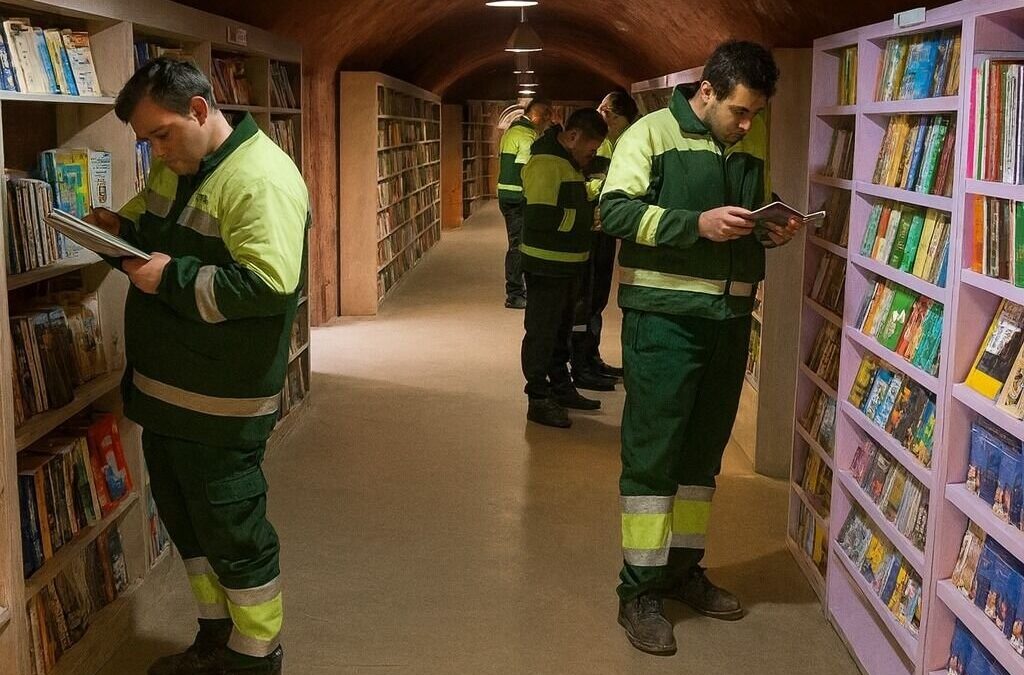
What began as an ordinary waste-collection effort in Ankara, Turkey eventually transformed into one of the country’s most remarkable community-driven cultural projects. Sanitation workers in the Çankaya district noticed that many perfectly readable books were being thrown away alongside household rubbish. Instead of letting them end up in landfills, the workers started rescuing and preserving them.
Over time, the rescued collection grew into a fully functioning public library that now houses around 40,000 books and serves readers across the community.
How sanitation workers built the library
The initiative began around 2016, when municipal garbage collectors started setting aside discarded books they found during daily collection rounds. Initially, workers shared the books among themselves and their families, but the collection expanded rapidly as more books were recovered.
Many books still carried handwritten notes, school stamps, and personal messages from previous owners, giving the project an emotional dimension beyond recycling.
As the number of books increased, municipal employees proposed creating a dedicated public library where the salvaged books could be catalogued and borrowed. The idea received support from local officials, including Çankaya Mayor Alper Taşdelen.
The library officially opened in 2017 inside a former brick factory once used by the sanitation department. Public awareness soon triggered an influx of donations from residents across Ankara, helping the collection grow dramatically.
A library inside a former factory
One of the project’s most distinctive features is its location. The library operates inside a renovated industrial brick factory, giving the space a unique atmosphere often described as a cultural warehouse filled with hidden treasures.
The collection includes literature, science, philosophy, history, children’s books, encyclopedias, academic texts, and foreign-language works, including books in English and French. The space also features reading rooms, study areas, chess tables, and dedicated children’s sections.
More than just recycling
As donations continued to grow, the library expanded beyond serving local readers. According to municipal reports, books from the collection have also been distributed to schools, prisons, and underserved communities across Turkey. Village teachers have requested books for students in remote regions, while the municipality eventually hired full-time staff to manage cataloguing and donations.
The project has gained international attention as an example of how recycling, literacy, and community cooperation can work together to create lasting social value.
A symbol of preservation and access
Nearly a decade after workers first began rescuing books from garbage piles, the library remains part of Çankaya’s municipal library network. For many visitors, it represents more than environmental awareness—it symbolises the idea that knowledge should remain accessible regardless of income or background.
What was once treated as waste became the foundation of a thriving public institution, proving that discarded objects can still carry immense cultural and educational value when communities choose preservation over disposal.