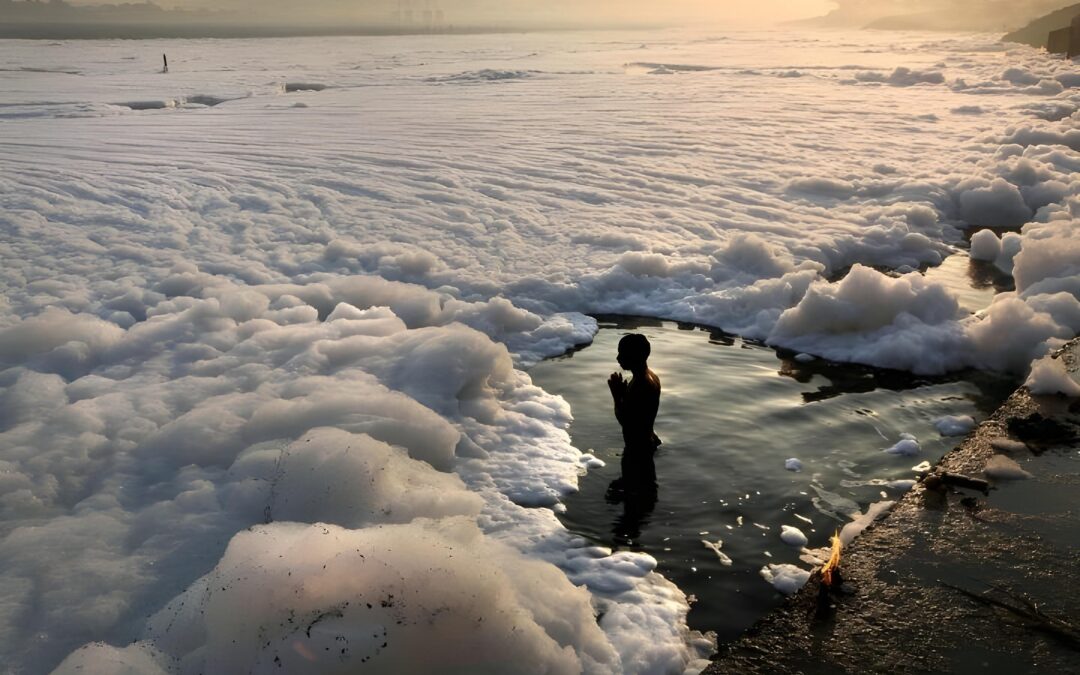
The Supreme Court has directed that states, Union territories and districts be penalised if Yamuna water quality deteriorates while flowing through their respective jurisdictions, fixing accountability for pollution in the river.
A bench of Justices Manoj Misra and Manmohan ordered the Central Pollution Control Board (CPCB) to recommend a formula for calculating the penalties, which will be deposited in the Supreme Court registry. States and UTs can subsequently recover the amount from identified polluters and officials found negligent.
In its detailed order, the court prescribed regular monitoring of water quality at the entry and exit points of every state, UT and district along the river. It also directed stricter oversight of sewage treatment plants (STPs), common effluent treatment plants (CETPs) and major drains to prevent untreated sewage and industrial waste from entering the Yamuna.
The bench observed that the river’s deteriorating condition reflected failures in civic administration, despite substantial expenditure on cleaning efforts. It emphasised that the Yamuna must be treated as one continuous ecosystem, with all basin states sharing responsibility for its protection.
The court also directed the installation of tamper-proof smart energy meters and continuous monitoring sensors at treatment plants. Water quality parameters, including biochemical oxygen demand (BOD), chemical oxygen demand (COD) and faecal coliform, must be monitored, with readings made publicly accessible online. Independent inspections and sampling must also be conducted regularly.
Highlighting the need to address pollution at its source, the court called for action against illegal sewage discharge, industrial waste and unauthorised settlements along drains and the riverbed, with rehabilitation for eligible occupants before removal.
The directions follow the examination of a Yamuna Action Plan proposing 125 new sewage treatment plants, upgrades to 20 existing plants and measures to intercept and treat 520 drains discharging wastewater into the river.
The bench cautioned that constructing additional treatment facilities alone would not restore the Yamuna without effective monitoring, enforcement and accountability. The matter will next be heard on January 13, 2027.