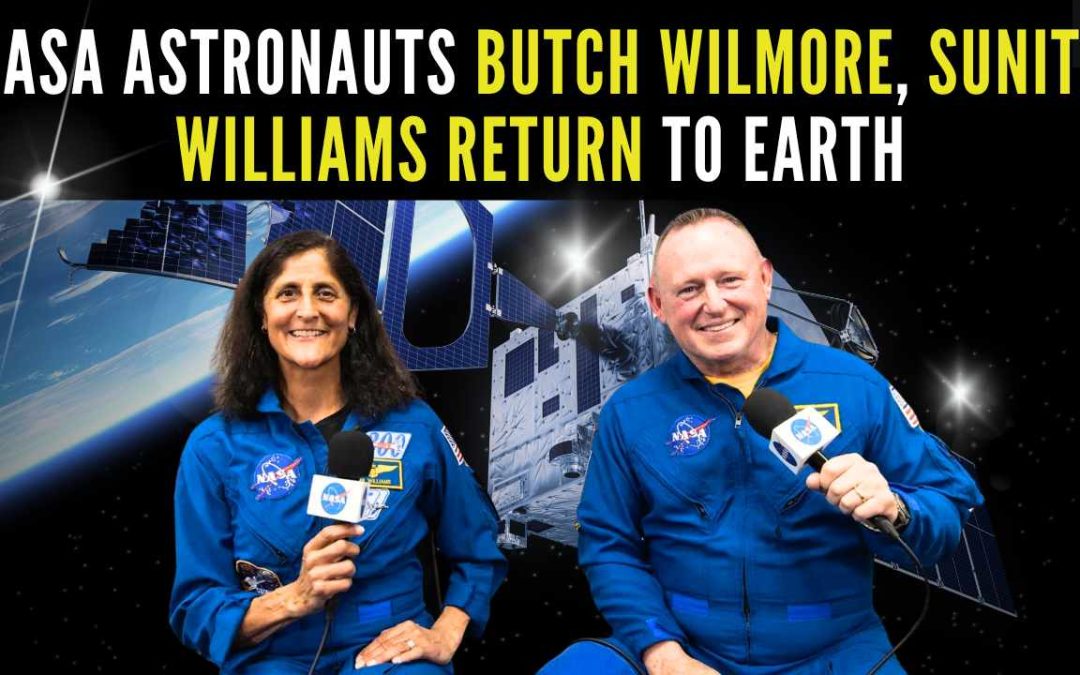
They set out for an eight-day stay at the International Space Station (ISS)—but their mission stretched to nine months. On Tuesday, NASA astronauts Sunita Williams and Butch Wilmore safely returned to Earth, splashing down in the calm waters off the Florida Panhandle, marking the end of a journey that captured global attention.
Their return aboard a SpaceX Crew Dragon capsule began when the spacecraft undocked from the ISS shortly after 1 a.m. Eastern Time. It then descended back to Earth, slowing from 17,000 mph before deploying four large parachutes to ensure a smooth ocean landing just before 6 p.m. Recovery teams quickly hoisted the capsule onto a ship, where the beaming astronauts emerged after months in microgravity.
With their bodies still adjusting to Earth’s gravity, they were placed on gurneys for initial medical checks. “They all looked like they were feeling about normal for the landing and recovery phase, where their body is trying to re-adapt,” said Steve Stich, manager of NASA’s Commercial Crew Program.
Mission Highlights and Political Tensions
Joining Williams and Wilmore on the return journey were Nick Hague, commander of Crew-9, and Alexander Gorbunov, a Russian astronaut. The crew was scheduled to fly to NASA’s Johnson Space Center in Houston, where they would undergo further medical evaluations before reuniting with their families.
The mission highlighted SpaceX’s dominance in private spaceflight while underscoring Boeing’s struggles in the sector. Their return also became a political flashpoint.
In January, former President Donald Trump suggested that the Biden administration had abandoned the astronauts in space. More recently, Elon Musk claimed that the White House rejected his offer to bring them back sooner. However, NASA Administrator Bill Nelson dismissed Musk’s claim, stating, “On the basis that there was no contact with NASA, there was no political consideration from NASA’s point of view.”
About 30 minutes after the astronauts landed, the Trump administration posted on social media, declaring, “PROMISE MADE, PROMISE KEPT”, referring to Trump’s previous pledge to bring the astronauts home. However, NASA had already planned their return for this timeframe since August.
An hour later, Musk congratulated SpaceX and NASA on X (formerly Twitter) for the successful return and added, “Thank you, President Trump, for prioritizing this mission!”
Challenges and Achievements in Space
Despite the political noise, the astronauts never felt abandoned. During their extended stay, Williams and Wilmore adapted to the unexpected delay. Clothing shortages became an early challenge, as their suitcases were left off the Boeing Starliner to make room for a replacement pump for the station’s toilet. NASA later sent up their clothes and other personal items via a Northrop Grumman cargo ship.
Throughout their time in space, the crew conducted nearly 1,000 hours of scientific research and maintenance work, including a spacewalk where Williams and Wilmore swabbed the exterior of the ISS to study whether Earth microbes could survive in space.
By the end of their journey, Williams and Wilmore had traveled 121,347,500 miles, orbiting Earth 4,576 times. Wilmore has now logged 31 hours of spacewalks in his career, while Williams has 62 hours—a record for a female astronaut.
Now back on Earth, the astronauts can finally reunite with their families—after an odyssey that took far longer than expected, but ended exactly as planned.