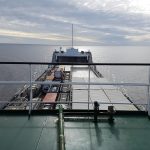
Project CAPTURED has achieved two regulatory milestones that strengthen the commercial case for onboard carbon capture and storage (OCCS), following its world’s first demonstration of an end-to-end value chain for onboard captured and liquefied CO₂ (LCO2).
Completed in June 2025, the pilot showed that CO₂ captured onboard a vessel can be offloaded ship-to-ship, transported overland and permanently bound through carbon mineralisation—a process that converts captured CO₂ into stable materials for industrial use.
EU ETS recognition for onboard captured CO₂
The CO₂ captured onboard during Project CAPTURED has been formally recognised for compliance under the European Union Emissions Trading System (EU ETS). This means the verified tonnage of captured CO₂ can be deducted from emissions requiring the surrender of EU Allowances (EUAs).
To qualify for this recognition, the CO₂ must be chemically bound permanently in eligible products. Project CAPTURED demonstrated that CO₂ captured onboard vessels can meet this requirement through carbon mineralisation.
IMO’s in-principle support for carbon mineralisation
The data and learnings from the same demonstration formed the basis of a proposal submitted to MEPC 84. This proposal received in-principle support from the International Maritime Organization (IMO) for recognising carbon mineralisation as a form of permanent CO₂ storage.
Complementing geological sequestration, which is already accepted by the IMO, this recognition broadens the downstream options for CO₂ captured onboard vessels, and supports the development of maritime carbon value chains. Beyond providing a permanent storage pathway, carbon mineralisation also creates the potential for captured CO₂ to serve not only as a waste stream requiring permanent storage, but also as a feedstock for industrial applications through carbon mineralisation, extending emissions reductions beyond the shipping value chain.
Source: Project CAPTURED