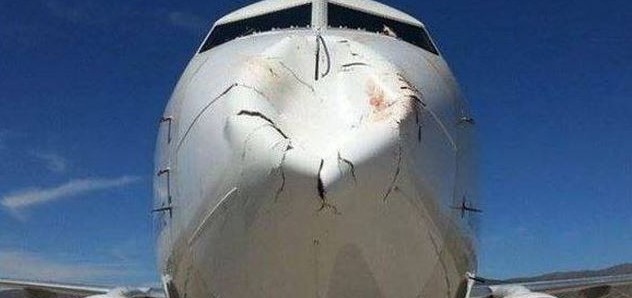
An IndiGo flight travelling from Patna to Lucknow was found to have sustained damage to its nose section after encountering an incident during descent, with authorities examining several possible causes, including severe weather, hail or ice impact, a bird strike and lightning.
Flight 6E925, operating from Patna to Lucknow, landed normally at Lucknow airport at around 4:05 pm with 104 passengers and six crew members on board. All passengers were reported safe.
The aircraft was subsequently taken out of service after airport personnel noticed damage to its forward section following landing. The airline designated the aircraft as Aircraft on Ground (AOG), meaning it will remain grounded until technical inspections and necessary safety checks are completed.
No official cause of the damage has been established so far.
Incident occurred during descent
Preliminary information indicates that the aircraft encountered an unusual event at an altitude of approximately 17,000 feet while descending towards Lucknow. The pilot reportedly informed air traffic control that the aircraft had experienced a strong jolt.
The exact nature of the object or phenomenon that caused the impact remains under investigation.
One possibility being examined is that the aircraft passed through an area of adverse weather and encountered lightning. However, aviation specialists have also pointed to hail or ice as potential explanations for the damage.
Thunderstorm clouds can contain hailstones or ice particles that may not always be visible to an aircraft crew. At cruising or descent speeds, even relatively small pieces of ice or hail can strike an aircraft with considerable force.
The aircraft’s forward nose section includes the radome, a specially designed structure that houses and protects weather radar and other equipment. Damage to this section can occur if the aircraft encounters hail, ice or other objects at high speed.
A bird strike is another possibility that may need to be ruled out during the technical investigation.
Lightning possibility being examined
The possibility of a lightning strike is also being considered because the aircraft was operating in potentially unsettled weather conditions.
However, a lightning strike does not necessarily mean that an aircraft is in immediate danger. Commercial aircraft are designed with protection against lightning and are routinely exposed to lightning during flight.
The electrical current from a lightning strike generally travels along the aircraft’s exterior rather than passing through the passenger cabin. Aircraft structures are designed to allow the current to move across the outer skin before it exits through designated points, often around the wings or tail.
For that reason, experts have suggested that further examination will be necessary to determine whether lightning actually caused the visible damage or whether the aircraft encountered another object or weather-related hazard.
The dent discovered on the nose section therefore does not, by itself, establish that lightning was responsible.
Aircraft grounded for inspection
After the aircraft arrived at Lucknow, airport personnel identified the damage and informed the airline.
IndiGo’s engineering team has since begun a detailed technical assessment of the aircraft. Engineers will examine the damaged nose section and surrounding components to determine the extent of the damage and establish whether any internal systems were affected.
The inspection is also expected to help investigators determine whether the damage is consistent with an impact from hail, ice, a bird or another object, or whether there are indications of lightning-related damage.
The aircraft will not return to commercial service until the required inspections and clearances have been completed.
The flight was scheduled to continue from Lucknow to Ahmedabad after completing the Patna-Lucknow sector. That onward flight was cancelled following the discovery of the damage.
Passengers affected by the cancellation were offered the option of travelling on another available flight or receiving a full refund.
No emergency landing
Officials clarified that the aircraft did not make an emergency landing in Lucknow.
Despite the reported jolt during descent, the flight completed its landing normally and reached the airport safely. There were no reports of injuries among passengers or crew.
The distinction is significant because an aircraft being grounded after landing does not necessarily mean that the flight itself was considered an emergency. In this case, the damage was identified after the aircraft had reached the airport and was subsequently taken out of service as a precaution.
Investigation to determine exact cause
The incident is now being examined through the airline’s technical assessment, while the relevant aviation authorities are expected to review the available information.
The pilot’s report and other operational information will form part of the investigation. The report is not being publicly released at this stage as the circumstances surrounding the incident are being assessed.
Investigators will likely examine the aircraft’s flight data, weather conditions along the route, air traffic control communications and the physical characteristics of the damage.
Weather data could be particularly important in determining whether the aircraft passed through a region containing thunderstorms, hail or significant ice formation.
The location and pattern of the damage may also provide clues. Different types of impacts can leave different marks on an aircraft’s exterior, allowing engineers to compare the damage with the effects normally associated with hail, bird strikes or other airborne objects.
If lightning is suspected, engineers can also look for evidence of electrical discharge or other characteristics associated with a lightning event.
At present, there is no confirmed conclusion about what caused the damage.
The aircraft’s safe arrival in Lucknow means the immediate operational risk was contained, but the investigation will determine whether the aircraft suffered only external damage or whether other components require inspection or replacement before it can fly again.
Further details are expected once the technical examination and investigation are completed