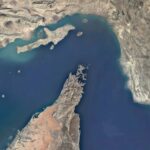
Global oil prices climbed more than 1% on Wednesday as tensions in the Middle East intensified following Iranian missile launches toward Kuwait and Bahrain, while continued disruption in the Strait of Hormuz entered its fourth month without a diplomatic breakthrough.
Brent crude futures rose by $1.05, or 1.09%, to $97.05 per barrel, while US West Texas Intermediate (WTI) crude gained $1.01, or 1.08%, to trade at $94.77 per barrel.
The latest gains came after Iran launched ballistic missiles toward Kuwait and Bahrain. According to the US military, the missiles failed to reach their intended targets. Washington subsequently said its forces carried out strikes on Iranian positions on Qeshm Island in response to what it described as attempted attacks.
Investors remained focused on developments surrounding the conflict as Tehran continued reviewing a proposed agreement with Washington aimed at ending hostilities. While Iranian media reported that there had been no recent direct contact between the two sides, US President Donald Trump maintained that negotiations were continuing.
On the supply side, oil prices also received support from declining US crude inventories. Market sources, citing data from the American Petroleum Institute, said US crude stockpiles fell by 6.8 million barrels during the week ending May 29, marking a seventh consecutive weekly decline.
Meanwhile, Iran claimed it had targeted US military facilities in Kuwait in retaliation for what it described as American aggression in the Persian Gulf.
“Following the hostile actions of the US in the Persian Gulf, the Strait of Hormuz, and Qeshm Island, American bases in Kuwait were hit,” Iran’s state-run broadcaster IRIB reported.
Kuwait, however, said its air defence systems successfully intercepted incoming missiles and drones after explosions were heard in several areas of the country. The Kuwaiti Army stated that the sounds were linked to interception operations against hostile aerial threats.
The US military’s United States Central Command said Iran launched multiple ballistic missiles toward neighbouring countries but asserted that none struck their intended targets. According to CENTCOM, two missiles fired toward Kuwait either fell short or broke apart mid-flight, while three missiles launched toward Bahrain were intercepted by American and Bahraini air defence systems.
The broader conflict has now entered its fourth month. The crisis began on February 28, when the United States and Israel launched coordinated strikes against Iranian targets. In the aftermath, Iran tightened restrictions around the strategically vital Strait of Hormuz, through which roughly one-fifth of the world’s oil and energy supplies normally pass.
The prolonged disruption has placed significant pressure on global energy markets. Crude oil prices surged from around $70 per barrel before the conflict to above $125 per barrel at their peak, raising concerns about inflation, fuel costs and economic growth worldwide.
Although prices have since eased amid intermittent diplomatic efforts and hopes of a negotiated settlement, oil remains elevated compared with pre-conflict levels. Market participants continue to monitor both military developments and ongoing diplomatic contacts, with any breakthrough or escalation likely to have an immediate impact on global energy prices.
As the Hormuz disruption reaches its 96th day, uncertainty over supply routes and regional stability remains a key driver of volatility in international oil markets.