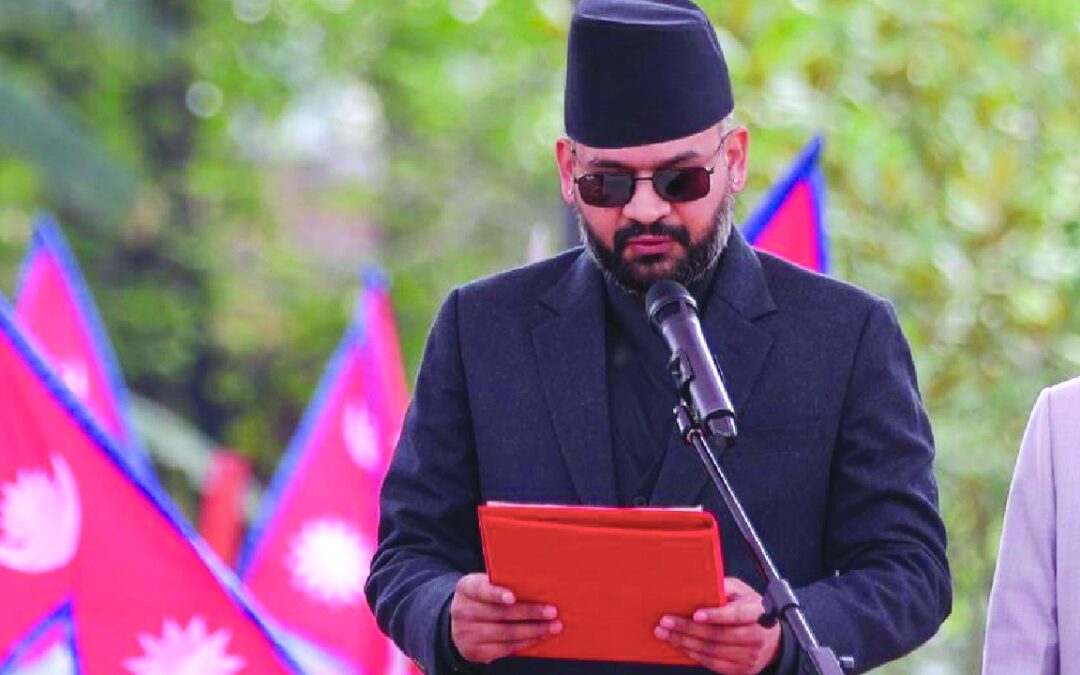
NEW DELHI: Nepal Prime Minister Balendra Shah is set to end his policy of avoiding one-on-one meetings with foreign diplomats by holding separate talks with Indian Ambassador Naveen Srivastava and Chinese Ambassador Zhang Maoming, marking a significant shift in his government’s diplomatic approach.
The meetings are expected to be held on the same day, a move seen as underscoring the importance of both India and China in Nepal’s foreign policy.
Shah assumed office on March 27 after a Gen Z-driven political campaign that promised to break from Nepal’s traditional political establishment. In the early weeks of his administration, he declined individual meetings with foreign diplomats and visiting officials, including India’s Foreign Secretary Vikram Misri, whose planned visit to Kathmandu was postponed. Senior U.S. diplomats, including Assistant Secretary of State Samir Paul Kapur, were also unable to secure one-on-one meetings.
Shah’s office had described the approach as a “new protocol,” under which the prime minister would not hold individual meetings with foreign officials below the rank of foreign minister. Such engagements were instead handled through Nepal’s Foreign Ministry or conducted in group settings.
Although Shah accepted an invitation from Indian Prime Minister Narendra Modi to visit India soon after taking office, the visit has yet to take place.
Meanwhile, Rashtriya Swatantra Party (RSP) Chairman Rabi Lamichhane received a high-profile welcome in New Delhi, where he met Prime Minister Modi, Home Minister Amit Shah, External Affairs Minister S. Jaishankar, National Security Adviser Ajit Doval, Foreign Secretary Vikram Misri and other senior leaders.
Shah did meet ambassadors and heads of diplomatic missions collectively on April 8. During that gathering, attended by representatives from 17 countries and the United Nations, he reaffirmed Nepal’s commitment to a “balanced and pragmatic foreign policy” based on trust, mutual respect and shared prosperity. His government later said the format reflected stricter implementation of Nepal’s diplomatic code of conduct.
Officials familiar with the decision said beginning individual meetings with the Indian and Chinese ambassadors was a deliberate choice reflecting Nepal’s foreign policy priorities. Scheduling both meetings on the same day is intended to avoid any perception of favouring one neighbour over the other.
The diplomatic shift comes after Shah’s government completed its first 100 days in office, a period marked by growing public dissatisfaction.
Protests have erupted over the use of municipal police and bulldozers to remove landless settlements, street vendors and informal workers in Kathmandu, with critics arguing that the city’s poorest residents have been disproportionately affected.
Border communities have also protested stricter enforcement of customs duties on goods valued at more than Nepali Rs 100 brought from Indian markets.
Public anger intensified after 25-year-old ride-hailing driver Ganesh Nepali set himself on fire following action by municipal police, prompting renewed demonstrations involving Gen Z activists, civil rights groups, informal workers and displaced residents.