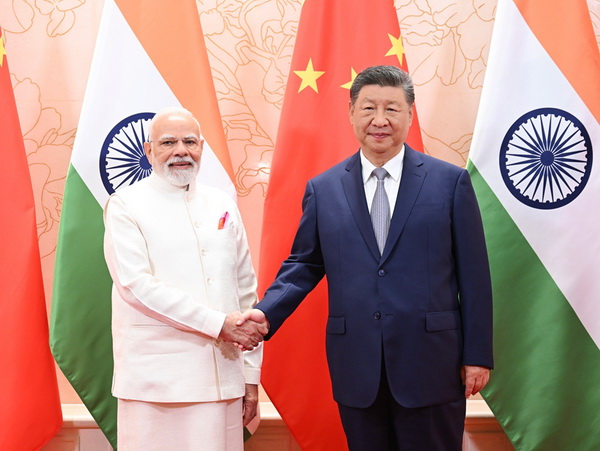
Prime Minister Narendra Modi told Chinese President Xi Jinping during their meeting on the sidelines of the BRICS summit that India and China must remain sensitive to each other’s core concerns, according to the Ministry of External Affairs (MEA).
The comments came in response to questions about a Chinese readout of the meeting, which said Modi had reiterated that India’s position on Tibet and Taiwan had not changed and that New Delhi does not permit activities directed against China from Indian territory.
“Prime Minister referred to Indian concerns as well and underlined that both sides should show sensitivity to each other’s core concerns and be guided by the three mutuals — mutual respect, mutual interest and mutual sensitivity,” MEA spokesperson Randhir Jaiswal said.
Modi also stressed that peace and tranquility along the India-China border were essential for taking bilateral relations forward. Both leaders discussed strengthening business and transport links, while also addressing concerns over trade imbalances and market access.
India had largely stopped publicly reiterating its One-China policy in the years following repeated tensions along the border. However, its positions concerning Tibet and Taiwan have remained consistent under successive governments.
On Taiwan, the Indian government has maintained that its policy is clear and consistent, while allowing and encouraging people-to-people exchanges in areas such as trade, investment, tourism, culture and education.
On Tibet, India continues to recognise the Tibet Autonomous Region as part of the People’s Republic of China. This position was reflected in the 2003 Declaration on Principles for Relations and Comprehensive Cooperation signed by then Prime Minister Atal Bihari Vajpayee and Chinese Premier Wen Jiabao. The declaration also stated that India would not allow Tibetans to engage in anti-China political activities on Indian soil.
Chinese and Indian Readouts Differ
According to China’s account of the Modi-Xi meeting, the Indian prime minister also said that New Delhi follows an independent foreign policy and that its approach towards China is not influenced by any third country.
India’s official readout, however, did not refer specifically to Tibet or Taiwan. It also differed from last year’s account of the Modi-Xi meeting by not using China’s “friends, not rivals” formulation.
The two leaders met during the BRICS summit in New Delhi, with both sides signalling an effort to improve bilateral relations after years of tensions. Xi’s visit was his first to India in seven years.
Sovereignty Remains a Point of Difference
The issue of sovereignty has also featured in recent India-China diplomatic exchanges.
Following External Affairs Minister S Jaishankar’s meeting with Chinese Foreign Minister Wang Yi in Manila in July, Chinese statements attributed remarks to Jaishankar concerning India’s recognition of China’s sovereignty. The MEA subsequently clarified India’s position, saying New Delhi does not violate China’s sovereignty while raising concerns about Chinese activities in territories claimed by India.
MEA spokesperson Randhir Jaiswal also referred to India’s objections to Chinese projects in areas of Jammu and Kashmir that India considers its territory, including projects associated with the China-Pakistan Economic Corridor.
Despite these differences, both governments have been working to restore diplomatic and economic engagement. Reuters reported that bilateral trade reached a record $155.6 billion in 2025, although India continues to run a substantial trade deficit with China.
The latest Modi-Xi meeting therefore combined efforts to improve economic and diplomatic engagement with continued emphasis from New Delhi on border peace and the need to address its concerns in the bilateral relationship.