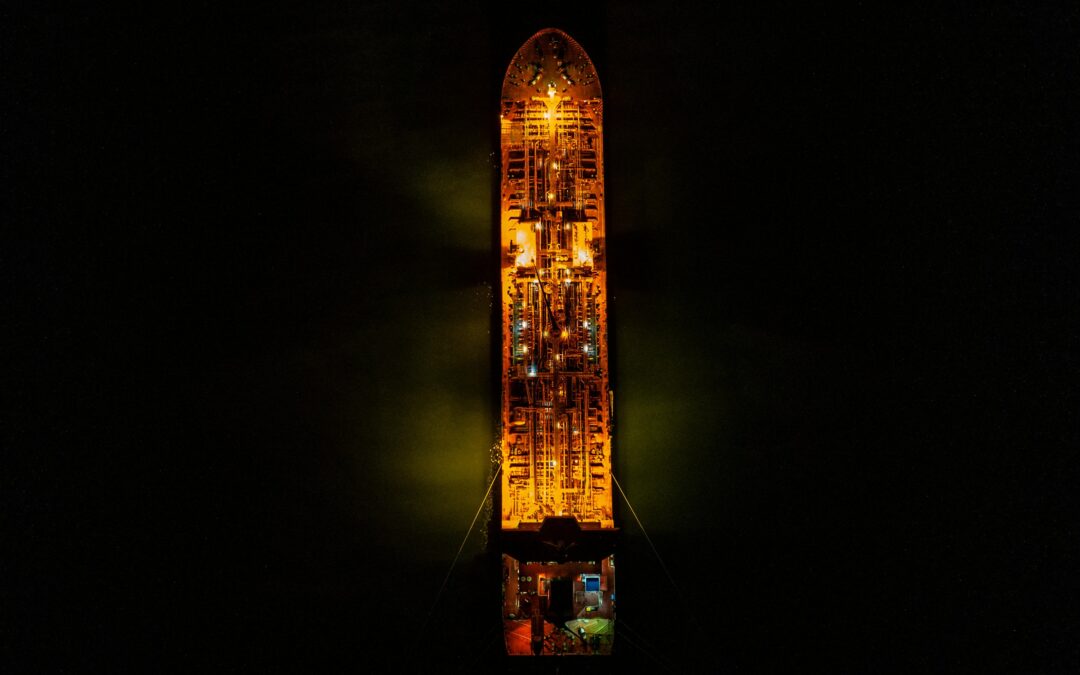
The high-value ship order range of Korean shipbuilders is expanding from liquefied natural gas (LNG) carriers to very large gas carriers and very large ammonia carriers (VLGC/VLAC) that carry liquefied petroleum gas (LPG) and ammonia. As freight rates for LPG carriers remain high due to increased LPG exports from the United States and Middle East risks, shipping companies are placing more newbuilding orders. Korean shipbuilders are leading the market this year, winning about 75% of VLGC/VLAC orders placed worldwide.
VLGC/VLAC are high-value ship types with higher prices and technological complexity than general merchant vessels, as they share similar basic designs such as cargo tanks and gas handling systems. Recently, order trends have been shifting toward multi-specification vessels that can carry both LPG and ammonia or can be adapted for future ammonia transport.
◇ Even with transits through the Strait of Hormuz, gas carrier shortage persists
According to shipbroking and shipping market firm Fearnleys on the 29th, the spot rate for an 84,000-cubic-meter VLGC in the third week of May was $6 million per month (about 9 billion won), up $300,000 (about 450 million won) from a week earlier. On a simple conversion, that is about $200,000 per day (about 300 million won). Fearnleys said some recently concluded contract rates have again hit a record high on a per-ton basis because there is a shortage of ships to load June cargoes departing the U.S. Gulf.
While easing tensions in Middle Eastern straits have somewhat reduced the burden of oil prices and bunker costs, gas carrier freight rates are not easily coming down. With LPG flows increasing from the U.S. Gulf to Asia and operational uncertainty around the Strait of Hormuz prompting shipping companies to redeploy fleets, the number of ships actually available has decreased. Even for the same cargo volume, a longer voyage requires more ships, so the expansion of U.S.-origin LPG exports to Asia is acting as a factor supporting rates.
In fact, shipments concluded for June loading from the U.S. Gulf and East Coast are estimated at about 20, falling by roughly 30 each from April and May. Although transport demand is strong, the continued difficulty of matching ships to load cargo is limiting concluded volumes. The industry sees a high possibility that this shortage of vessel capacity will continue at least through July.
Korea sweeps 22 ships just this month
Newbuilding orders are following the increase in LPG transport demand. According to Clarksons Research, as of the 25th, a total of 36 VLGC/VLACs have been ordered this year, already reaching 63% of last year’s total orders (57). By country, Korea has 27, China 8, and Japan 1.
In particular, orders have concentrated on Korean shipbuilders this month. HD Hyundai Heavy Industries won 9 VLGCs, HD Hyundai Samho won 2 VLGCs and 6 VLACs, and Hanwha Ocean won 3 VLACs. In addition, Samsung Heavy Industries secured 2 more VLGCs on the 26th, bringing Korean shipbuilders’ cumulative VLGC/VLAC orders this year to 29.
These ships are difficult to build due to cargo tanks, gas handling systems, and fuel propulsion technology. Ammonia carriers must also be equipped with storage and transport technologies that address toxicity and corrosiveness. Based on recent contracts, the newbuilding price is around $120 million per ship, higher than general bulkers and tankers, making them attractive ships for Korean shipbuilders to fill their orderbooks. Daehan Shipbuilding, a mid-sized shipbuilder, is also preparing to enter this market, seeing further growth in VLGC demand.
An industry official said, “Chinese shipbuilders are also increasing orders for gas carriers, but VLGCs and VLACs are harder to build than general merchant ships and have more stringent safety equipment requirements, so shipowners who prioritize proven construction experience and delivery reliability still tend to prefer Korean shipbuilders,” adding, “If the ammonia transport market fully expands, demand for VLACs will increase further.”
Source: ChosunBiz