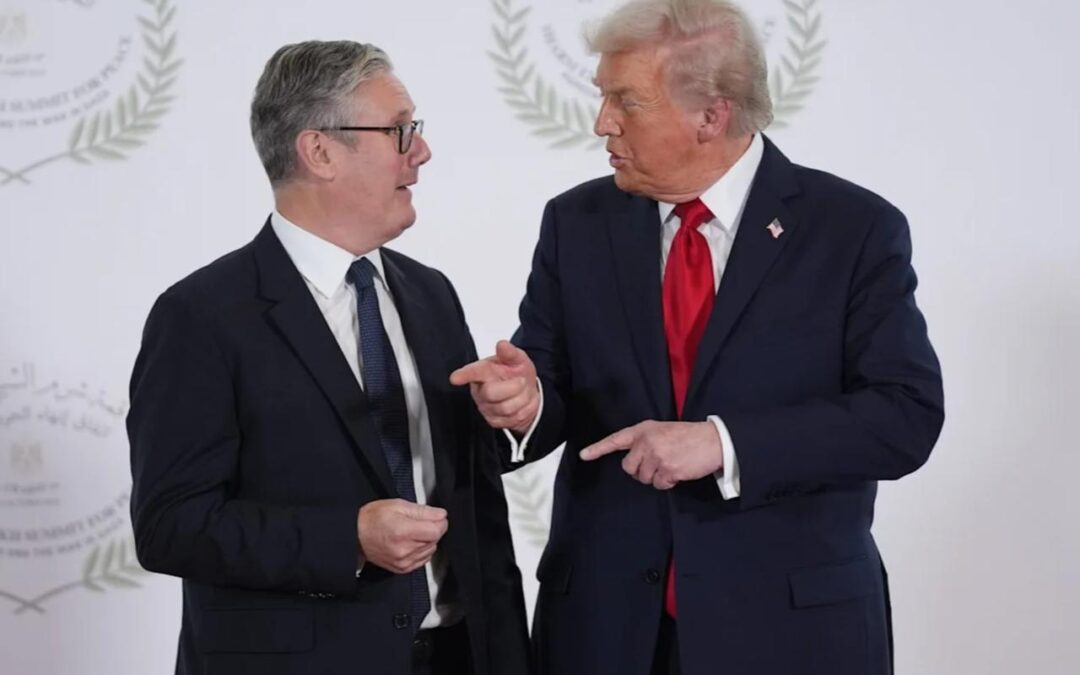
UK Prime Minister Keir Starmer has refused to grant the United States permission to use RAF bases for potential airstrikes on Iran, as tensions escalate between Washington and Tehran over Iran’s refusal to sign a deal curbing its nuclear programme.
According to The Telegraph, Trump was believed to have reconsidered his support for Starmer’s proposed Chagos Islands agreement after the British government declined to approve the use of UK military bases for possible bombing operations. The US has reportedly been drawing up contingency plans for direct military action against Iran, with long-range bombers and refuelling aircraft deployed to the Middle East in recent days.
American defence officials are said to have informed Trump that the US would be ready for military action by the weekend, following what has been described as the largest US military build-up in the region since the 2003 Iraq War.
Any strike on Iran was expected to involve the Diego Garcia military base in the Chagos Islands — a British overseas territory that the UK is planning to transfer to Mauritius under a long-term agreement — along with European air bases in allied countries. While Washington does not require London’s consent to operate from Diego Garcia under existing treaty arrangements, it must seek approval before launching missions from RAF bases such as RAF Fairford in Gloucestershire.
On Wednesday, Trump publicly urged the UK not to “give away” the Chagos Islands and to remain “strong in the face of wokeism.” Writing on Truth Social, he suggested that if Iran refused to reach a deal, the United States might need to use Diego Garcia and RAF Fairford to “eradicate a potential attack by a highly unstable and dangerous regime.”
His remarks were widely interpreted as referencing a US request to conduct long-range bombing runs from RAF Fairford, which hosts US Air Force personnel. However, the UK has reportedly withheld consent following legal concerns raised by government lawyers. According to The Times, officials warned that participating in pre-emptive strikes could breach international law.
Government sources indicated that Britain is unlikely to back any pre-emptive US military action against Iran, consistent with its earlier refusal to join US strikes on Iranian nuclear facilities last summer. Under a 2001 UN resolution, the UK could potentially face legal consequences if it knowingly facilitated an internationally wrongful act.
Following last year’s US strikes, British ministers repeatedly declined to clarify whether government lawyers had deemed the action lawful. In his recent comments, Trump sought to frame potential strikes as defensive, arguing they could prevent an attack on the UK and other allied nations.
Tehran has warned it would retaliate against any military assault.
Legal responsibility for advising the UK government on such matters rests with the Attorney General, Lord Hermer. Reports last year suggested he had cautioned that any British involvement beyond defending UK assets and allies in the region could be unlawful. Although his full legal advice has not been made public, Whitehall sources indicated that the UK’s legal stance remains unchanged.
In recent weeks, the Ministry of Defence has deployed additional Typhoon and F-35 fighter jets to the region in anticipation of possible Iranian retaliation in the event of US action.
Under Starmer’s proposed Chagos agreement, sovereignty of the islands would transfer to Mauritius, while the Diego Garcia base would be leased back to the UK and US for 99 years at a reported cost of £35 billion. Trump has alternated between criticising and supporting the deal, previously calling it an act of “great stupidity” before later describing it as the best arrangement available to maintain strategic control of the base.
Reasserting his earlier position on Wednesday, Trump wrote: “We will always be ready, willing, and able to fight for the U.K., but they have to remain strong… DO NOT GIVE AWAY DIEGO GARCIA!”