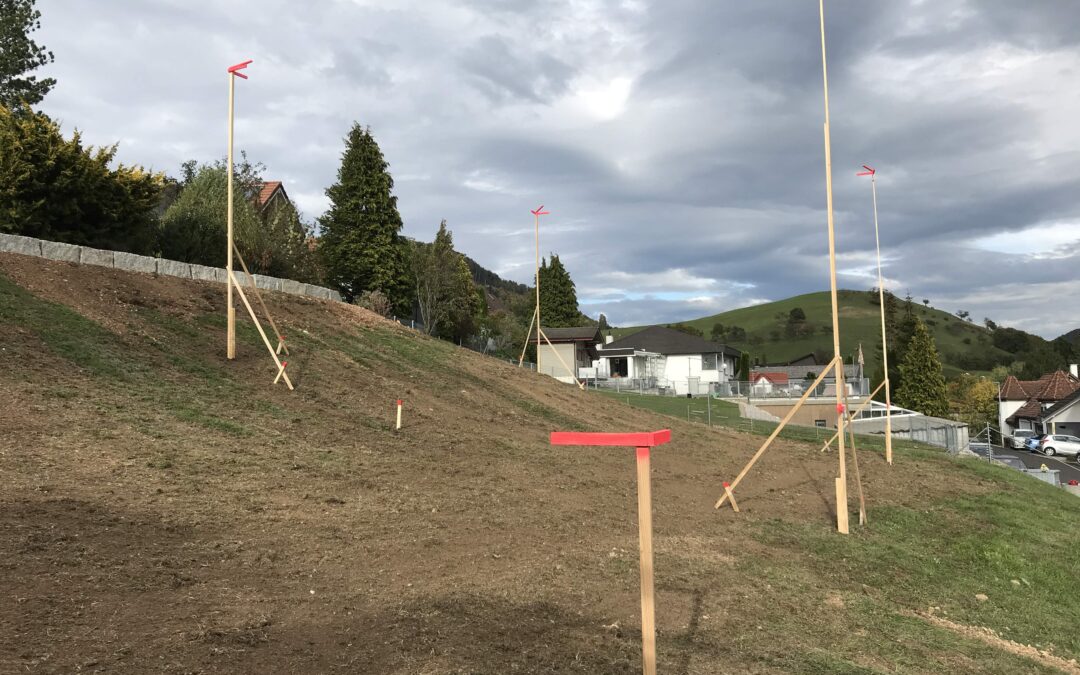
What are Bauprofile?
In Switzerland, construction often begins with something strikingly minimal: tall poles and thin lines outlining a building that isn’t there yet. These full-scale frameworks, called Bauprofile, trace the exact dimensions of a proposed structure—walls, roofs, balconies—weeks before approval.
Instead of relying solely on drawings or digital renders, this system places a life-sized “ghost” of the building directly into its future surroundings.
How the system works
Surveyors first convert architectural plans into precise ground coordinates. Poles are then installed at key points—corners, rooflines, façade edges—and connected with wires or slats to map the structure’s geometry.
The result is a skeletal outline that lacks mass but conveys something equally important: scale and presence. Standing beside it, passersby can instantly grasp how large the building will feel and how it will sit in the space.
Why Switzerland requires it
Bauprofile are not optional—they are embedded in Swiss planning law. Once a proposal is submitted, the outline must remain on-site during a public notification period (typically two to three weeks).
This is when neighbours and stakeholders can:
- Assess sunlight blockage and shadows
- Check sightlines and privacy concerns
- Evaluate how the building fits the neighbourhood
Crucially, objections are based on real-world perception, not abstract plans.
Why drawings and renders fall short
Even detailed blueprints or polished 3D visuals require spatial imagination—and can sometimes mislead by presenting idealised views.
Bauprofile solve this by:
- Showing true scale instantly
- Allowing people to physically move around the structure
- Revealing impacts like height, bulk, and visual intrusion
What looks acceptable on paper can feel overwhelming in reality—and vice versa.
A more democratic planning process
One of the biggest impacts of Bauprofile is how they shift power.
Instead of decisions being confined to architects, developers, and regulators, ordinary residents gain a tangible way to engage. Developers, knowing their designs will be publicly “visible” before approval, are often pushed to plan more thoughtfully.
It doesn’t mean every objection stops a project—but it makes concerns harder to ignore.
Could this work elsewhere?
The idea is simple and widely applicable: make future buildings understandable before they are built.
But its success depends on:
- Legal frameworks that allow meaningful public feedback
- Authorities willing to act on objections
- Developers open to scrutiny
Without these, the poles would become symbolic rather than effective.
Seeing the future—before it’s built
Switzerland’s “invisible buildings” highlight a powerful principle: people make better decisions when they can see consequences clearly.
In a world dominated by digital visualisation, this low-tech approach stands out. By briefly turning the future into something visible and walkable, Bauprofile give communities a rare chance to respond before change becomes permanent.