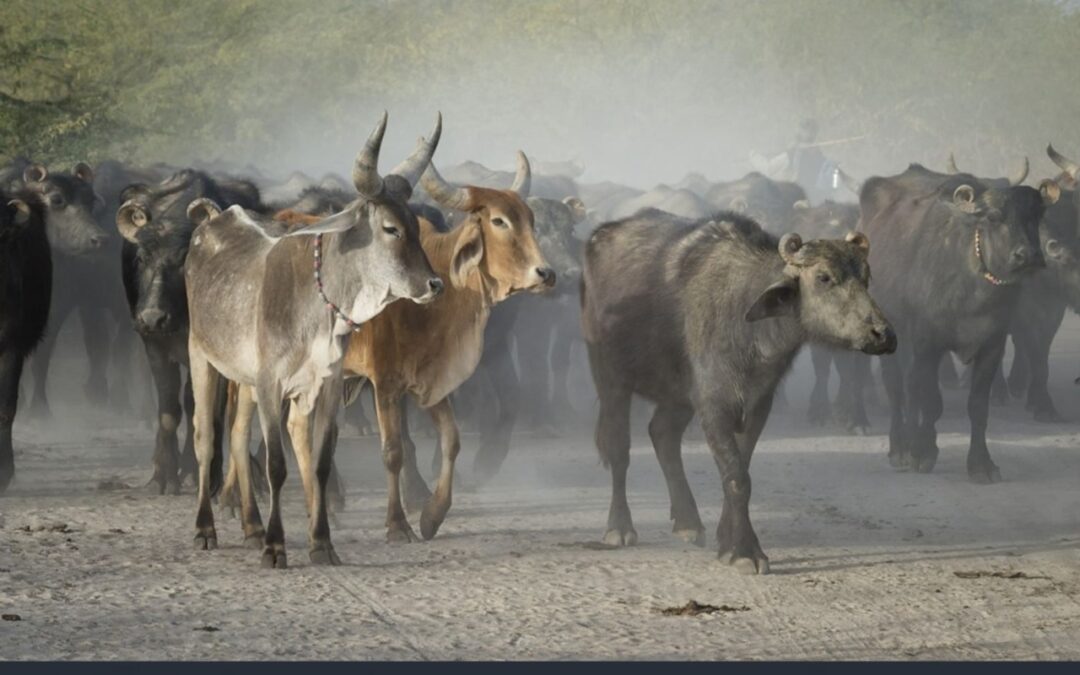
The Indian Council of Agricultural Research (ICAR) has registered 16 new indigenous animal breeds, including four cattle breeds, expanding the country’s scientifically documented livestock genetic resources to 262.
The latest registrations are expected to support the conservation and sustainable use of India’s diverse animal genetic resources, particularly as rising temperatures linked to climate change pose growing challenges to livestock productivity and food security.
The newly registered breeds include four cattle breeds—Umarda, Periyar, Koppal and Mahakaushali—and four sheep breeds—Madgyal, Seemanchali, Kow Debar and Asomi. The list also includes two goat breeds, Totapuri and Battisi, and one breed each of buffalo, dog, pig, horse/pony, donkey and yak: Gomanchali, Kombai, Nagal, Kashmiri, Braj and Sikkimese yak, respectively.
The breeds were registered earlier this month and are spread across diverse agro-ecological regions covering 13 states—Karnataka, Madhya Pradesh, Kerala, Maharashtra, Goa, Rajasthan, Uttar Pradesh, Assam, Uttarakhand, Bihar, Nagaland, Sikkim and Tamil Nadu—as well as the Union Territory of Jammu & Kashmir.
The Battisi goat is found in Rajasthan and Uttar Pradesh, while the Madgyal sheep is distributed across Maharashtra and Karnataka.
Indigenous breeds seen as key to climate resilience
N H Mohan, director of the ICAR-National Bureau of Animal Genetic Resources (NBAGR), said indigenous breeds have developed over generations in varied production environments and possess characteristics that can be valuable for adapting to climate change and local disease conditions.
“Indigenous breeds have evolved under diverse production environments and possess locally adapted characteristics that can be valuable for climate resilience, disease adaptation, low-input production, livelihood support and sustainable livestock farming,” Mohan said.
He added that conserving these breeds is important not only for protecting genetic diversity but also for ensuring that adaptive livestock resources remain available to future generations.
India now has 262 recognised indigenous animal breeds
The Karnal-based ICAR-NBAGR is the nodal institution responsible for registering livestock and poultry breeds in India.
Following the latest additions, the country’s recognised indigenous animal genetic resources include 59 cattle breeds, among them Sahiwal, Gir, Red Kandhari and Hallikar; 23 buffalo breeds, including Murrah, Nili Ravi, Bhadawari and Mehsana; 45 goat breeds; 50 sheep breeds; and 16 pig breeds.
The list also comprises nine horse and pony breeds, nine camel breeds, nine duck breeds, five donkey breeds, six dog breeds and three yak breeds, among others.
Registration aims to preserve locally adapted populations
Mohan said the new registrations would strengthen efforts to identify and document indigenous animal populations that have traditionally remained classified as nondescript livestock.
“The new registrations strengthen the national effort to reduce the proportion of nondescript livestock populations through systematic breed identification and documentation,” he said.
According to him, scientific recognition of such populations can help bring them under suitable conservation and sustainable utilisation programmes.
He said the work of ICAR-NBAGR supports the broader national objective of strengthening India’s livestock genetic base while contributing to food and nutritional security, sustainable livelihoods and climate-resilient livestock production.
The recognition of the 16 new breeds therefore marks another step towards documenting India’s rich livestock diversity and ensuring that locally adapted genetic resources remain available for sustainable farming in the years ahead.