As disruption in the Strait of Hormuz pushes governments and businesses to seek alternative routes, Syria is re-emerging as a potential trade corridor, linking Iraq to the Mediterranean and the Gulf to Europe.
Syria’s interim president, Ahmad Al-Sharaa, said earlier this month that the country’s geography makes it a “safe corridor” and an “alternative route” for energy supplies and supply chains, particularly between the Gulf and Turkiye.
That role is already beginning to take shape. Under a joint agreement between Syria and Iraq, Iraqi oil exports have started moving through Syrian ports, Al-Sharaa said.
His remarks come as the regional conflict has upended longstanding energy and commercial trade routes.
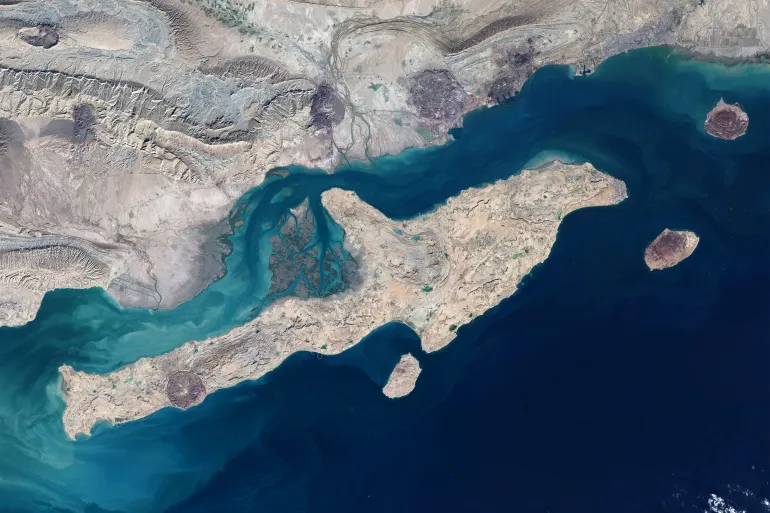
When the US and Israel began joint strikes on Iran on Feb. 28, Tehran retaliated by attacking Israel and the Arab states and effectively blockading the Strait of Hormuz, a key waterway through which about 20 percent of the world’s oil normally passes.
US President Donald Trump responded by imposing a naval blockade on Iranian ports.
Although the two-week ceasefire that began April 8 has been extended indefinitely at the request of Pakistani mediators, the two sides remain at an impasse.
Against this backdrop, Syria has emerged as a possible alternative, offering a shorter and potentially more secure route for oil and gas flows from the Gulf to Europe and other markets.
“Syria is the natural corridor for transit, gas lines and trade in the Middle East,” Joshua Landis, director of the Center for Middle East Studies at the University of Oklahoma, told Arab News.
The idea is not new. Deposed President Bashar Assad “came up with his Five Seas plan after visiting (then-Prime Minister Recep Tayyip) Erdogan in 2004,” said Landis.
“He could not implement it because of the Iraq war, sanctions, and ultimately the uprising and civil war that raged following 2011.
“President Al-Sharaa has a chance to make good on Syria’s central geography. It is the natural entrepot of the Middle East.”
The Five Seas concept links the Mediterranean, Black Sea, Caspian Sea, Red Sea and the Gulf — a region that has served as a center of trade for millennia at the intersection of Europe, Asia and Africa.
Any revival of that vision is likely premature, yet recent developments suggest the idea of Syria as a transit route is regaining traction.
On April 20, Iraq reopened a key border crossing with Syria, known as Rabia in Iraq and Yarubiyah in Syria, after more than a decade of closure.
‘’ If Hormuz is disrupted and Red Sea routing is constrained, Syria becomes commercially interesting.’’
Benjamin Feve, Senior research analyst, Karam Shaar Advisory
Iraq, which relies on oil revenues for about 90 percent of its budget and which exports most of its crude through Hormuz, has resumed shipments through Syrian territory via the Baniyas terminal for transport to Europe, Syria’s state news agency SANA reported.
In freight terms, that matters beyond energy.
Benjamin Feve, senior research analyst at Karam Shaar Advisory, said Syria’s reemergence as a regional land bridge “means that truck, tanker, and some transshipment flows can once again cross Syria instead of bypassing it, which is good for regional and international trade.”
“Several key border points and ports are now operating,” Feve told Arab News. “On the Turkish side, Bab Al-Hawa is one of the most active. There is also Nassib on the Jordanian border, and Al-Waleed toward Iraq.
“We also have the ports of Latakia and Tartus, which have become much more active since the collapse of the (Assad) regime. So we know that all of these border points and ports are active.”
That opening has been made possible in part by Syria’s political transition. On Dec. 8, 2024, Assad fled the country as a coalition of rebel groups led by the current interim president seized Damascus in a lightning offensive.
Since then, the interim government has worked to restore diplomatic ties with the US, Europe, the Gulf states, and others. Most Western sanctions have been lifted to allow for economic recovery and reconstruction during a fragile transitional phase.
Assad’s fall has created an opportunity to reposition Syria as an energy corridor. Still, Feve cautioned that operational access does not yet make Syria a reliable option.
“That does not yet mean Syria is a seamless, high-volume, low-friction corridor of the sort operators would compare with more mature routes through Turkiye, Jordan or the Gulf ports,” he said.
“In most cases, it means limited passage, often with extra paperwork, transit risks, uncertainty around insurance, and route-by-route security calculations.”
Even the highly publicized reopening of Iraq’s Rabia crossing was framed mainly as a way to ease pressure on the only previously operating Iraq-Syria crossing and to provide an overland workaround to disruptions in Gulf shipping.
“It is important in that sense, but it does not amount to proof that Syria has become a fully restored logistics hub,” Feve said. “If anything, it underlines the extent of the disruption that has affected Middle Eastern logistics in recent weeks and months.”
Even so, interest in Syrian transit routes is expanding beyond the Iraq-Mediterranean corridor. The Gulf states, Turkiye, and Jordan are also working to reopen a historic overland route through Syria that would connect the Arabian Peninsula to Europe.
For Syria, that would mean not only transit fees and logistics revenue, but also something less tangible and equally important — trust.
Even with that potential, analysts say the obstacles remain substantial. For one, moving cargo through Syria will not be cheap. “In cost terms, I don’t think Syria is all that attractive,” Feve said.
Under normal conditions, maritime routes still beat Syrian overland transit for bulk cargo, especially fuel and large volumes of container trade. We all know it is much cheaper to trade by sea than by land.”
Where Syria may prove more attractive, he said, is in “speed, redundancy, and maybe political hedging.”
“Some overland corridors through Syria can move cargo in one to 10 days depending on the origin and destination,” Feve said. “Maritime options to Europe can take a few weeks, which is fine under normal conditions.”
Nonetheless, he said, “if Hormuz is disrupted and Red Sea routing is constrained, Syria becomes commercially interesting despite higher direct trucking costs.”
“It may be cheaper than not exporting at all, but that does not mean Syria would immediately become the main logistics hub once restrictions in Hormuz or the Red Sea are lifted. Syria still is not as cheap as sea transport, and it remains full of potential risks.”
Landis agrees. Syria must clear major political and legal hurdles before it can become a reliable trade corridor, he said.
The last sanctions hurdle facing Syria is its designation as a terrorist-supporting country by the US Congress. Before that is lifted, any US business in Syria can be sued.”
With Assad gone, however, Syrian officials believe Washington is moving toward delisting the country. Finance Minister Yisr Barnieh has described delisting as the “last milestone” needed to unlock US investment.
Even if that happens, security and infrastructure remain obstacles.
The highways and all transit routes need serious upgrades. So do border crossings,” Landis said. “Already Bab Al-Hawa is undergoing major renovations and expansion.
“The main highway linking Damascus and Baghdad has been opened now that the US has pulled out of Tanf.
“But the US is placing increasing restrictions on trade and banking in Iraq due to America and Israel’s war with Iran. Politics will remain an important roadblock to exploiting Syria’s geographical assets.”
For Feve, “security is still the first filter.”
“You have continued risks of hostilities in northern and northeastern Syria, in southern Syria, and also in coastal areas where there are localized clashes,” he said.
“You also have unexploded ordnance contamination, which is quite widespread across Syria. There are also fluctuating access restrictions, especially in the northeast, where there are continued warnings about the (Daesh) threat. So yes, security remains very difficult.”
Since its territorial defeat in 2019, the Daesh extremist group has remained a persistent threat, particularly in the isolated desert regions of eastern Syria.
On infrastructure, Feve said that while ports are functioning and some roads are usable, the transport network remains heavily damaged, with logistics assessments placing transport-sector losses in the low billions of dollars.
“This is not something Syria can fix overnight,” he said. “Even driving on Syrian roads is a challenge in and of itself. It increases costs, causes delays, and creates additional risks.”
Both Landis and Feve also pointed to the risk of spillover from the wider regional war, particularly from Lebanon and, to a lesser extent, Iran.
“Al-Sharaa recently said his country is being transformed ‘from a conduit for conflict into a platform for sustainable investment,’” Landis said. “This is true, but the ongoing wars in the region may suck Syria in, destroying regional stability which is key to development.”
Source: Arab News