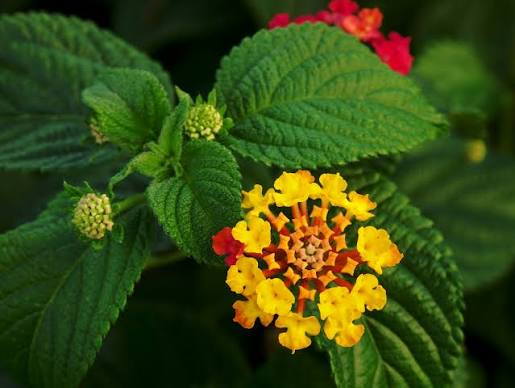
Lantana arrived in India as a garden plant after 1800 and now covers more than 13 million hectares. A 2025 study found that dry forests invaded by it had fewer plant species.
A pretty ornamental plant seems an unlikely forest villain, yet that is what lantana has turned into in India. Its impact on the dry forests of Madhya Pradesh was examined in a 2025 paper in Frontiers in Forests and Global Change, based on fieldwork carried out in 2017 and 2018. The shrub, which covers over 13 million hectares, threatens 44% of India’s forest cover.
From garden shrub to forest pest
Lantana camara is native to tropical Central and South America and was first brought to India as an ornamental. Researchers writing in PLOS ONE, who went through two centuries of historical records, concluded that it reached India soon after 1800. The same team also traced its spread in Australia and South Africa. According to the Frontiers paper, lantana now grows in more than 60 countries. In India it is found in tropical rainforests, semi-arid areas and mangroves, a long way from its humble beginnings.
Why it is so hard to stop
Lantana does well in forests that are already under stress, for instance after fires or floods. Such events can let more sunlight reach the ground, which may help the plant grow and reproduce faster. Birds carry its seeds from place to place, and it releases chemicals that discourage other plants from growing nearby. The Frontiers authors say these traits let lantana outcompete native species. Efforts to control it have mostly failed: it has kept spreading despite long and determined attempts to contain it, and it is expected to expand further as the climate changes. The PLOS ONE team found that two centuries of attempts to eradicate it in Australia, India and South Africa have largely come to nothing.
What the forest study found
The Frontiers researchers looked at tropical dry deciduous forests, which make up 40.9% of India’s forest cover according to the India State of Forest Report 2019. They worked at three forest sites in Sagar, Madhya Pradesh, during 2017 and 2018, comparing sites with less than 50% lantana ground cover against sites with none. They set up 60 plots, 30 in each group. Lantana sites held 98 plant species in total, against 132 at sites without it.
The carbon findings were mixed. Total forest carbon averaged 142.4 metric tons per hectare in lantana areas and 153.7 in non-lantana areas. The top 50 centimetres of soil, however, held an average of 73.1 metric tons of carbon per hectare in lantana areas, compared with 65.2 elsewhere. The authors caution that fewer young trees coming up is likely to disturb how the forest stores carbon over the long term.
Limits of the study and possible remedies
The authors are frank about what the research cannot prove. Because it compared sites in the field, the lantana-affected plots may already have had fewer species and less carbon before the shrub arrived. To limit that risk, the team picked lantana-free plots 50 to 100 metres from invaded ones, under similar conditions. They also call for long-term monitoring to track how these forests change.
Several ideas exist for controlling lantana, though none has worked at scale. The Frontiers paper reports good results in Punjab from chemical control followed by planting fast-growing native species. It also notes that fire can help lantana spread even more. Some people have tried putting the shrub to use, in compost and basket-making among other things. The PLOS ONE authors suggest that the aim may need to be managing lantana over time rather than trying to wipe it out. The story shows how a plant introduced for decoration can end up as a lasting headache for forests.