The Strait of Hormuz remained under acute operational pressure between June 11 and June 14. AIS-visible commercial traffic stayed near zero, IRGC small-craft activity surged, and covert export infrastructure continued functioning despite sustained U.S. enforcement.
The most immediate signal is the collapse in visible movement. Only one AIS crossing was detected from June 11 to 12, followed by seven AIS-visible transits from June 12 to 13 and six from June 13 to 14. EO imagery also confirmed at least one additional dark inbound transit, reinforcing that AIS-visible traffic no longer reflects total movement through the Strait.
At the same time, IRGC small-craft activity intensified. On June 14, approximately 106 high-speed craft surged from the Khasab South staging area within two and a half hours, covering both the western approach and the northeastern choke point. This suggests a coordinated maritime-control posture rather than isolated patrol activity.
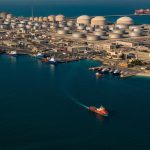
Iranian export activity remains constrained but not halted. Kharg Island’s crude terminals were empty across multiple June 13–14 collections, with 23 tankers holding offshore and recurring slicks pointing to a probable infrastructure fault. Yet a bulk carrier at the LPG/Sulphur terminal was in the final stage of sulphur loading, marking the first such event recorded at that berth during the Operation Epic Fury window.
Beyond Kharg, Windward identified six tankers spoofing positions in the Gulf of Oman, 19 potential blockade breakers across the Arabian Gulf, and eight Iran-origin cargoes moving toward external markets. The result is a maritime environment where visible commercial flow is severely reduced, but covert movement, staging, and export workarounds remain active.
Khasab Barge Strike Raises Questions Around Enforcement
Early on June 11, a cargo barge of approximately 150 tons was reportedly struck by a U.S. projectile about five nautical miles off Khasab, Oman, while departing toward Sirik, Iran.
The vessel was reported to be carrying essential consumer goods and owned by local residents of Sirik County. No AIS transmission was detected for the voyage during the prior 30 days.
There are two plausible explanations for the lack of AIS. Small traditional dhows operating in this corridor are often not legally required or technically equipped to transmit. The barge may also have been operating under escort by a high-speed craft.
No official explanation has been provided for why the vessel was targeted, and the circumstances remain unconfirmed by any authoritative source. The incident nevertheless adds uncertainty around enforcement thresholds in a corridor historically used for high-volume trade between Oman and coastal Iran.
Iranian Tug Follows Unprecedented Cross-Gulf Route
An Iranian tug was detected by SAR imagery at 02:06 UTC on June 11, towing a second contact, assessed as a barge, after departing Bandar Abbas the previous morning.
By later that day, the vessel was proceeding south toward Sirik on a route with no precedent in at least one year of historical operating data. The tug typically operates along the Bushehr–Bandar Abbas corridor and has occasionally run to UAE ports, but had not previously been observed near Khasab or on a cross-Gulf approach toward Sirik.
The vessel’s compliance profile raises further concern. Over the past six months, it accumulated 677 hours of AIS dark time across seven periods, including an 11-day dark stretch at Shahid Rajai port in Bandar Abbas. Its most recent dark period ended just 24 hours before the SAR collection.
In the ten days prior, four vessels met with the tug, and each meeting was logged at a false position in the equatorial Atlantic. One of the four vessels is OFAC-sanctioned and Iranian state-controlled. Three others carry high compliance flags for Iran or Russia programs. Another has transmitted a spoofed Atlantic position continuously since June 10, with its actual location unknown.
Windward assesses that the route deviation, recent dark history, and spoofing-linked vessel network indicate deliberate concealment rather than routine towing operations. The purpose and intended destination of the movement remain unclear.
IRGC Speedboat Swarms Intensify
EO imagery collected on June 14 between 06:51 and 09:21 UTC documented a significant IRGC small-craft deployment across the Strait of Hormuz.
A swarm of 42 high-speed craft departed the Khasab South staging area and fanned northeast across the central and northeastern Strait. A second swarm of 64 craft departed the same node and moved northwest along the western edge.
In total, approximately 106 small craft surged from a single southern staging point within two and a half hours, simultaneously covering the northeastern choke point and western approach.
The Khasab South node appears to be functioning as a primary launch point feeding two divergent swarm axes. The overlapping coverage links the southern foothold to a broader Strait-control envelope and reinforces the assessment of a coordinated maritime-control posture.
Six Tankers Spoof Positions in the Gulf of Oman
AIS analysis and high-resolution EO imagery from June 13 identified six tankers broadcasting spoofed AIS positions in a tight cluster approximately 55 nautical miles southeast of the Strait, off the Musandam Peninsula.
The vessels reported coordinates within a roughly ten-by-four nautical mile box, assessed as consistent with staging for Strait transit.
Four of the six vessels are sanctioned under Iran programs. One has conducted ongoing location manipulation since December 2024, with spoofing tied to Oman/Iran border coordinates. Another has reported being stationary at the same coordinates for more than 12 months. A third began location manipulation on May 20, using Iranian coordinates nearly identical to the first vessel’s reported position. A fourth carries high sanctions exposure under Iran programs and has been engaged in ongoing identity manipulation since April 2026.
The remaining two are not formally designated but carry a high compliance risk. One is owned by a Hong Kong entity and operated by a Shanghai-based shipping company, with spoofing activity beginning in late April 2026. The other is a Comoros-flagged vessel with UAE management that began identity manipulation on June 3 after six dark activity periods totaling more than 162 hours between May 14 and May 26.
A separate EO image from June 13 detected a single dark Panamax tanker of approximately 180 meters transiting the central Gulf of Oman heading north-northwest, likely inbound toward the Strait and likely in ballast.
AIS-Visible Transits Remain Severely Constrained
AIS-visible commercial traffic through the Strait remained critically suppressed across the reporting period.
From June 11 to 12, only one AIS crossing was detected — a single outbound cargo vessel, possibly a dhow, flying a Sri Lankan flag and transiting north of Khasab. Its recent route pattern is more consistent with vessel-supply runs to ships anchored off Khor Fakkan than with a standard commercial Strait transit. Meanwhile, another vessel remained in a position consistent with an imminent Hormuz transit, where it has remained for a couple of days, within the Khasab and Qeshm corridor. However, the vessel may be spoofing its position or experiencing AIS jamming.
From June 12 to 13, seven AIS-visible transits were recorded, including six outbound and one inbound. The outbound movements included three India-flagged cargo vessels, a St. Kitts and Nevis-flagged bulk carrier, a Palau-flagged oil/chemical tanker, and an Iran-flagged sanctioned tanker, possibly transiting while dark.
The inbound vessel was a Marshall Islands-flagged general cargo vessel with UAE ownership and no sanctions concerns.
From June 13 to 14, five outbound and one inbound AIS transit were recorded.
The outbound group included four India-flagged small craft and a Panama-flagged bulk carrier that departed Imam Khomeini, Iran, after a 10.6-day port stay. The bulk carrier went dark southwest of Asalouyeh on June 13, then resumed AIS east of Sirik on June 14 after roughly 14 hours of dark activity, consistent with a North Corridor transit through Iranian-controlled waters.
EO imagery during the same window confirmed one additional inbound dark transit: a handysize product tanker of approximately 110 meters moving through the northern Hormuz corridor with visible wake and no AIS transmission.
Covert Crude Flows Continue Below Pre-Conflict Levels
Windward assesses that covert exports through Hormuz continue, but at volumes far below pre-conflict levels.
Over the past 30 days, 20 non-Iranian-trading tankers of 250 meters or greater went dark in the Gulf of Oman for periods ranging from two to 15 days. The group included 13 VLCCs, four Suezmaxes, and three Aframaxes. During dark windows, the vessels loaded crude either via ship-to-ship transfer east of Hormuz or at Fujairah before sailing toward Asia and India.
A further four VLCCs transited the Strait outbound with AIS active. Combined, Windward estimates these tankers moved approximately 32 million barrels of crude in the past 30 days, equivalent to roughly 2.5 million barrels per day.
Using satellite imagery and multi-source intelligence, Windward identified 16 tankers transiting the Strait dark during the seven days ending June 11. Excluding Iran-trading, LPG, and LNG vessels, the group included three VLCCs, two Suezmaxes, and one Aframax, representing approximately 8.6 million barrels, or a weekly pace of around 1.2 million barrels per day.
Vortexa data placed weekly arrivals of oil loaded from terminals west of Hormuz, excluding Iran, at 3.4 million barrels per day for the seven days ending June 13, up from just over 2.5 million barrels per day the prior week. Crude accounted for approximately 2.4 million barrels per day, with the UAE responsible for roughly half.
Over May, total non-Iranian crude export arrivals from terminals west of Hormuz were estimated at 1.84 million barrels per day. While the volumes show movement is continuing, crude exports remain only a fraction of pre-conflict levels, estimated at 10–12% at best.
Nineteen Potential Blockade Breakers Identified
Windward assessed 19 vessels operating as potential blockade breakers and part of a probable Iranian oil smuggling network in the Arabian Gulf as of June 12.
The full group is either sanctioned or carries a high compliance risk for Iranian sanctions evasion. All exhibited fraudulent flag operations, identity manipulation, and dark activity in the Arabian Gulf during May and June.
Fourteen vessels are sanctioned under Iran programs, including OFAC Executive Order 13846 and SDGT designations. The remaining five carry high-risk exposure for Iran or Russia-related programs. All 19 show active identity or location manipulation, with 11 maintaining ongoing manipulation as of June 12.
Fifteen of the 19 conducted dark activity in the Arabian Gulf during the reporting window, with dark periods ranging from 8 hours to 395 hours per event. Three vessels recorded confirmed port calls at Iranian oil terminals, including Assaluyeh and Lavan Island, during the first and second quarters of 2026.
The network’s flag profile matches established shadow fleet patterns, with registries spanning the Netherlands Caribbean, Mozambique, Malawi, Gabon, Guyana, and Gambia, alongside several unknown or data-gap flags.
Iran-Origin Cargoes Reach Markets Despite Strait Restrictions
Windward and Vortexa data for June to date identified eight vessels that loaded oil in Iran. Seven have been detected in transit toward destinations outside the Arabian Gulf, indicating they transited the Strait while dark or while manipulating location.
Four are reporting coordinates clustered in the equatorial Atlantic, a classic null-island GPS jamming artifact rather than a real position. These vessels are assessed as physically located elsewhere, with falsified AIS consistent with sanctioned Iranian-origin crude and product evasion behavior.
Three others report plausible positions off Oman in the Gulf of Oman and Arabian Sea, consistent with stated China and Oman destinations after Strait transit. The eighth reports from Iraq near the Khor Abdullah approaches, consistent with a short UAE-bound bitumen run.
The flag profile reflects a typical shadow fleet pattern, with registries spanning Mozambique, the Cook Islands, Guinea, and Madagascar, alongside two Iranian-flagged vessels.
Sanctioned Vessels Cluster Near Basrah and Khor Abdullah
SAR and AIS analysis of the Basrah Oil Terminal and Khor Abdullah area on June 12 identified a cluster of sanctioned and high-risk tankers and cargo vessels assessed as manipulating AIS-reported positions.
Five sanctioned vessels were identified, including an Iran-flagged chemicals tanker, two Netherlands Caribbean-flagged tankers, a Mozambique-flagged vessel, and a Hong Kong-flagged crude oil tanker.
Four additional high-risk vessels on open-registry flags consistent with dark fleet patterns were also detected. These included two Panama-flagged vessels, a Palau-flagged oil and chemicals tanker, and a Cameroon-flagged limestone carrier.
The activity is consistent with concealment of illicit crude and product movements around key northern Gulf export and approach areas.
Kharg Crude Loading Suspended as Sulphur Loading Advances
EO and SAR imagery collected across three windows on June 13 and June 14 showed no tankers at any crude loading berth on Kharg Island.
The last tanker observed at a crude loading berth was on June 10. The eastern and western crude terminals remained empty across the June 14 collection, while approximately 23 tankers were observed in the offshore waiting area. This is consistent with a crude loading suspension and a growing queue.
Recurring oil slicks were identified on the western and eastern foreshore, with additional small slicks pointing to a probable berth, pipeline, or shore-side infrastructure fault rather than a single transient discharge. Elevated support-vessel activity across the island and waiting area was consistent with a maintenance posture.
At the LPG/Sulphur terminal, the dark bulk carrier first observed on June 10 remained at berth with no AIS transmission. Imagery showed a clear sulphur loading progression. On June 10, yellow powder was visible being poured into the middle holds, while the forward holds remained empty. By June 14, the middle holds were full, and the forward holds were actively filling.
The vessel also repositioned along the berth between the two dates, consistent with standard bulk sulphur loading procedures. With the middle holds full and the forward section actively filling, departure is assessed as imminent within 24 to 48 hours.
This is the first sulphur loading event recorded at the berth during the Operation Epic Fury window, indicating that non-crude commodity exports continue despite the suspension of crude loading.
Three Dark Vessels Anchor Off Chabahar
EO imagery collected over Chabahar on June 12 identified three dark vessels anchored in the offshore holding area.
The group included a 333-meter tanker, a 273-meter tanker, and a 221-meter container ship. All were stationary and operating without AIS.
No activity beyond routine port operations was observed, but the presence of large dark vessels reinforces Chabahar’s role as a holding area for Iran-connected tonnage.
Russian Shadow Fleet Interdiction Expands in the English Channel
The UK and France intercepted and detained the Russia-linked tanker SMYRTOS as it transited the English Channel, laden from the Russian Baltic port of Ust Luga.
The 2009-built Aframax was broadcasting under the Cameroon flag at the time of the interdiction. It later emerged that the vessel had already been expelled from the Cameroon ship registry, although the International Maritime Organization database had not yet been updated to reflect the change. As a result, the vessel was assessed as operating without a valid flag, rendering it stateless under international maritime law and providing the legal basis for British forces to board and detain it.
SMYRTOS had been sanctioned by the UK in October 2025 and by the EU in July 2025. The incident followed Cameroon’s announcement earlier in June that it was cleaning up its ship registry after a surge of Russia-linked shadow fleet tankers reflagged to Cameroon following the loss of other registries.
SMYRTOS is the 12th Russian shadow fleet tanker intercepted and boarded by European or UK authorities in 2026. The previous vessel, TAGOR, was boarded by French authorities with UK support on May 31 while flying a fraudulent Madagascar registry flag.
The interdiction has not fully deterred sanctioned shadow fleet activity. Three sanctioned shadow fleet tankers were tracked transiting the English Channel on June 14.
However, several Cameroon-flagged tankers have begun diverting from planned Channel routes following the SMYRTOS boarding, suggesting operators are reassessing the enforcement risk associated with registry scrutiny and potential statelessness.
Outlook
Hormuz remains operational, but only under severe constraint.
AIS-visible commercial traffic is near zero, while dark transits, spoofed positions, tanker staging, and covert export flows continue beneath the visible surface. The Strait is not closed in absolute terms, but it is no longer operating as a conventional commercial corridor.
Kharg Island highlights the contradiction. Crude loading appears suspended, with 23 tankers waiting offshore and recurring slicks pointing to infrastructure stress. Yet sulphur loading is advancing, showing that non-crude exports continue even as crude capacity is disrupted.
The wider export picture is similarly uneven. Iranian oil continues to reach markets through dark transits, identity manipulation, and ship-to-ship networks, but at volumes far below pre-conflict levels. Non-Iranian crude flows through Hormuz are also moving under significant opacity, supported in part by dark shuttle and transfer patterns.
The operational environment remains high risk. IRGC small-craft deployments, unexplained enforcement incidents near Khasab, U.S. kinetic actions, spoofing clusters, and growing European interdictions against shadow fleet activity all point to a maritime system increasingly shaped by enforcement, concealment, and selective movement.
Source: Windward.ai