For Jaspreet Kaur, turmeric is more than just a crop growing on her family’s farm in Punjab’s Moga district. It has become an important part of the career she is building for herself.
Her father, Harnail Singh, had always hoped his children would see farming differently. For years, the family had relied on traditional crops such as wheat and paddy. But Harnail was increasingly concerned about whether conventional farming could provide his children with a stable and rewarding future.
Rather than encouraging them to move away from agriculture, he decided to experiment with it.
The family began by trying organic vegetables and mustard before eventually turning their attention to turmeric. What started as a small experiment has since grown into a three-acre turmeric farm, with different members of the family now contributing their own skills to the business.
Jaspreet, the younger daughter, is pursuing an MSc in Food Processing and has taken responsibility for much of the turmeric processing and product development.
For the family, the idea is no longer simply to grow a crop and sell it. They are trying to build a business around what they produce.
A father’s decision to try something different
Harnail had watched farming become increasingly difficult for many young people to see as a long-term career. Traditional crops could involve considerable expenses and uncertain returns, while younger generations often looked towards jobs outside agriculture.
He chose a different approach.
Instead of abandoning farming, he began experimenting with new crops and methods on a small portion of the family’s land. The family also ran a grocery store, which gave him an opportunity to understand what customers were actually buying.
That experience gradually changed the way he thought about farming.
The question was no longer simply what the family could grow. It became a question of what they could grow, process and sell in a way that created greater value.
Turmeric eventually emerged as one of the crops with potential.
From half an acre to three acres
In 2018, Harnail planted turmeric on half an acre, using planting material sourced from Punjab Agricultural University in Ludhiana.
The first harvest encouraged the family to expand. They reportedly harvested around 40 quintals from the initial half-acre plot.
The following year, the area under turmeric increased to one acre. It later expanded to two acres and eventually three acres.
The family now cultivates the Punjab Number 2 variety. Last year, they reported a yield of around 70 quintals per acre, compared with approximately 75 quintals per acre in 2024.
But cultivation is only one part of the family’s approach.
They have also focused on what happens to the turmeric once it comes out of the ground.
One crop, several sources of income
Fresh turmeric harvested in December is used to make pickle, which the family sells for around Rs 400 per kilogram.
Turmeric harvested later is processed and dried to make powder. According to Jaspreet, approximately 5 kg of fresh turmeric is required to produce 1 kg of dry turmeric powder, which is sold for around Rs 350 per kilogram.
The family has also entered the market for turmeric planting material.
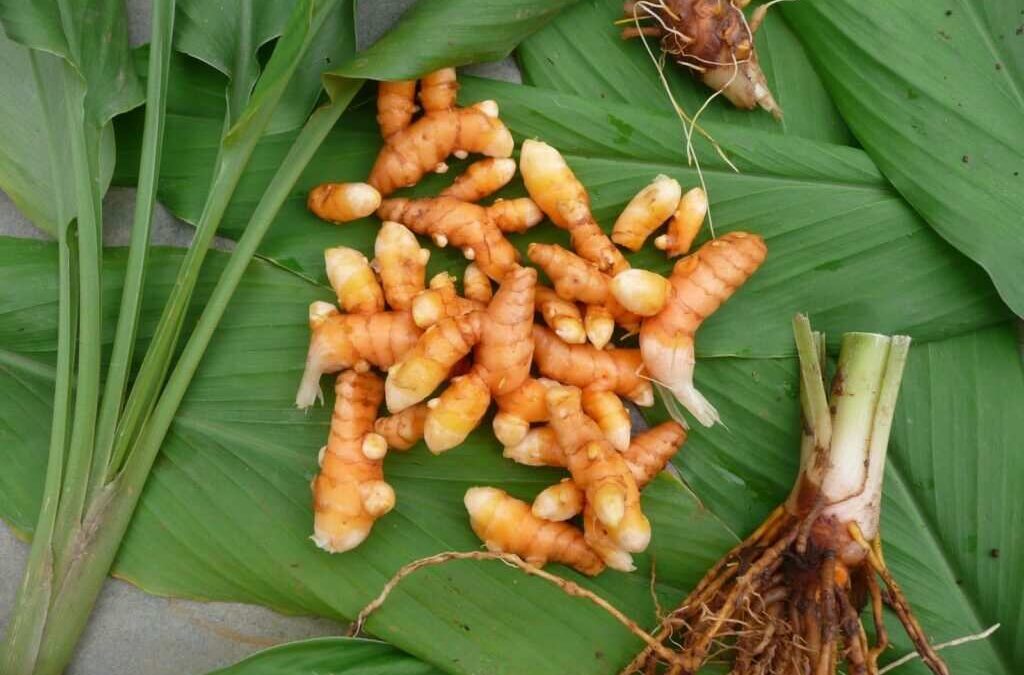
Turmeric rhizomes are prepared and sold to other farmers who want to cultivate the crop. In 2025, the family reportedly sold around 100 quintals of rhizomes at Rs 60 per kilogram, generating approximately Rs 6 lakh in revenue, according to Harnail.
This means the same crop can generate value in several ways — as fresh produce, as a processed food product, as a spice and as planting material for another farmer.
For Jaspreet, this is where her education in food processing fits naturally into the family business.
Bringing food-processing skills back to the farm
While pursuing her MSc in Food Processing, Jaspreet has become closely involved in the processing side of the enterprise.
She works on turmeric processing as well as developing products such as spice blends and pickles. She is also exploring processing techniques that can help retain the nutritional qualities of the ingredients.
Her role goes beyond simply converting harvested turmeric into another product.
The family has to think about cleaning, processing, packaging, pricing and ultimately what customers are willing to buy. Since they sell directly to consumers, understanding the entire journey from farm to finished product has become an important part of the business.
For Jaspreet, processing also offers farmers a way to capture more value from what they grow rather than selling everything as an unprocessed commodity.
A family business built around different skills
Each member of the family now has a different role.
Harnail remains closely involved in cultivation, while his son Gurpreet helps with marketing. Jaspreet focuses on processing and product development. Their elder daughter, who studied fashion designing, has pursued her own work through a boutique.
It is not simply a story of a daughter returning home to take over her father’s farm.
Instead, the family is finding ways to combine different interests, skills and areas of education within the same agricultural enterprise.
That may be what makes Harnail’s original idea particularly meaningful. He did not want his children to view farming as something they had to leave behind in order to build a future.
He wanted them to see that there could be another possibility — that farming could evolve into something they could create, improve and build together.
For Jaspreet, turmeric has become part of that journey. What began with a small patch of land has gradually developed into a family-run venture where cultivation, processing and marketing come together.
And for the next generation, the farm is no longer simply a place where crops are grown. It is becoming a place where a career and a business can grow too.