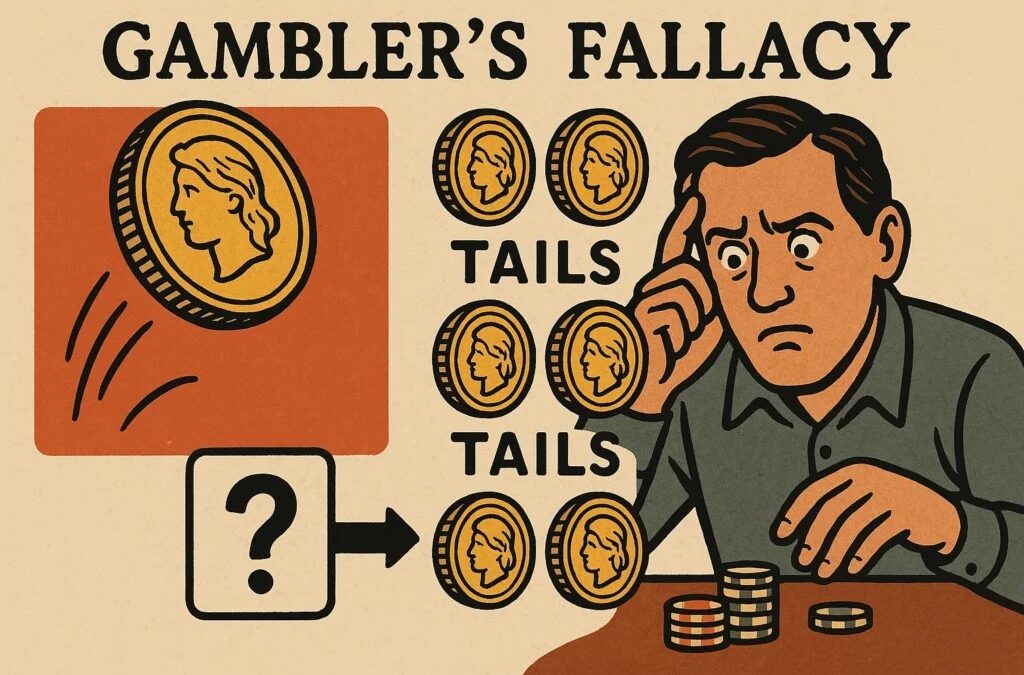
Imagine a coin being tossed repeatedly. It lands on heads five times in a row. On the sixth toss, someone watching the sequence says, “It has to be tails now.” The statement sounds reasonable. After all, how likely is it that heads will appear again?
But there is a problem: the coin does not know what happened on the previous five tosses.
This simple mistake in reasoning is known as the Gambler’s Fallacy—the belief that if an independent random event has produced one outcome repeatedly, the opposite outcome becomes more likely simply because it is “due.” It is one of the most familiar examples of how human beings struggle to think about probability, randomness and uncertainty.
The fallacy appears most obviously in gambling, but its influence extends far beyond casinos. We encounter it when predicting sports results, interpreting streaks, making financial decisions, judging luck and even thinking about everyday events.
What Is the Gambler’s Fallacy?
The Gambler’s Fallacy is the mistaken belief that past independent events affect the probability of future independent events.
Consider a fair coin. Every time it is tossed, there is a 50% chance of heads and a 50% chance of tails. If the coin lands on heads ten times consecutively, the probability of heads on the next toss remains 50%.
A person influenced by the Gambler’s Fallacy might reason:
“Heads has appeared ten times. Tails is overdue.”
But “overdue” has no meaning for an independent coin toss. The coin has no memory. It does not attempt to balance the score.
The important word here is independent. One event does not influence another. The outcome of one fair coin toss has no causal effect on the next.
The Famous Casino Example
The fallacy gets its name from gambling because casinos provide some of the clearest examples.
Imagine a roulette wheel. The ball lands on black several times in succession—perhaps ten times. Some gamblers may begin betting heavily on red because they believe red is now more likely.
They might say, “Red has to come soon.”
But unless something has changed about the wheel, the probability of red on the next spin has not increased merely because black appeared repeatedly.
In 1913, an extraordinary example occurred at a casino in Monte Carlo. A roulette ball landed on black many times consecutively. Gamblers began betting enormous amounts of money on red, convinced that such a long sequence of black outcomes could not continue. Yet the wheel continued producing black. People lost fortunes because they confused a remarkable streak with evidence that the opposite outcome was becoming more probable.
The event became one of the classic illustrations of the Gambler’s Fallacy.
The Law of Large Numbers
One reason people fall into this trap is that they misunderstand the Law of Large Numbers.
The law tells us that as the number of trials increases, the average result tends to approach the expected probability.
For a fair coin, if we toss it an enormous number of times, the proportion of heads will tend to approach 50%.
But this does not mean that after five heads, the next toss is more likely to be tails.
Suppose a coin produces 60 heads and 40 tails in the first 100 tosses. If we continue tossing it thousands of times, the overall proportion may move closer to 50%.
How can that happen?
It does not require the coin to compensate for the earlier imbalance. Instead, the new tosses simply accumulate around the expected probability. The original 60–40 difference becomes relatively smaller as the total number of tosses grows.
This distinction is crucial: long-run balance does not require short-run correction.
Gambler’s Fallacy vs. Genuine Patterns
Not every belief about streaks is irrational.
The key question is whether the events are genuinely independent.
Suppose a basketball player has missed ten shots in a row. Someone might say, “The next shot is due to go in.” If every shot were completely independent, this could be an example of the Gambler’s Fallacy.
But real-world events are often more complicated than coin tosses.
A player’s performance can be affected by fatigue, confidence, defensive pressure, shot selection and many other factors. Similarly, a machine producing defective products may have a mechanical problem that makes consecutive failures more likely.
In such situations, previous events may contain information about future ones.
This is why the Gambler’s Fallacy is not simply the belief that streaks exist. It is the belief that an outcome is becoming more likely because the alternative has not appeared for some time, when there is no mechanism causing that correction.
The Hot-Hand Fallacy
Interestingly, the Gambler’s Fallacy has an almost opposite counterpart: the Hot-Hand Fallacy.
Here, people assume that because someone has succeeded repeatedly, they are more likely to succeed again.
A basketball player scores five consecutive shots, and spectators say, “He’s hot—give him the ball.”
The gambler says, “Red hasn’t appeared for ten spins, so red must be next.”
The two beliefs appear contradictory. One assumes that streaks will end; the other assumes that streaks will continue.
Yet both emerge from the same human tendency: seeing meaningful patterns in sequences of events.
We are uncomfortable with randomness. We want streaks to mean something.
The Fallacy in Everyday Life
You do not have to visit a casino to encounter the Gambler’s Fallacy.
Imagine that a person applies for five jobs and is rejected each time. They might conclude, “The next application is bound to succeed.”
It may succeed, but not because five previous applications failed.
Similarly, someone who experiences several unfortunate events might think, “I’ve had so much bad luck lately that something good must happen soon.”
This can be emotionally comforting, but probability does not operate according to a fairness principle. Life does not keep a ledger of good and bad outcomes and automatically settle the account.
The same reasoning can appear in relationships, business decisions, sports predictions and investing.
How to Avoid the Gambler’s Fallacy
The easiest way to protect yourself is to ask three questions.
First: Are the events independent?
If the outcome of the previous event cannot influence the next one, a streak does not automatically change the odds.
Second: What mechanism would cause the next outcome to change?
If you cannot identify one, “it’s due” is probably not a good argument.
Third: Am I confusing long-term probability with short-term prediction?
Knowing that a fair coin produces approximately 50% heads over a huge number of tosses tells you very little about what the next individual toss will be.
These questions can slow down our instinctive reactions and replace them with more careful reasoning.
The Deeper Lesson
The Gambler’s Fallacy ultimately tells us something larger about the human mind.
We want the universe to be orderly. We expect imbalance to correct itself and randomness to contain visible structure. When events cluster unexpectedly, we search for meaning.
But randomness can produce streaks. Coin tosses can produce ten heads in a row. A roulette wheel can produce the same colour repeatedly. Several independent events can happen in the same direction without creating a hidden obligation for the next event to reverse.
The deeper lesson is therefore not merely “don’t gamble.”
It is to recognize the difference between what has happened and what that history actually tells us about what comes next.
A streak may be interesting. It may be surprising. It may even demand investigation if there is reason to suspect that the events are not independent.
But a streak, by itself, is not a promise of reversal.
And perhaps that is why the Gambler’s Fallacy remains so fascinating: it reveals how easily our desire for balance can overpower our understanding of chance.