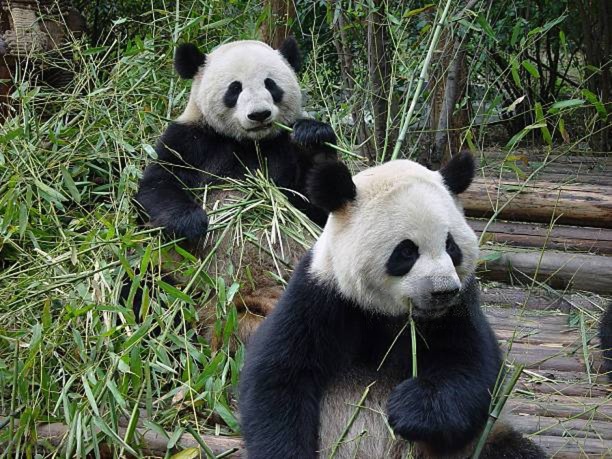
Two giant pandas, Ping Ping and Fu Shuang, arrived at Zoo Atlanta on September 27 for a planned 10-year stay, continuing a decades-old practice in which China sends giant pandas to other countries as part of conservation partnerships and diplomatic exchanges.
The pandas travelled from Chengdu to Atlanta on a dedicated flight after Chinese President Xi Jinping announced the arrangement during a visit to the United States. Xi described the giant panda as an “envoy of friendship” between the Chinese and American peoples.
The timing of the pandas’ arrival has attracted attention because it comes during a period of significant disagreements between the United States and China over trade, technology, security and other issues.
The practice is commonly known as “panda diplomacy.”
What is panda diplomacy?
Panda diplomacy refers to China’s practice of sending giant pandas to other countries, initially as gifts and later primarily through long-term loan arrangements.
Under the modern loan system, China retains ownership of the pandas. Host institutions generally contribute financially to conservation efforts and pay fees associated with the agreement, in addition to covering the substantial costs of housing, feeding and caring for the animals.
Panda agreements can also involve cooperation in breeding, scientific research and conservation. They create long-term connections between Chinese and international scientists, veterinarians and conservation organisations.
Cubs born overseas generally remain under Chinese ownership and are eventually returned to China.
Zoo Atlanta’s current arrangement is an international cooperative agreement concerning giant panda conservation with the China Wildlife Conservation Association.
How pandas became diplomatic symbols
China has used giant pandas in international relations for decades. During the Mao era, pandas were given to countries including the Soviet Union and North Korea.
Their role in US-China relations became particularly prominent after US President Richard Nixon’s historic 1972 visit to China. Following the visit, China sent two pandas, Ling-Ling and Hsing-Hsing, to the National Zoo in Washington.
The animals became extremely popular in the United States, attracting more than one million visitors during their first year.
The exchange became associated with the improvement in US-China relations during that period. China subsequently developed similar panda partnerships with countries including Japan, Australia, France, Canada, Malaysia and South Korea.
From gifts to long-term loans
China shifted from giving pandas as gifts to primarily arranging loans in 1984, amid growing concerns about the species’ declining population.
There are now nearly 1,900 giant pandas in the wild in China, while the global captive population is reported to number more than 700.
The loan system also means that panda transfers, renewals and returns can attract diplomatic attention. Changes to panda agreements sometimes occur alongside broader changes in a country’s relationship with China, although such timing does not by itself demonstrate that the pandas caused those changes.
Pandas and international relations
Panda movements have occasionally coincided with shifts in relations between China and other countries.
For example, Japan returned two pandas to China in 2026 amid tensions between Beijing and Tokyo. This left Japan without pandas for the first time since the two countries established diplomatic relations in 1972.
The United States has also experienced several notable panda transfers. In 2010, two US-born panda cubs were sent to China after Chinese officials expressed objections to then-President Barack Obama’s planned meeting with the Dalai Lama.
Several pandas subsequently left US zoos in 2023 and 2024, while new pairs arrived at the San Diego Zoo and the National Zoo in Washington later in 2024.
These developments have led some researchers and observers to describe pandas as a potential indicator of diplomatic relationships. However, panda transfers alone cannot establish whether relations between countries are improving or deteriorating.
Why Atlanta is significant
Zoo Atlanta has maintained a long-running conservation relationship with China. Its previous panda agreement began in 1999 and continued for 25 years.
During that period, pandas Lun Lun and Yang Yang produced seven cubs between 2006 and 2016. The zoo’s partnership involved conservation work, research and information exchange, and the pandas and their offspring were eventually returned to China.
The renewed partnership brings giant pandas back to Atlanta while continuing the zoo’s collaboration with Chinese conservation organisations.
Does panda diplomacy influence public opinion?
Researchers have differing views about how much pandas can affect perceptions of China.
Some experts argue that pandas provide a visible symbol of friendship and goodwill and can maintain people-to-people connections even when governments disagree on major issues.
Others argue that the animals’ friendly public image has a more limited effect because audiences also consider broader issues involving China’s foreign policy, trade, national security and geopolitical activity.
Research has nevertheless found evidence that pandas can influence perceptions in certain circumstances.
A 2022 study from the University of Connecticut found that US students who watched panda videos not produced by the Chinese government were more likely to express positive attitudes toward Chinese culture and, in turn, Chinese people.
A 2026 survey by NORC at the University of Chicago found that 28% of US adults said sending pandas to American zoos would improve their view of China. Other respondents placed greater importance on substantive issues, including cooperation on fentanyl-related chemicals and trade restrictions.
Researchers have also noted that affection for pandas does not necessarily translate into support for Chinese government policies. Instead, the animals may create a positive point of contact and provide an area in which cooperation can continue despite disagreements in other areas.
What happens to Ping Ping and Fu Shuang?
The two pandas are expected to remain in quarantine for approximately a month before being placed on public display. Chinese veterinarians and keepers are involved in their care.
Ping Ping, the male, was born in March 2020, while Fu Shuang, the female, was born in October 2020.
Their arrival extends Zoo Atlanta’s conservation partnership with China and provides another example of how giant pandas have become associated with international conservation cooperation as well as China’s broader diplomatic outreach.