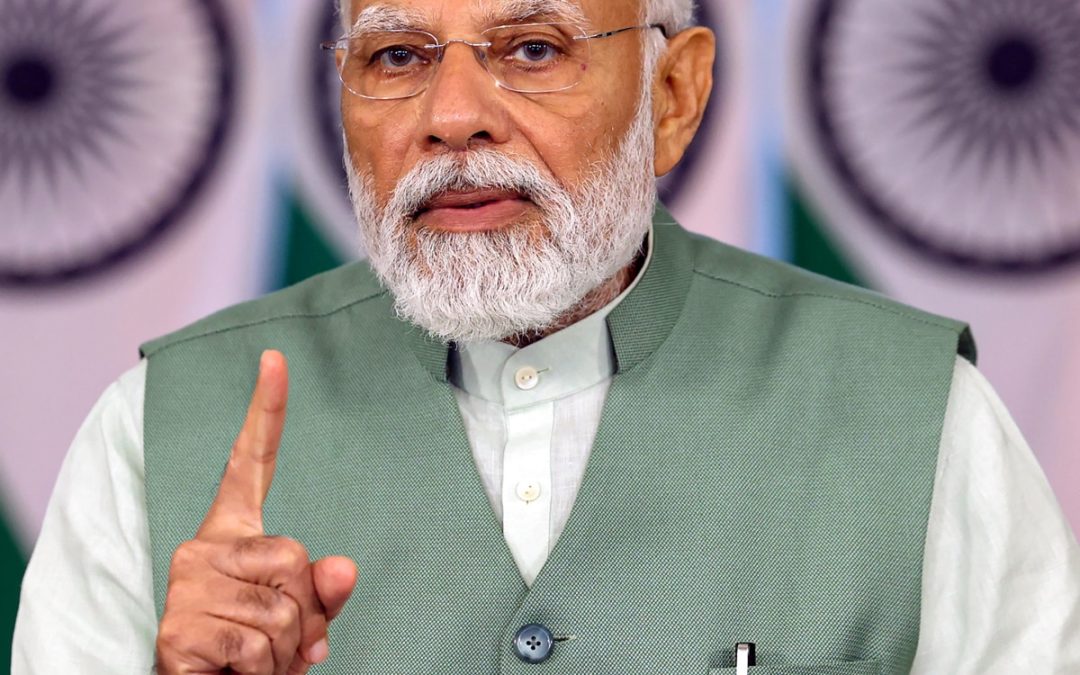
New Delhi: Prime Minister Narendra Modi on Thursday said the Economic Survey 2025–26 presents a comprehensive snapshot of India’s growth journey, describing it as a reflection of the country’s “Reform Express”.
In a post on X, the prime minister said the survey “presents a comprehensive picture of India’s Reform Express, reflecting steady progress in a challenging global environment.” He added that it highlights strong macroeconomic fundamentals, sustained growth momentum, and the expanding role of innovation, entrepreneurship and infrastructure in nation-building.
Modi said the survey underscores the importance of inclusive development, with focused attention on farmers, MSMEs, youth employment and social welfare. “It also outlines a roadmap for strengthening manufacturing, enhancing productivity and accelerating our march towards becoming a Viksit Bharat,” he said, adding that the findings would help guide policymaking and reinforce confidence in India’s economic future.
India to remain fastest-growing major economy
According to the Economic Survey 2025–26, India is projected to remain the world’s fastest-growing major economy, with real GDP growth estimated at 7.4% in FY26, even as the global outlook remains fragile amid geopolitical tensions, trade fragmentation and financial vulnerabilities.
Tabled in Parliament by Union finance minister Nirmala Sitharaman, the survey said India’s macroeconomic fundamentals have strengthened on the back of robust domestic demand, disciplined fiscal consolidation and improving financial sector health, while stressing the need for strategic resilience in a rapidly changing global environment.
The survey projects real GDP growth of 7.4% in FY26 and 6.8–7.2% in FY27, with gross value added (GVA) growth estimated at 7.3% in FY26, reaffirming India’s position as the fastest-growing major economy for the fourth consecutive year.
Sitharaman said the survey outlines India’s transition from “Swadeshi” to “Strategic Resilience” and ultimately to “Strategic Indispensability”, a shift that would move the world from “thinking about buying Indian” to “buying Indian without thinking”.
“It is in this context that the government has focused on deregulation and strengthening domestic manufacturing through a range of measures,” she said in a post on X. Aligning with Prime Minister Modi’s vision of Aatmanirbhar Bharat and Make in India, she added that India’s industrial sector is evolving from traditional manufacturing to high-tech capabilities, resilience and deeper global integration.
Initiatives such as the National Logistics Policy and the Unified Logistics Interface Platform (ULIP) are improving logistics efficiency and reducing transaction costs, thereby enhancing the competitiveness of Indian manufacturing, Sitharaman said.