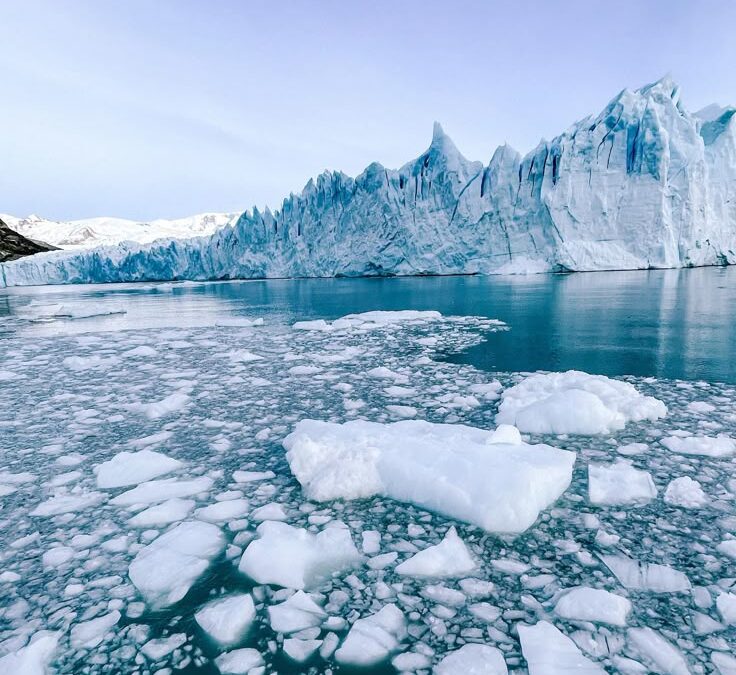
Thwaites Glacier in West Antarctica, widely known as the “Doomsday Glacier,” is melting more aggressively than previously estimated, according to a new study by glaciologists. The findings suggest that the glacier could contribute up to 1.2 inches (30 millimetres) to global sea-level rise by 2100, nearly twice earlier estimates, even without additional climate warming.
The study, published in Nature Communications on October 12, 2026, was conducted by researchers associated with the University of California, Irvine, the University of California, Los Angeles, and NASA’s Jet Propulsion Laboratory.
Thwaites is one of the most closely monitored glaciers in Antarctica because of its potential impact on global sea levels. Its retreat has accelerated over recent decades, raising concerns about the stability of the wider Antarctic ice sheet.
What the New Study Found
The researchers developed an improved ice-sheet model to understand the processes occurring beneath Thwaites Glacier. Their findings suggest that previous models may have underestimated melting because they did not adequately account for the broad area where the glacier meets the ocean.
The updated model indicates that the glacier’s contribution to sea-level rise could reach approximately 30 millimetres by the end of the century under a climate scenario based on historical conditions. This is about twice the average contribution projected by earlier modelling estimates.
The researchers also found that melting could gradually detach the glacier from an underwater ridge that currently helps slow its movement towards the ocean. Such a development could accelerate the glacier’s retreat.
Why Is Thwaites Glacier Difficult to Predict?
One of the major challenges in forecasting the glacier’s future is understanding the interaction between ocean water and the ice beneath its surface.
Thwaites is located in a remote and difficult-to-access region of West Antarctica. Its retreat is influenced by ocean temperatures, the shape of the seabed and the movement of ice towards the coast.
The glacier currently contributes around 4% of global sea-level rise, according to previous research. However, predicting its future remains difficult because several interconnected processes influence its melting and movement.
What Is the ‘Grounding Zone’?
The study focuses on an area known as the grounding zone, where ice resting on the seabed transitions into a floating ice shelf.
Earlier ice-sheet models generally treated this transition as a narrow boundary. However, satellite observations indicate that the grounding zone can extend across several kilometres.
Within this region, seawater moves beneath the ice as tides rise and fall. This process, known as tidal pumping, allows relatively warm ocean water to penetrate farther underneath the glacier, increasing melting and weakening the ice’s attachment to the seabed.
The researchers found that accounting for this wider grounding zone helped their model reproduce nearly three decades of observed retreat, thinning and acceleration more accurately.
Underwater Ridge Could Lose Its Stabilising Effect
Another important finding concerns the Mouginot Ridge, an underwater formation that currently helps restrain the glacier’s movement.
As the ice melts, Thwaites could gradually detach from this ridge and retreat towards another major underwater elevation known as South Ridge. The seabed between these formations slopes downwards towards deeper areas, potentially allowing the glacier to retreat further once its stabilising support is lost.
The study estimates that simulations incorporating grounding zones consistent with recent observations show approximately a 60% probability of the glacier moving beyond the Mouginot Ridge by 2100. Some model simulations suggest that this detachment could begin as early as 2038.
These projections are based on modelled scenarios and do not mean that the glacier’s complete collapse is inevitable.
Why Does It Matter?
Thwaites holds enough ice to contribute approximately 65 centimetres, or about 2 feet, to global sea-level rise if the entire glacier were lost. Its retreat could also destabilise neighbouring parts of the West Antarctic Ice Sheet, increasing the potential long-term impact.
Rising sea levels can increase coastal flooding risks, accelerate shoreline erosion and threaten communities in low-lying coastal regions around the world.
The latest findings suggest that overlooking processes beneath glaciers could lead scientists to underestimate future sea-level rise. Even a relatively small additional rise in global sea levels can increase flooding risks in vulnerable coastal areas.
What Happens Next?
The researchers have emphasised the need for more direct observations of the grounding zone to improve predictions. Future investigations are expected to focus on measuring how seawater moves beneath the ice and how these interactions affect melting and retreat.