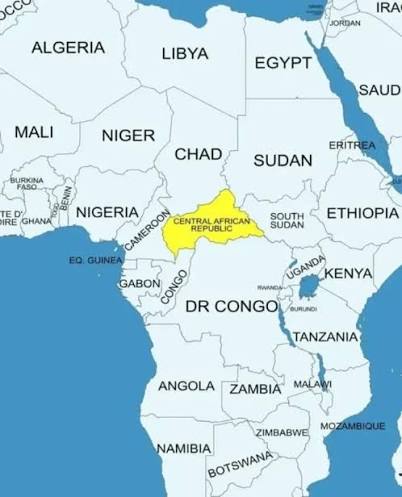
A&S Resources, which is developing iron ore and other mineral assets in the Central African Republic, has announced plans to develop a railway line linking its deposits with Cameroon’s Kribi port. The proposed corridor could support more than 90 million tonnes of annual iron ore exports and emerge as a significant new source of dry bulk shipping demand, supporting an additional 70-80 Capesize vessels and generating shipping demand equivalent to around 5% of that created by global iron ore trade in 2025.
The Central African Republic’s (CAR’s) mineral resources have remained largely stranded because the country lacks direct access to the sea. There is therefore a proposal to build a 1,350-kilometre rail-line between the Central African Republic and Kribi in neighbouring Cameroon, which would create a new route for the CAR’s iron ore and other minerals to reach international markets.
A&S Resources has reportedly secured $6 billion from an Indian financial institution to develop the railway infrastructure between its mining assets in CAR to Kribi, which is likely to be developed by a Chinese infrastructure company. The announcement followed A&S Resources’ February 2026 statement that it had signed agreements covering mine development, railway construction and other logistics for the long-term offtake. However, given that the exploration is at its early stage, exports of iron ore from this region are unlikely before the early 2030s.
A&S Resources estimates that its Bakala/Topa and Bogoin properties contain more than 20 billion tonnes of predominantly high-grade iron ore. However, the figure remains a company estimate rather than a publicly verified source. Even if it is proven to be partially correct, it would generate massive export potential. The company has also identified copper, rare earth elements and other strategic minerals, which could broaden the corridor’s importance as China and India seek greater access to critical mineral supplies.
The proposed railway would initially carry 250,000 tonnes per day, equivalent to 91 million tonnes annually, before potentially scaling up to 300,000 to the most likely destination for a large share of the ore. Its iron ore imports reached around 1.3 billion tonnes in 2025, and we expect nearly 110 million tonnes annually. Kribi would also require to expand its port handling capacity to support these volumes.
China remains the imports to expand by 1.5-2% every year at least until 2031. Meanwhile, India could be another growing market. Drewry’s earlier analyses showed that India’s strong growth in steel production has the potential to make it a major iron ore importer over the next few years. India’s imports reached more than 12 million tonnes in 2025, while the country’s target of producing 255 million tonnes of crude steel by 2030-31 could substantially expand its iron ore imports.
If Kribi exports about 100 million tonnes annually, split equally between China and India, in all likelihood, both countries will diversify away from Australian iron ore. Hence, this diversification could generate more than 500 billion additional tonne-miles of shipping demand, translating into demand for around 70-80 additional Capesize vessels annually by the late 2030s.
Conclusion
The project faces substantial financing, construction and execution risks, but its potential shipping impact warrants attention. If developed as planned, the CAR-Kribi corridor could create a major Atlantic iron ore loading hub.
Source: Drewry