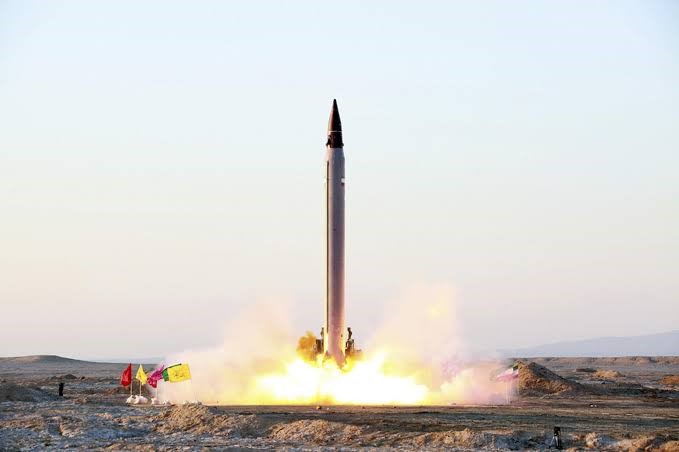
China’s military on Monday conducted a test launch of a missile from a nuclear-powered submarine into the Pacific Ocean, prompting expressions of concern from Japan, Australia and New Zealand over Beijing’s expanding military capabilities and regional security posture.
According to state-run Xinhua News Agency, a submarine of the People’s Liberation Army Navy launched a missile carrying a dummy warhead toward international waters in the Pacific at 12.01 pm local time. The missile reportedly landed in a designated area, though authorities did not disclose its precise location.
Chinese state media described the launch as part of routine annual military training, saying it complied with international law and was not directed at any country or specific target. The statement was later reposted by China’s Ministry of National Defense.
Regional concerns over military expansion
Australian Foreign Minister Penny Wong said Beijing had provided advance notification of the missile test but described the launch as a destabilising development.
“The test comes in the context of a rapid military build-up by China, which is lacking the transparency and reassurance as to intent that the region expects,” Wong told reporters.
The missile test took place hours after Australia and Fiji signed a new defence agreement committing both countries to assist each other in the event of an attack.
The South Pacific has become an increasingly important arena of strategic competition, with China, the United States and Australia seeking to expand their influence among Pacific island nations through security, economic and diplomatic partnerships.
Japan, New Zealand react
New Zealand Foreign Minister Winston Peters said Wellington was “deeply concerned” by the missile launch, noting that China had informed the country only hours before carrying out the test.
“New Zealand considers this an unwelcome and concerning development. We, like our neighbours in other Pacific countries, have no interest in China using the South Pacific as a testing site for missile capability,” Peters said.
Japan also confirmed that it had been notified in advance and said it had conveyed its concerns to Beijing over increased Chinese military activity in the region.
Tokyo added that Chinese authorities had separately informed Japan’s Coast Guard about the possibility of space debris falling within Japan’s Exclusive Economic Zone (EEZ).
China defends launch
Responding to criticism, Chinese Foreign Ministry spokesperson Mao Ning said the missile test was conducted “safely, in a standardised and professional manner throughout” and urged countries not to overinterpret the exercise.
She also commented on the Australia-Fiji defence pact, saying China hopes countries in the region will respect the independence of Pacific island nations and avoid actions that target the interests of third parties.
Growing military capabilities
China maintains a formal “no first use” nuclear policy but has continued to modernise its armed forces and expand its strategic capabilities.
According to the Washington-based Nuclear Threat Initiative, China operates six ballistic missile submarines and dozens of nuclear-powered attack submarines as part of its broader military modernisation programme.
Long-range missile launches into the Pacific remain relatively rare. China last publicly announced an intercontinental ballistic missile test in 2024, underscoring its growing strategic reach and military capabilities.