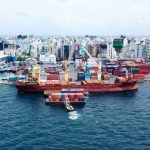
Rates for shipping containers from east Asia and China to the US were mostly higher this week while rates for liquid chemical tankers ex-US Gulf were mostly softer, all while schedule reliability is decreasing because of congestion at Asia ports.
PORT CONGESTION
Global container vessel schedule reliability dropped to 56.4% in July 2026, a decline of 6.1 percentage points compared with the previous month, according to Alan Murphy, CEO, Sea-Intelligence and as shown in the following chart.
“Concurrently, the average delay for late vessel arrivals climbed to 6.06 days, an increase of 0.59 days month on month,” Murphy said.
Murphy said the pronounced drop was driven primarily by congestion across major Asian ports.
“All 14 of the region’s busiest ports experienced a decrease in on time vessel arrivals,” Murphy said, adding that the situation is likely to impact shipping in the near term.
“With the region’s busiest ports operating with more than half of their incoming vessels delayed, this backlog will naturally cascade through the maritime network, likely triggering a new wave of delays for critical head haul trade lanes in the coming months,” Murphy said.
One reason is that two of the region’s biggest ports – Shanghai and Ningbo – have seen consecutive typhoons.
Things could get worse as there are currently three named hurricanes in the Pacific Ocean.
Rates to the West Coast are now between $6,000/FEU (40-foot equivalent unit) and $7,800/FEU, while rates to the East Coast are between $8,200/FEU and $11,250/FEU.
.
He also noted sustained demand for imports as consumer and commercial demand remains strong.
“Retailers and e-commerce sellers (such as Amazon merchants) are accelerating shipments to meet mandatory early-to-mid-October fulfillment center delivery deadlines for Black Friday and holiday inventory,” Khachatryan said.
Rates from online shipping marketplace and platform provider Freightos rose by 2% to both US coasts, reaching new peak highs
Judah Levine, head of research at Freightos, said volume strength has stretched on through August despite the early start to peak season demand back in late May.
Levine said carriers are increasing capacity slightly for September in anticipation of still-elevated volumes – with more rate increases, especially for the East Coast, possibly to start the month – up until October’s Golden Week, with blanked sailings set for the holiday period.
Rates on the SCFI, which tracks rates for containers leaving Shanghai, rose by 2.3%, the sixth weekly gain in a row following three consecutive down weeks.
Rates on the NYSHEX Freight Index (NYFI) rose by 1.0% to the West Coast and fell by 2.0% to the East Coast.
Container ships and costs for shipping containers are relevant to the chemical industry because while most chemicals are liquids and are shipped in tankers, container ships transport polymers, such as polyethylene (PE) and polypropylene (PP), which are shipped in pellets. Titanium dioxide (TiO2) is also shipped in containers.
They also transport liquid chemicals in isotanks.
LIQUID TANKERS
US chemical tanker freight rates assessed by ICIS were steady to lower this week with rates on the transatlantic route edging lower on the low side as most trade lanes are facing persistent downward pressure as the usual summer slowness emerges and the peak season comes to an end.
Although most of the regular carriers along this route have noted that there is little prompt space, they did comment that plenty of pockets of space remain for September. Should this trend continue, rates could be pressured even lower.
Large parcels of methanol and caustic soda continue to dominate the market, as several cargoes were reportedly fixed. Contract volumes remain steady heading into the second half of September.
Rates along the USG-Asia trade lane have declined a bit as prompt space has become limited, particularly for the balance of the month. Regardless, steady contract of affreightment (COA) volumes remains the bright spot supporting any significant movement in rates, preventing them from declining any further.
The number of new fixtures seems to have dropped off this week, as increasing competition for transit slots via the Panama Canal have also contributed to pressure along this trade lane and as auction levels have hit record levels.
From the USG to Brazil, this trade lane remains unusually quiet and in turn rates seem to have steadied. Fewer fixtures were noted this week, and the lack of prompt availability seems to indicate supply is somewhat tight and therefore owners appear to be cautious about letting rates decline any further.
Much like the other trade lanes, demand seems to be mostly covered by COAs, caustic soda, ethanol and MEG continue to be seen quoted in the market. However, Brazil recently renewed higher tariffs on a wide variety of petrochemicals leading to some caution by most traders as they take a wait and see approach.
However, the USG to India route has seen an uptick in enquiries over the last week with several confirmed fixtures, leading to higher rates along this trade lane.
There were several methanol cargoes fixed with a few new enquiries for MEG. Traders continue to explore a variety of cargoes well into October keeping pressure on any available space.
Source: By Adam Yanelli, Additional reporting by Kevin Callahan, ICIS