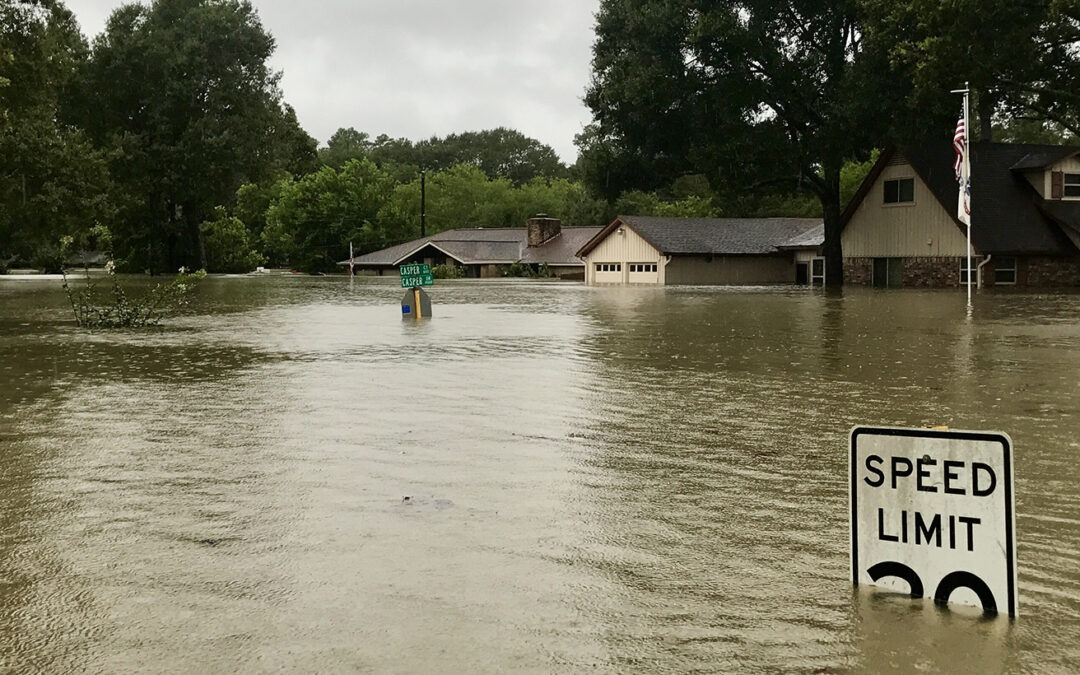
Several parts of Lucknow remained flooded days after heavy rainfall had ended, with the delayed rise in the Gomti River linked to runoff travelling downstream from areas nearly 250 kilometers upstream.
The flooding was not solely the result of rainfall within Lucknow. Heavy rain across the Gomti catchment generated large volumes of runoff that moved gradually downstream, taking an estimated eight to 10 days to reach the city.
On Monday afternoon, the Gomti stood at 106.99 meters at Hanuman Setu, below the danger level of 109.50 meters and well below the historic high flood level of 110.85 meters recorded in 1971. Despite the river remaining below these thresholds, low-lying areas such as Faizullahganj, Ghaila and Daud Nagar experienced inundation.
The situation highlights how a delayed river response, combined with development and encroachment on floodplains, can contribute to urban flooding even when river levels and discharge remain below historical extremes.
The Gomti originates at Gomat Taal in Pilibhit and flows through Shahjahanpur, Lakhimpur Kheri, Hardoi and Sitapur before reaching Lucknow. It then continues through Barabanki, Ayodhya, Sultanpur, Jaunpur and Ghazipur, where it joins the Ganga.
The river’s downstream flow averages roughly 30 kilometers a day. As a result, runoff generated in the upper catchment can take eight to 10 days to reach Lucknow. This explains why river levels in the city continued to rise even after the heaviest rainfall had ended.
Rainfall recorded between September 25 and 27 illustrates the scale of precipitation across the Gomti basin. Lakhimpur Kheri received 268.3 mm, compared with a normal of 7.3 mm for the period, while Shahjahanpur recorded 263.9 mm against 5.3 mm. Hardoi received 147.2 mm against 4.1 mm, Sitapur 144.1 mm against 7.5 mm, and Pilibhit 119.9 mm against 8.6 mm. Lucknow itself recorded 180.5 mm during the three-day period, compared with a normal of 9.4 mm.
The amount of water ultimately reaching Lucknow depends on cumulative rainfall throughout the upstream basin rather than rainfall in the city alone. Runoff from Pilibhit, Shahjahanpur, Lakhimpur Kheri, Hardoi and Sitapur continued entering the Gomti as it moved downstream, sustaining the river’s rise after rainfall had subsided in Lucknow.
Additional inflows from tributaries such as the Kathina, Sarayan, Gon, Behta and Kukrail rivers, along with several seasonal streams, also contributed to the river’s discharge.
The delayed flood pulse was reflected in measurements at Hanuman Setu. The river level increased from 106.55 meters on October 2 to 106.63 meters on October 3, 106.80 meters on October 4 and 106.94 meters on the morning of October 5. It later reached around 107 meters.
Despite the flooding, the discharge through Lucknow remained well below historical levels. Current estimates put the flow at approximately 40,000 cusecs, while the barrage is designed to handle up to 1.25 lakh cusecs.
During the September 10, 1971 flood, when the Gomti reached 110.85 meters, approximately 1.07 lakh cusecs passed through the barrage. In 1985, when the river reached the danger level of 109.50 meters, discharge was around 74,000 cusecs.
The flooding is being attributed to a combination of factors: exceptionally heavy rainfall across the Gomti basin, smaller rivers and streams reaching or approaching their carrying capacity, and the loss of natural floodplain areas to urban development and encroachment.
Historically, the Gomti could spread across a wider floodplain during periods of high flow, allowing excess water to disperse and recede more gradually. Development and construction across parts of the floodplain have reduced the space available for the river, concentrating water within a narrower corridor and increasing the risk of inundation in low-lying areas.
If there is no significant additional rainfall in the upstream districts, conditions are expected to gradually improve. The runoff generated during the September 25–27 rainfall spell is nearing the end of its downstream travel time, with the Gomti expected to stabilize around Tuesday evening and begin a gradual decline from Wednesday morning.