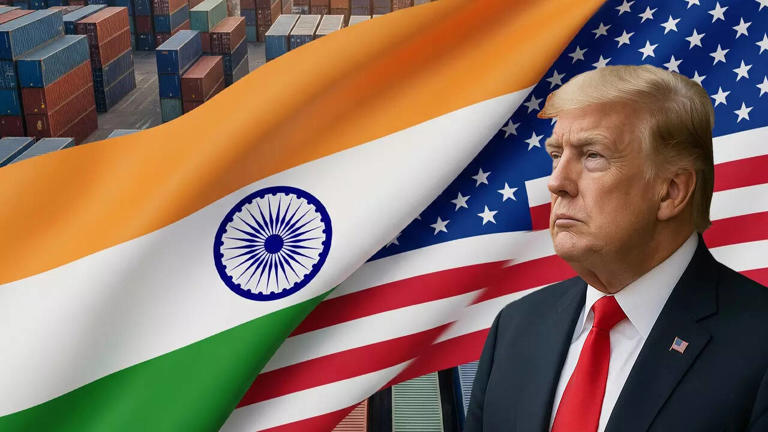
WASHINGTON/NEW DELHI: The United States has imposed sanctions on six Indian companies accused of conducting oil and petrochemical trade with Iran, part of a wider crackdown targeting 20 entities across multiple countries. This action comes just days after former President Donald Trump announced a 25% tariff on Indian imports, escalating trade tensions.
The US State Department on Wednesday said the Indian firms were involved in “significant transactions” with Iran in violation of American sanctions. These include high-value imports of petroleum-based products, despite ongoing restrictions tied to Washington’s “maximum pressure” campaign against Tehran.
Among the sanctioned companies:
- Alchemical Solutions Pvt Ltd is alleged to have imported over $84 million in Iranian petrochemicals between January and December 2024.
- Global Industrial Chemicals Ltd reportedly purchased $51 million worth of methanol and other Iranian products between July 2024 and January 2025.
- Jupiter Dye Chem Pvt Ltd is said to have imported Iranian products, including toluene, valued at $49 million in the same timeframe.
- Ramniklal S Gosalia & Co allegedly procured Iranian petrochemicals worth over $22 million.
- Persistent Petrochem Pvt Ltd reportedly brought in $14 million in methanol imports between October and December 2024.
- Kanchan Polymers is accused of acquiring over $1.3 million in Iranian-origin polyethylene.
Additionally, Tanais Way General Trading LLC, a UAE-based company with Indian links, was also sanctioned for facilitating shipments of Iranian polyethylene to Kanchan Polymers.
The sanctions freeze all US-held assets belonging to these firms and prohibit American entities from conducting any transactions with them. This also extends to any entity with 50% or more ownership by the blacklisted companies.
“These actions are part of a broader strategy targeting Iran’s global oil and petrochemical network,” said the US State Department, alleging that Iran uses revenue from these exports to fund “destabilising activities” and support terrorism in the Middle East.
While India has historically maintained trade ties with Iran, particularly in energy, its oil imports from the country have declined significantly since 2019 following earlier US sanctions.
According to officials, the sanctioned companies can appeal their inclusion on the Specially Designated Nationals (SDN) list maintained by the US Treasury. Appeals may be submitted to the Office of Foreign Assets Control (OFAC), the US stated.
Wider Crackdown Includes Other Nations
In addition to the Indian firms, businesses based in Turkey, the UAE, China, and Indonesia were also targeted. The US alleges these entities play key roles in a global logistics network used by Iran to bypass sanctions and distribute its oil and petrochemicals internationally.
Trade Tensions Deepen as Trump Slaps Tariffs on India
The sanctions come in the wake of another blow to India–US trade ties. Former President Donald Trump recently announced a 25% tariff on Indian imports, effective August 1, as part of his “Liberation Day” trade strategy. The move follows the failure of bilateral trade talks and growing US frustration over India’s import tariffs and procurement of Russian defence and energy supplies.
“India has some of the most strenuous and obnoxious trade barriers in the world,” Trump wrote on Truth Social. “While India is our friend, they continue to purchase a majority of their military equipment and energy from Russia… therefore, INDIA WILL BE PAYING A TARIFF OF 25%, PLUS A PENALTY.”
The details of the additional penalty have not been disclosed.
The new tariff is expected to significantly impact Indian exports to the US, projected at $87 billion in 2024. Key sectors likely to be hit include apparel, pharmaceuticals, gems and jewellery, and petrochemicals. India currently holds a $45.7 billion trade surplus with the US.
India Responds Cautiously
India’s Ministry of Commerce and Industry acknowledged the developments, saying it is “closely studying the implications” of both the sanctions and the new US tariffs. It reiterated the government’s commitment to “a fair, balanced, and mutually beneficial trade agreement.”
A statement from the ministry added, “India will take all necessary steps to safeguard its national interest, including protecting the welfare of our farmers, MSMEs, and entrepreneurs.”
This dual blow—from sanctions and tariffs—poses new challenges for India’s foreign trade policy, particularly as it navigates complex geopolitical alignments with both the US and countries like Iran and Russia.