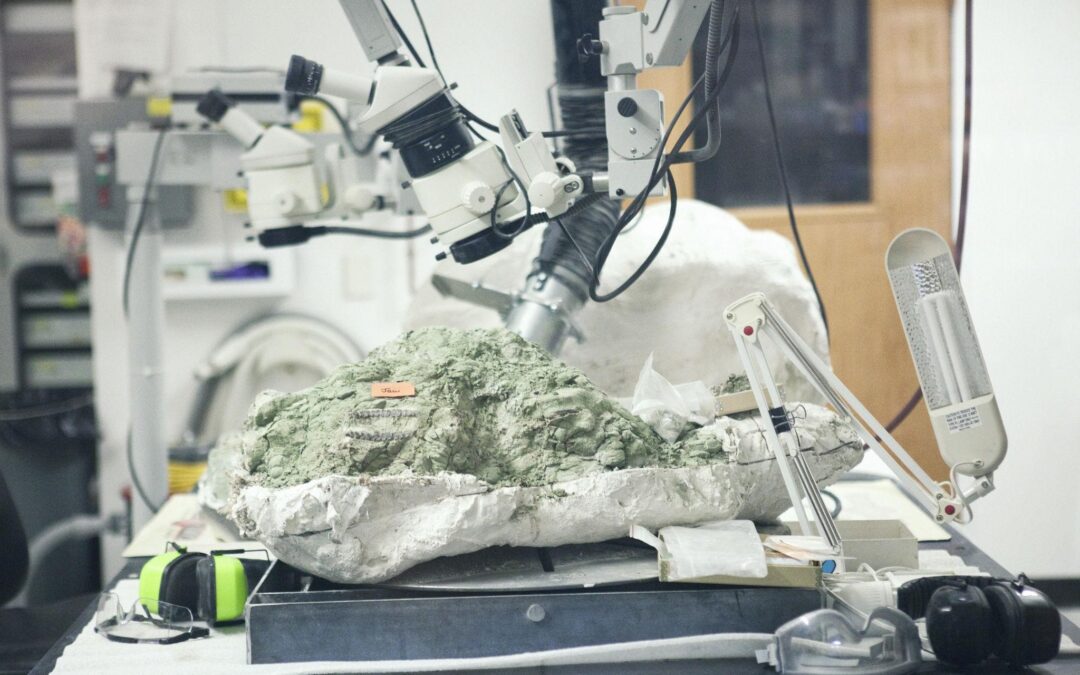
A remarkable scientific discovery of a 150-million-year-old fossil containing preserved soft tissue is offering powerful new support for Theory of Evolution, first proposed by Charles Darwin in his 1859 work On the Origin of Species.
Bridging Darwin’s “Missing Fossil” Gap
Darwin himself acknowledged that the fossil record in his time was incomplete, raising questions about the absence of transitional forms. Rather than weakening his theory, he argued that fossilisation is a rare and selective process, meaning many organisms leave no trace.
This new discovery directly addresses that long-standing gap. The presence of preserved soft tissue—something once thought nearly impossible over such vast timescales—adds a crucial layer of evidence to the evolutionary timeline.
Why Soft Tissue Fossils Matter
Unlike bones or shells, soft tissues like muscles, skin, and cellular structures usually decay quickly after death. Their preservation in a fossil this old is exceptionally rare and scientifically valuable.
Such fossils provide deeper insights into ancient organisms, revealing details about their biology, physiology, and even potential molecular structures—information that skeletal remains alone cannot offer.
How This Strengthens Evolutionary Science
The discovery supports Darwin’s prediction that future evidence would eventually fill gaps in the fossil record. Modern techniques now allow scientists to examine fossils at microscopic and even molecular levels, uncovering data that was unimaginable in Darwin’s time.
By comparing preserved tissues with modern organisms, researchers can better trace evolutionary links and understand how species have changed over millions of years.
A Growing Body of Evidence
Findings like this reinforce the robustness of evolutionary theory more than 150 years after it was first proposed. They also challenge earlier assumptions about fossilisation, showing that biological materials can survive far longer than previously believed.
As scientific tools continue to advance, discoveries like this not only validate Darwin’s ideas but also expand our understanding of life’s history on Earth—turning what was once seen as a limitation of evolution into one of its strongest proofs.