Passing through a tunnel is usually just another part of a road trip. But Norway’s Lærdal Tunnel is anything but ordinary. Stretching 15.2 miles (24.5 km) beneath a dramatic mountain range, it allows drivers to travel for nearly 20 minutes without seeing daylight.
The tunnel connects the towns of Lærdal and Aurland and forms a crucial link between Oslo in the east and Bergen in the west. Each year, thousands of commuters, tourists and freight vehicles rely on it. Beyond its practical importance, the Lærdal Tunnel is celebrated worldwide as an engineering landmark—one designed not just for efficiency, but for the comfort and safety of the people who use it.
A remarkable feat of engineering
Construction of the tunnel took around five years, and it officially opened in November 2000. The project cost 1.08 billion Norwegian kroner (about £80 million at the time). Carved through mountains rising up to 1,400 metres, it remains the longest road tunnel in the world.
Engineers faced a unique challenge: how to ensure that drivers could safely navigate such a long underground stretch without fatigue, disorientation or loss of concentration. Their solution transformed the tunnel into something far more thoughtful than a simple concrete tube.
Designed with drivers in mind
Unlike conventional tunnels, the Lærdal Tunnel includes wider, cavern-like sections at regular intervals. These spaces break the visual monotony of the drive and offer areas where motorists can safely pull over if needed.
This human-centred design reflects a clear understanding of how people experience long, enclosed environments. The result is a tunnel that feels structured, varied and psychologically easier to navigate.
Lighting that reduces fatigue
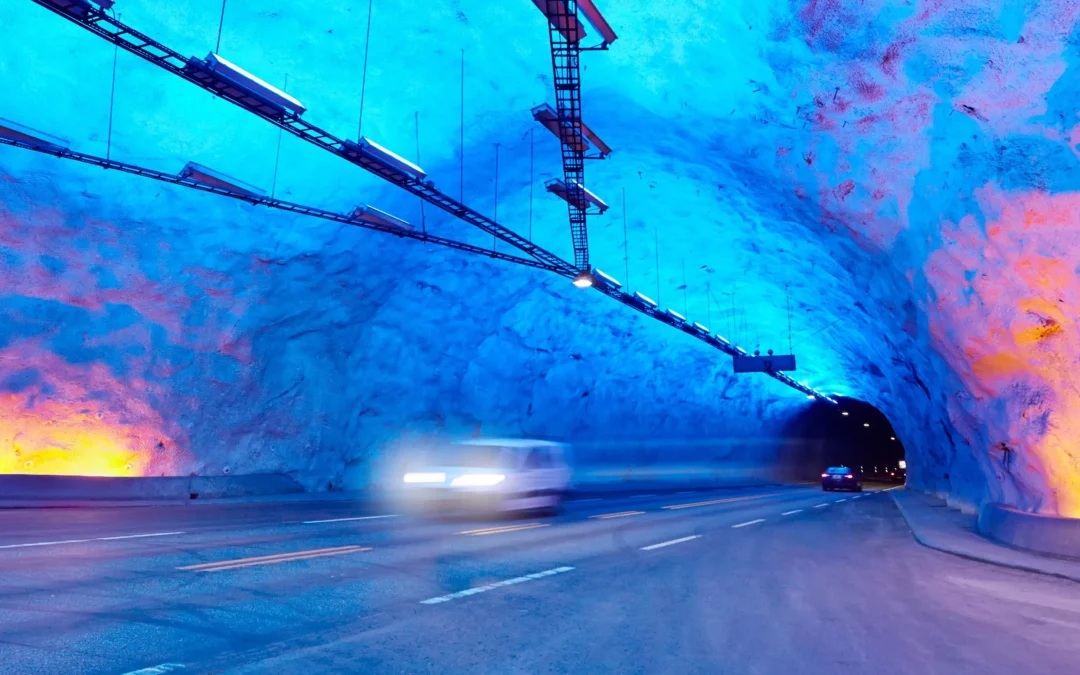
One of the tunnel’s most distinctive features is its innovative lighting system. Instead of harsh white fluorescent lights throughout, the tunnel uses soft blue and warm orange tones in specially designed sections.
These colour shifts help keep drivers alert by changing the visual environment, reducing boredom and fatigue. Some of these illuminated areas are also large enough for vehicles to stop safely, giving drivers a chance to rest before continuing their journey.
Safety built into every kilometre
Safety has been a central priority in the tunnel’s design. It is equipped with:
- A powerful ventilation system to maintain clean air
- 15 surveillance cameras to monitor traffic and incidents
- Automated systems that can close the tunnel quickly in emergencies
- Emergency stations every 500 metres, complete with fire extinguishers, phones and essential equipment
These features make the Lærdal Tunnel not only the longest of its kind, but also one of the safest.
More than infrastructure — a destination in itself
For many visitors, driving through the tunnel feels less like routine travel and more like an experience. Tourists often describe the coloured chambers as beautiful and futuristic, and many are struck by the sheer scale of the structure.
The tunnel itself has become a reason to visit Norway. It stands as a symbol of the country’s commitment to innovation, smart design and people-focused infrastructure—proving that even deep beneath solid rock, engineering can be both practical and inspiring.