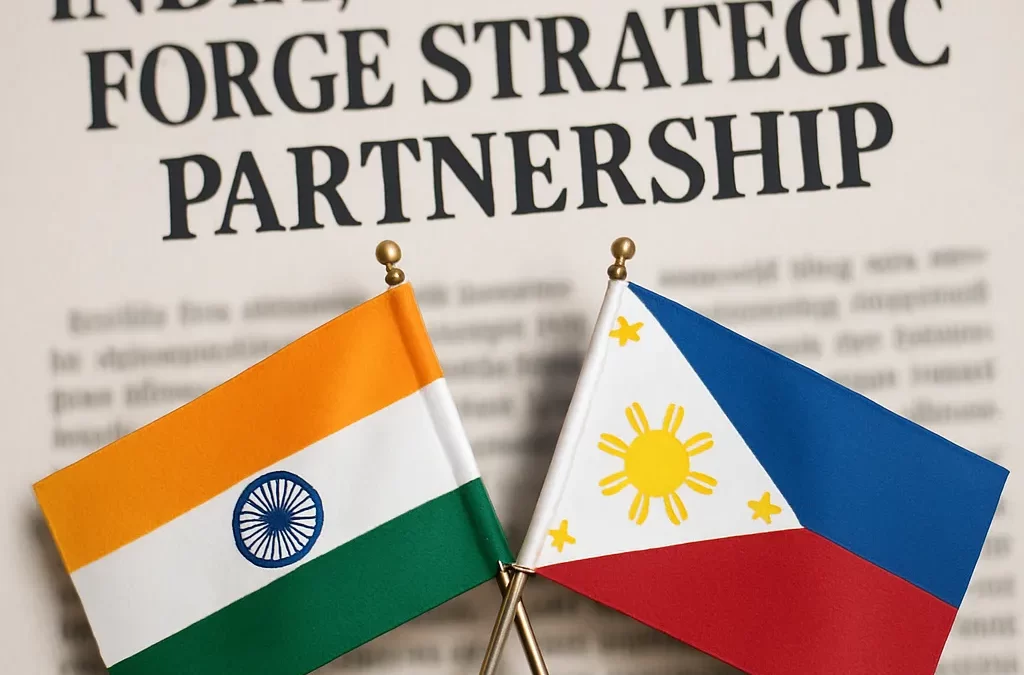
NEW DELHI: In a significant move aimed at deepening defence and maritime cooperation amid rising regional tensions, India and the Philippines on Tuesday upgraded their relationship to a strategic partnership. Prime Minister Narendra Modi hosted President Ferdinand Marcos Jr. in New Delhi for bilateral talks that saw both nations align more closely on security, trade, and regional stability—particularly in the contested South China Sea (SCS).
The two leaders oversaw the signing of 13 agreements and memoranda of understanding, including a landmark Terms of Reference for defence cooperation involving all three branches of the armed forces. Modi reaffirmed India’s commitment to freedom of navigation in the Indo-Pacific in accordance with international law.
The move comes against the backdrop of growing Chinese assertiveness in the SCS. Both India and the Philippines voiced concern over “coercive and aggressive actions” in the region and urged all parties to exercise restraint and resolve disputes through peaceful means.
Reaffirming 2016 Arbitral Award
In a joint statement, the leaders underscored the importance of the 2016 arbitral award on the SCS dispute—an international ruling that rejected China’s sweeping territorial claims in the waters. They called it a “significant milestone” and a legal basis for peaceful dispute resolution under international law. India had previously urged China to comply with the ruling, including through the 2023 Quad joint statement.
Expanding Economic and Legal Ties
Among other key developments:
- Both nations agreed to begin negotiations for a preferential trade agreement (PTA) to boost bilateral trade.
- An agreement on mutual legal assistance in criminal matters was signed.
- A 2025–2029 Plan of Action to implement the new strategic partnership was adopted.
- India announced a gratis e-tourist visa for Filipino nationals for a one-year period.
Maritime Cooperation and Defence Push
Emphasizing shared maritime interests, Modi highlighted that three Indian Navy ships are currently participating in a joint naval exercise in the Philippines—a first for both nations. An Indian hydrography ship is also involved in the initiative.
“As maritime nations, cooperation between us is both natural and necessary,” Modi said, calling India and the Philippines “friends by choice and partners by destiny.”
The Philippines, which has already ordered BrahMos missile systems from India, expressed interest in procuring more defence equipment. Manila’s growing collaboration with India and Japan signals its intent to diversify defence partnerships amid escalating friction with China in the SCS.
For India, supporting the Philippines’ defence capabilities also serves as a strategic counterweight to China, which remains a key arms supplier to Pakistan.
Diplomatic Crosscurrents
President Marcos’ visit coincided with India and the Philippines conducting their first joint patrol in the South China Sea—drawing a sharp response from China’s PLA, which accused the Philippines of “rallying an external country” to interfere in the region, without naming India.
The timing of the visit is also notable, coming just ahead of a likely visit by PM Modi to China later this month for the Shanghai Cooperation Organisation (SCO) summit. Discussions are also reportedly ongoing for a potential visit to India by Chinese Foreign Minister Wang Yi.
President Marcos also extended his strong condemnation of the recent terrorist attack in Pahalgam, a gesture appreciated by PM Modi during their talks.