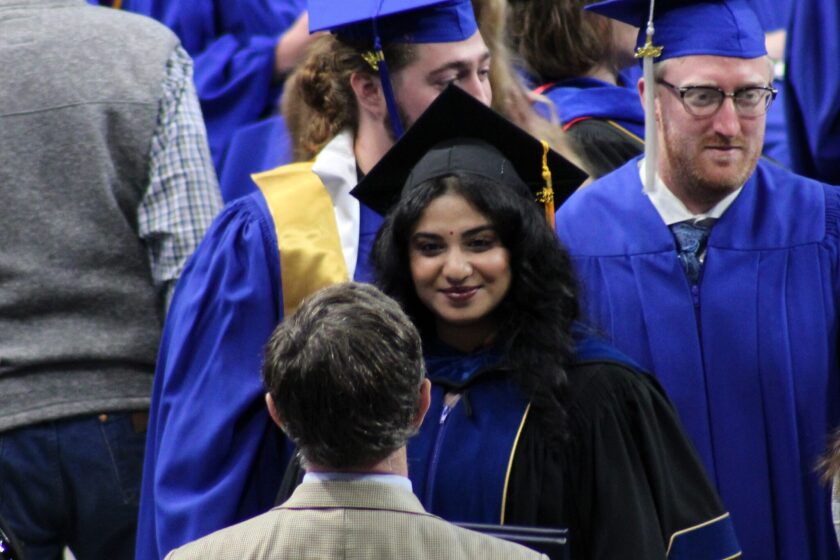
WASHINGTON, D.C. — A U.S. federal court has issued a preliminary injunction protecting Priya Saxena, a 28-year-old Indian student, from deportation after the Department of Homeland Security (DHS) attempted to revoke her visa over a minor traffic infraction.
Saxena, who recently completed her PhD in chemical and biological engineering at the South Dakota School of Mines & Technology, was abruptly notified in April that her F-1 student visa—valid until 2027—had been revoked. She received the alert via email from the U.S. embassy in New Delhi, along with a notice that her SEVIS (Student and Exchange Visitor Information System) record had been terminated, jeopardizing her legal status and her ability to complete her program.
The visa revocation stemmed from a 2021 traffic violation in which Saxena failed to yield to an emergency vehicle. Her attorney, Jim Leach, explained that she had disclosed the incident during her visa application process, and U.S. immigration officials had reissued her visa after reviewing the case. Although she was initially suspected of DUI, charges were dropped following a blood test—information that was known to officials when the visa was granted.
“The government reissued her visa, and then three and a half years later says, ‘Wait a minute—get out of the country,’” Leach told NBC News. “It just makes no sense.”
Saxena challenged the decision, arguing that the DHS violated her due process rights under the Fifth Amendment and the Administrative Procedure Act by revoking her visa without prior notice or a chance to respond. A temporary restraining order was granted to allow her to graduate, and on Thursday, the court extended that protection through a preliminary injunction. This ruling allows Saxena to remain in the U.S. and apply for Optional Practical Training (OPT), a program that permits international students to work after graduation.
Her case could have broader implications, as DHS revealed it had reviewed records of 1.3 million foreign students and had flagged thousands for possible visa revocations. Leach said Saxena’s case is among “dozens and dozens” where international students have successfully contested similar government actions.
The legal battle unfolded against a symbolic backdrop: South Dakota Governor Kristi Noem was receiving an honorary doctorate at Dakota State University at the same time Saxena’s classmates celebrated her graduation. Noem faced protests over her immigration stance, creating what Leach described as “something out of a really far-out novel.”
Although the government argued that Saxena suffered no lasting harm because her visa status had since been restored, the judge ruled otherwise—granting the injunction to prevent further arbitrary actions and affirming the need to safeguard the rights of international students.