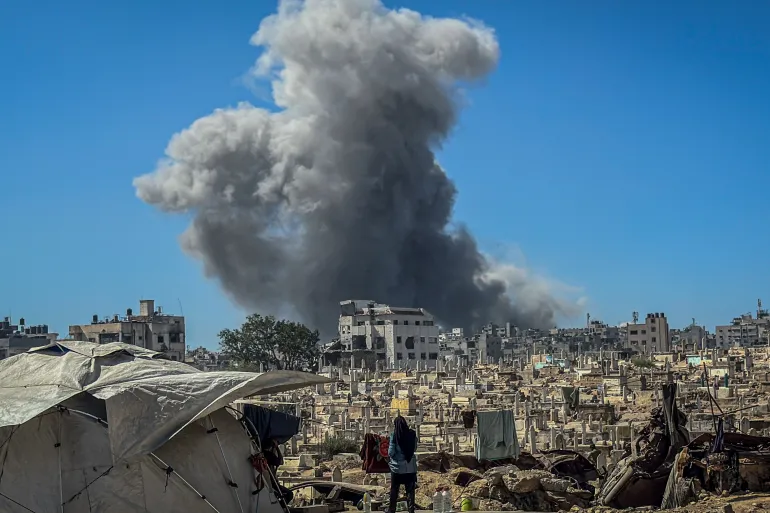
GAZA CITY: Two years after Israel launched a large-scale military campaign in Gaza in response to the October 7, 2023 Hamas attacks, the toll on Palestinian lives, infrastructure, and society has reached staggering proportions.
The conflict began after 251 people were taken hostage during the Hamas-led assault, prompting Israel to impose a siege on Gaza, cutting off electricity, food, fuel, and ordering nearly half of Gaza’s 2 million northern residents to evacuate.
Since then, Gaza has endured waves of airstrikes, ground offensives, and blockades. At the height of the siege, between March and May 2025, Israel imposed a full blockade over concerns that Hamas was diverting humanitarian aid for military use. Although some restrictions were eased following international pressure, by August, parts of Gaza were officially declared to be facing famine.
According to the United Nations, the war has set Gaza’s development back by almost seven decades.
Human Cost of the War
Israeli military operations have resulted in the deaths of more than 67,000 Palestinians, according to health officials and humanitarian organizations. The vast majority are civilians, including at least 20,000 children — approximately 2% of Gaza’s child population.
An additional 168,000 people have been injured, many with life-altering wounds typically seen in high-intensity warzones.
Beyond direct violence, Palestinians have died from hunger, disease, exposure, and a collapsed healthcare system. A study published in The Lancet suggests that life expectancy in Gaza may have dropped by up to 50% during the first year of the war.
On the Israeli side, the conflict has claimed the lives of 466 soldiers and wounded nearly 3,000. About 1,200 people, including over 700 civilians, were killed in the October 7 attacks, and 251 hostages were taken into Gaza.
Accusations of Genocide and War Crimes
Israel’s actions in Gaza have drawn international scrutiny and accusations of genocide, which Israel has strongly denied.
In September 2025, independent UN human rights experts concluded that the scale of death and destruction in Gaza could meet the legal definition of genocide. Israel rejected the claims, with Prime Minister Benjamin Netanyahu dismissing related famine warnings as “outright lies,” according to Reuters.
Famine and Aid Crisis
The UN has confirmed that famine is underway in parts of Gaza, with over 400 reported deaths from malnutrition, including 101 children, mostly in recent months. Aid agencies say that tens of thousands of children are now reliant on emergency feeding programs.
According to humanitarian groups, most pregnant women in Gaza were surviving on just one meal a day by October. The Gaza Ministry of Health reports that since famine was officially declared, at least 177 people, including 36 children, have died of starvation or related causes.
Mass Displacement and Destruction
Roughly 95% of Gaza’s population — around 2.1 million people — have been displaced during the war, often multiple times. The Israeli military currently designates more than 80% of Gaza as evacuation zones, active combat areas, or otherwise inaccessible.
A recent Israeli offensive into Gaza City, where many displaced people had sought shelter, forced hundreds of thousands to flee once again. “This is a traumatic, violent process, often repeated again and again,” said James Elder, spokesperson for UNICEF. “There are people who have lost absolutely everything.”
In addition, access to clean water has sharply declined: about 1 million people have less than six liters of drinking water per day, while 500,000 people survive on under nine liters — a fraction of the pre-war standard.
The war has also inflicted widespread damage on Gaza’s cultural heritage, with historic mosques, markets, and churches either heavily damaged or destroyed.
As the conflict enters its third year, humanitarian organizations continue to sound the alarm over the deepening crisis, calling for urgent ceasefire efforts, unrestricted aid access, and renewed diplomatic engagement to prevent further loss of life and suffering.