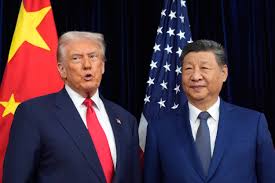
President Donald Trump appeared to imply that the United States may recommence nuclear weapons testing for the first time in thirty years, stating it would occur on an “equal basis” with Russia and China.
The Kremlin noted that a worldwide prohibition on nuclear tests remains in effect, but cautioned that should any nation resume nuclear testing, Russia would respond in kind.
There was no indication that the United States would initiate the detonation of warheads, yet Trump provided scant details regarding what appeared to be a considerable alteration in U.S. policy.
He made this announcement on social media just minutes before his meeting with Chinese leader Xi Jinping on Thursday in South Korea to discuss trade matters. He offered little clarification when addressing reporters later aboard Air Force One as he returned to Washington.
The U.S. military routinely tests its missiles capable of delivering a nuclear warhead; however, it has not detonated such weapons since 1992. The Comprehensive Nuclear Test Ban Treaty, which the U.S. signed but did not ratify, has been adhered to by all nations possessing nuclear arms, with North Korea being the sole exception.
Nevertheless, Trump suggested that modifications were essential due to other nations conducting weapons tests. It was ambiguous what he was alluding to, but it conjured memories of Cold War-era tensions.
“Due to the testing programs of other countries, I have directed the Department of War to commence testing our Nuclear Weapons on an equal basis,” he stated in a post on his Truth Social platform. “That process will begin immediately.”
The Kremlin has issued a warning that Russia will reciprocate if nuclear tests are resumed.
In response to inquiries regarding Trump’s remarks, Kremlin spokesman Dmitry Peskov reiterated a previous caution from Russian President Vladimir Putin, who indicated that Moscow would recommence nuclear tests should other nations initiate them first.
“If someone abandons the moratorium, Russia will act accordingly,” Peskov stated during a call with journalists.
The White House did not provide an immediate response to requests for further information.
When Trump addressed reporters subsequently, he seemed to confuse the testing of missiles capable of delivering a nuclear warhead with the testing of the warheads themselves.
He remarked that other nations, “appear to be engaging in nuclear testing,” but asserted that regarding the U.S., “We possess more nuclear weapons than anyone else. We do not conduct testing.”
“I observe them testing and I think, well, if they are going to test, I suppose we must test as well,” Trump commented while continuing his dialogue with reporters.
When asked about the locations of the tests, he replied, “It will be announced. We have test sites.”
Pentagon officials did not immediately address inquiries concerning Trump’s announcement regarding nuclear missile tests.
Vice Admiral Richard Correll, who has been nominated by Trump to oversee the military command responsible for the nation’s nuclear arsenal, was questioned by U.S. senators during his confirmation hearing on Thursday to clarify the president’s statements.
“I would not assume that the president’s remarks indicated nuclear testing,” Correll stated.
“Well, that is what he articulated,” remarked Sen. Mazie Hirono, D-Hawaii.
Correll noted that neither China nor Russia has performed a nuclear explosive test, but added, “I am not interpreting anything into it or taking anything out of it.”
Independent Sen. Angus King of Maine later inquired whether Trump might have been referring to the testing of weapons delivery systems, such as missiles, rather than the weapons themselves.
“I do not possess insight into the president’s intentions,” Correll responded. “I concur that this could be a possible interpretation.”
U.N. Secretary-General Antonio Guterres criticized Trump’s announcement on Thursday, stating in a declaration that “the current nuclear risks are alarmingly high already.”
“We must always remember the catastrophic legacy of over 2,000 nuclear weapons tests conducted in the past 80 years,” Guterres remarked, as reported by his deputy spokesperson, Farhan Haqq.
Russia’s tests of new nuclear-powered weapons
This week, Putin revealed that Russia has tested a new atomic-powered and nuclear-capable underwater drone, along with a new nuclear-powered cruise missile. However, Putin did not disclose any tests of Russia’s nuclear weapons, the last of which occurred in 1990.
Peskov, the Kremlin spokesperson, stressed that Russia’s recent tests of the Burevestnik nuclear-powered cruise missile and the Poseidon nuclear-powered underwater drone were unrelated to the global ban on nuclear warhead testing.
“Concerning the tests of the Burevestnik and the Poseidon, we trust that President Trump was accurately informed about this,” Peskov stated. “It cannot be interpreted as nuclear testing in any way.”
Although Trump did not specifically reference the Russian tests in his statement, he hinted at the nuclear arsenals managed by both Xi and Putin, asserting, “Russia is second, and China is a distant third, but will be even closer within five years.”
In 2023, Putin enacted a law that revoked Russia’s ratification of a global nuclear test ban, which Moscow claimed was necessary to align Russia with the U.S. The global test ban was signed by President Bill Clinton but was never ratified by the Senate.
Earlier this year, Trump indicated his desire to encourage his Russian and Chinese counterparts to move in the opposite direction, expressing his intention to resume nuclear arms control discussions with both nations.
A spokesperson from the Chinese Foreign Ministry urged the U.S. to abstain from conducting nuclear tests.
“China hopes the U.S. will sincerely fulfill its obligations under the Comprehensive Nuclear Test Ban Treaty and uphold its commitment to halt nuclear testing,” Guo Jiakun stated during a briefing.
Despite his announcement, which appeared to indicate an escalation, Trump informed reporters of his desire for both “denuclearization” and “de-escalation.”
“We are indeed in discussions with Russia regarding this matter,” Trump stated, although he did not provide further details.
Concerns were raised by arms control advocates.
Daryl Kimball, the executive director of the Arms Control Association based in Washington, promptly criticized the president’s statement, asserting that Trump was “misinformed and disconnected from reality.”
In his social media comments, Kimball noted that the U.S. has no justification for resuming nuclear explosive testing and that it would require a minimum of 36 months to restart testing at the previous test site in Nevada, where the last underground detonations took place.