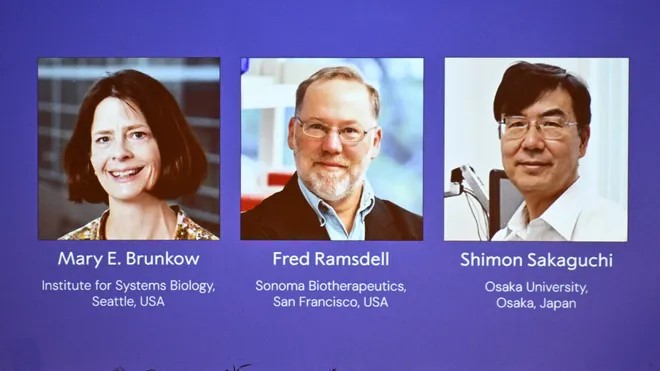
STOCKHOLM: Three scientists — Mary Brunkow and Fred Ramsdell of the United States, and Shimon Sakaguchi of Japan — have been awarded the 2025 Nobel Prize in Medicine for their groundbreaking work that revealed how the immune system distinguishes between harmful invaders and the body’s own healthy cells.
Their pioneering research led to the discovery of regulatory T cells (Tregs) — described by the Nobel committee as “the immune system’s security guards” — which prevent the immune system from attacking the body’s own tissues. The findings opened up new possibilities for developing treatments for cancer, autoimmune disorders, and transplant-related complications.
The award recognizes discoveries in peripheral immune tolerance, a mechanism that keeps immune responses in check. “This work explains how we can fight infections without turning our immune system against ourselves,” said Marie Wahren-Herlenius, professor at Sweden’s Karolinska Institute, whose Nobel panel selects the laureates.
According to the committee, more than 200 clinical trials are currently exploring therapies based on this research, though none have yet reached the market. “The hope is to treat or even cure autoimmune diseases, create more effective cancer treatments, and prevent serious post-transplant complications,” the Nobel jury said.
‘Cancer will no longer be scary, but curable’: Sakaguchi
Speaking at a press conference in Japan, Professor Shimon Sakaguchi of Osaka University said he hoped the recognition would “help the field advance further toward real-world clinical applications.”
Japanese Prime Minister Shigeru Ishiba personally congratulated him over the phone, asking about the future of cancer immunotherapy. “I believe the time will come when cancer is no longer a scary disease, but a curable one,” Sakaguchi replied.
Laureates caught by surprise
The Nobel committee said it had been unable to reach the two US-based winners at the time of the announcement.
Mary Brunkow, currently a senior program manager at the Institute for Systems Biology in Seattle, told the Nobel Foundation she was asleep when the call came. “My career in science has changed quite a bit since that work was done, and I don’t actually even work in that particular field anymore,” she said. “It’s an honor to have been a part of that.”
Fred Ramsdell, scientific adviser at Sonoma Biotherapeutics in San Francisco, had not yet been contacted hours after the official announcement.
The trio’s discoveries have not only deepened the world’s understanding of immune regulation but also paved the way for therapies that could transform modern medicine — bringing humanity closer to a future where autoimmune diseases are treatable and cancer is curable.