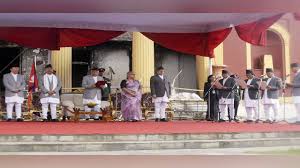
KATHMANDU: Nepal’s President Ram Chandra Paudel administered the oath of office to four new ministers in the interim government led by Prime Minister Sushila Karki at Shital Niwas, Kathmandu.
This action increases the total number of ministers in Karki’s cabinet to eight. On the same day, Interim Prime Minister Sushila Karki reshuffled the ministerial portfolios, redistributing responsibilities among the members while introducing four new ministers.
The four newly appointed ministers took their oaths, following the cabinet nominations made by Interim Prime Minister Sushila Karki.
Former Supreme Court Justice Anil Kumar Sinha has been designated as the Minister for Industry and Law; innovator Mahabir Pun will lead the Ministry of Education, Science, and Technology; Madan Pariyar has assumed the role of Minister for Agriculture; and journalist Jagdish Kharel will head the Ministry of Communication and Information Technology.
Sangita Mishra, who was initially proposed for the Health Ministry, was not included in the swearing-in ceremony. Her exclusion arises amid controversy surrounding her prior tenure as a government official. Mishra had resigned from the civil service in anticipation of her appointment.
According to the announcement from the Office of the President, the decision also impacts Finance Minister Rameshwor Khanal and Home Minister Om Prakash Aryal, both of whom were appointed earlier. Khanal, who was already managing the Finance Ministry, has now been assigned the additional responsibility of the Ministry of Federal Affairs and General Administration.
Aryal, on the other hand, has been relieved of his duties as Law Minister and will now focus solely on the Home Ministry. The Law Ministry portfolio has been transferred to Anil Kumar Sinha, who was appointed to the cabinet.
With these changes, the cabinet now comprises eight members. Among them, Kulman Ghising and Sinha each oversee three ministries, while Khanal manages two.
Interim Prime Minister Karki appointed Madan Pariyar (Agriculture), Mahabir Pun (Education), and Jagdish Kharel (Communication), each overseeing a single ministry. The other ministries remain under the direct control of Prime Minister Karki herself.
Tensions escalated in Nepal after police fatally shot 21 students and young protesters while they were demonstrating in front of the parliament during the anti-corruption movement and the conclusion of the social media ban. The next day, 39 individuals lost their lives, with 15 succumbing to burns. The remaining 12 fatalities were reported by the seventh day following the outbreak of violence.
Prime Minister Sushila Karki, who is Nepal’s first female Prime Minister, was appointed on September 12 after Gen-Z protests resulted in the dissolution of the previous government. This interim administration is responsible for organizing the House of Representatives elections scheduled for March 5, 2026.