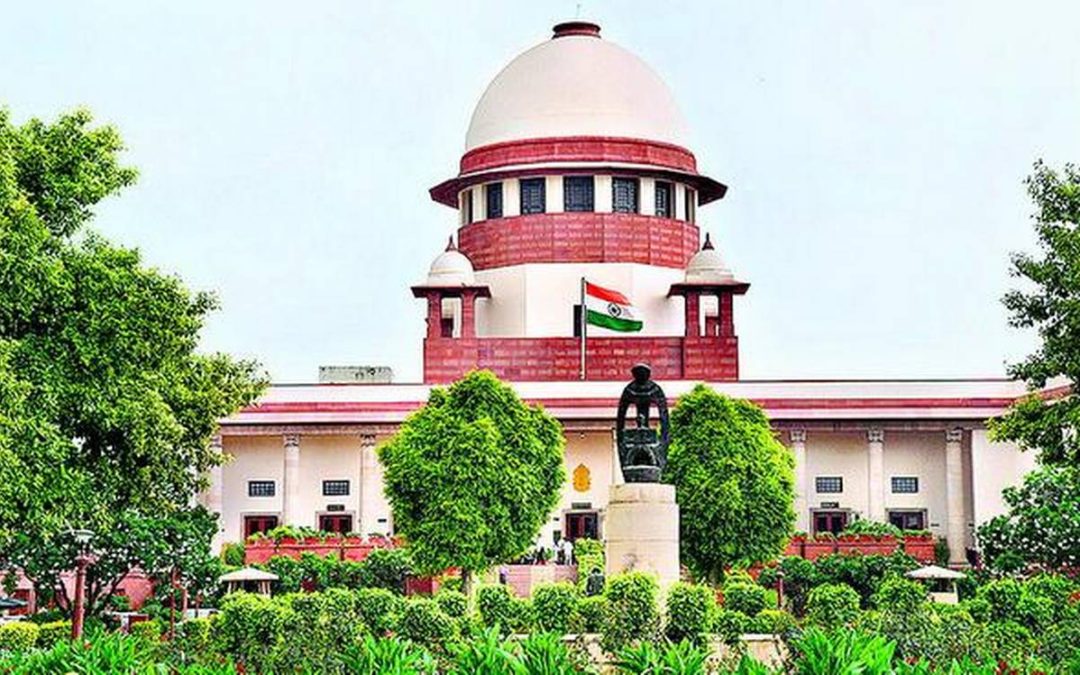
NEW DELHI: In a strong rebuke to the misuse of stringent laws, the Supreme Court has cautioned governments against invoking statutes like the Uttar Pradesh Gangsters and Anti-Social Activities (Prevention) Act as tools of harassment or political intimidation. The court quashed an FIR filed under the Act against individuals involved in a protest following a communal flare-up triggered by a provocative social media post targeting a religious group, reports Amit Anand Choudhary.
The bench, comprising Justices Vikram Nath and Sandeep Mehta, said the accused were already arrested under various Indian Penal Code (IPC) sections for allegedly vandalising a shop owned by the person responsible for the inflammatory post. Yet, a second FIR under the Gangsters Act was filed six months later — shortly after the daughter-in-law of one of the accused, Lal Mohammad, submitted her nomination for the post of Nagar Panchayat chairperson in Khargupur, Uttar Pradesh.
“This timing lends credence to the claim that the Act was used for extraneous considerations,” the court observed.
In its judgment, the bench made it clear that the Gangsters Act was designed to tackle organized, gang-based criminal activity, not isolated incidents of protest or communal violence. “Invoking such a stringent law on the basis of a single incident of unrest represents a significant departure from its intended legislative purpose,” the court stated.
Justice Mehta, who authored the ruling, emphasized the importance of safeguarding personal liberty, particularly when extraordinary laws that override standard legal protections are involved. “While the state enjoys broad discretion in criminal prosecution, this power must be exercised judiciously, guided by statutory purpose, and grounded in credible evidence—not wielded as a means of intimidation or political reprisal,” he said.
He further underlined that harsh legal provisions that restrict liberty must be backed by solid evidence, not vague claims. “Extraordinary penal statutes, especially those that dilute procedural safeguards, must be invoked only when there is clear, credible, and substantial evidence linking the accused to organised criminal activity. Mere theoretical possibilities or speculative associations do not suffice.”
The court’s ruling reinforces the principle that legal tools created to address serious threats to public safety cannot be repurposed to suppress dissent or settle political scores.