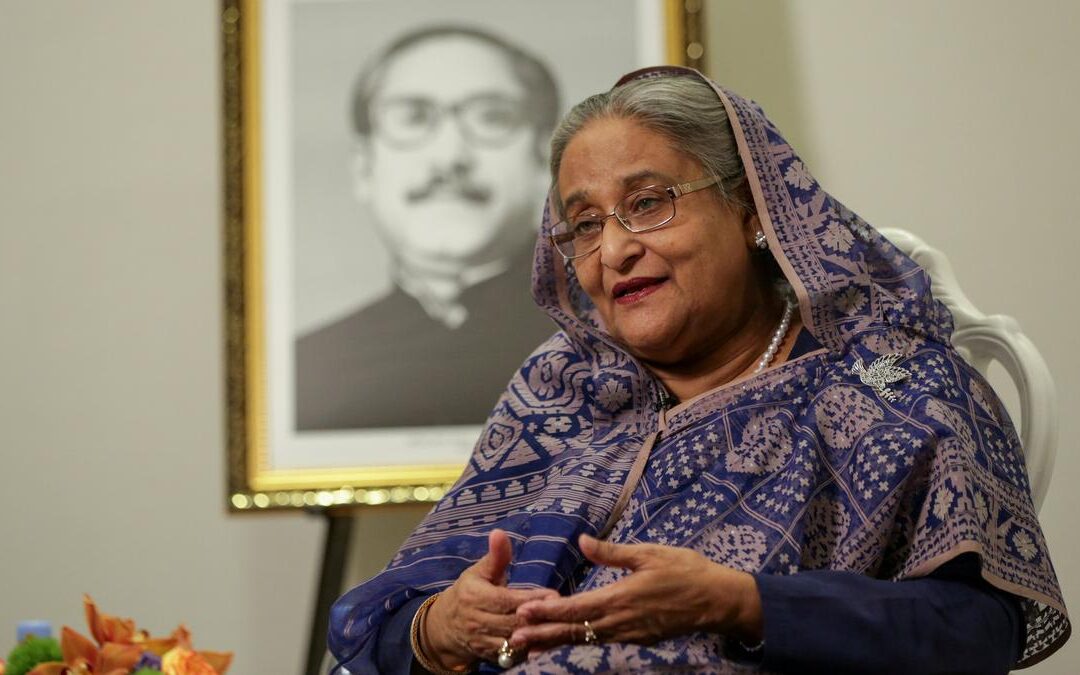
Former Prime Minister Sheikh Hasina describes India as Bangladesh’s most significant ally, urging the Indian government to encourage Dhaka to uphold democratic principles and avoid disenfranchising millions of Bangladeshis.
Hasina has been in India since her removal from power in August of the previous year, and her political future may hinge on a verdict from a special tribunal regarding the alleged crimes against humanity she faces, which is expected on Monday. The decision from Bangladesh’s International Crimes Tribunal (ICT) could also determine whether the ban on her party, the Awami League, will remain in effect, thus preventing it from participating in the elections scheduled for February.
The ousted Prime Minister asserted that the ICT is influenced by her political opponents, who, she claims, are attempting to undermine the Awami League and divert attention from their own governance failures. “India is our nation’s most crucial ally and would naturally prefer to engage with a Dhaka regime that has been legitimized through a popular vote. Therefore, I urge our friends in India to persist in their calls for Yunus (the chief adviser) and his associates to honor democratic norms and refrain from disenfranchising millions of Bangladeshis,” Hasina stated in a written response to a query from TOI last week.
While striving to avoid an overbearing stance, India has advocated for the forthcoming elections to be conducted in a free, fair, and inclusive manner. The election commission previously revoked the registration of the Awami League, preventing it from contesting in the elections.
“An election cannot be considered free or fair when millions of citizens are deprived of their right to vote, and when every Bangladeshi is stripped of their choice. Yunus must permit the involvement of all political parties, ensuring that the winner in February has the consent and trust of the populace,” Hasina stated, noting the irony that the only party that facilitated free elections is currently excluded from participation. Hasina asserted that in a fair and unbiased judicial setting, such as the International Criminal Court in The Hague, she would find it easy to contest the “so-called” evidence against her. “I unequivocally deny all allegations made against me. No credible evidence has been provided at the so-called International Crimes Tribunal, as none exists. The audio recordings and fragments of transcripts submitted to the Tribunal were taken out of context and do not substantiate anything,” she remarked. Hasina further accused Yunus of appointing radical extremists to high-ranking positions within his government and of implicitly endorsing sectarianism and the oppression of women’s rights. “Local human rights organizations estimate that more than 2,400 incidents of violence against religious and ethnic minorities have been documented during Yunus’ administration. He has overseen and even denied the numerous recorded assaults against religious minorities,” Hasina stated, adding that Yunus is either incapable or unwilling to safeguard ordinary Bangladeshis who fear leaving their homes. Regarding Dhaka’s attempts to mend relations with Pakistan, she commented that amid the turmoil on the domestic front, it is difficult to envision that the interim government is pursuing a coherent international strategy.”
“It is evident that Bangladesh ought to maintain a stable relationship with Pakistan; however, I am concerned about the antagonism that Yunus’s administration is displaying towards India,” stated Hasina.