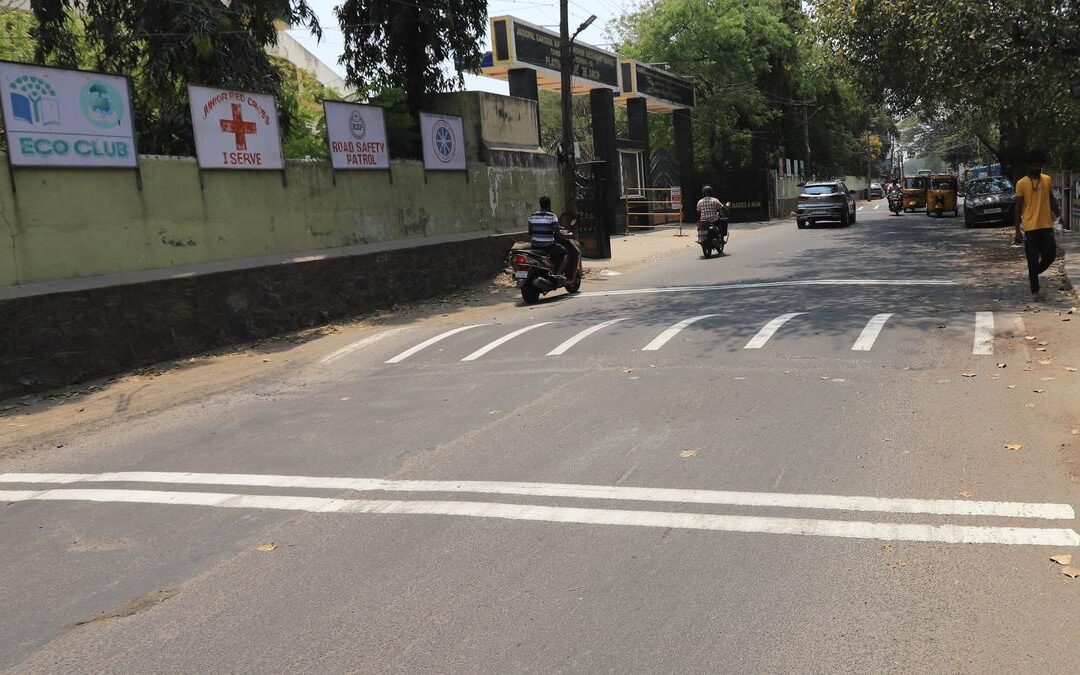
Chennai: A 61-year-old hospital worker, Ranganayaki, died on September 10 after an MTC bus hit her from behind on the Grand Southern Trunk (GST) Road while she was walking towards the Chromepet bus stand. With no designated pedestrian space and footpaths encroached by shops, she had been forced to walk along the busy arterial stretch.
Her death is part of a growing pattern. Official data shows that 130 pedestrians have been killed and 280 injured this year in Tambaram after being struck by speeding vehicles. Police and transport planners say vehicle speeds remain dangerously high on peripheral corridors even as average speeds inside Chennai’s core have dropped below 13 kmph. Wider roads such as GST Road, the 200-Feet Radial Road, OMR and ECR often see vehicles touching 80–100 kmph during late nights and early mornings.
“Pedestrian crossings are unmarked on many stretches managed by state or national highway agencies, and several junctions suffer from long periods of non-functional streetlights,” said urban planner R. Naveen. On the 14-km 200-Feet Radial Road that links the IT corridor with the airport, two-wheeler riders say dust kicked up by trucks and buses on the left lane often reduces visibility.
Residents say they have repeatedly raised concerns. “There are eateries, shops and at least 10 marriage halls along this stretch. Though they built parking lots, they rent them out to other businesses and occupy service roads and pavements instead,” said Pallavaram resident David Manohar. Chromepet resident V. Santhanam added that the state highways department frequently shifts responsibility to the Tambaram Corporation when residents complain.
Conditions are similar on stretches under the National Highways Authority of India. “Several streetlights on the Chennai–Trichy highway have remained non-functional for more than two years. Despite deaths and injuries after 6 pm, NHAI has not acted,” said G. Ganesh, who led a protest last Saturday.
According to official data, Tambaram Corporation—which manages 530 roads—has provided marked pedestrian spaces and vending zones on only about 50 of them. Commissioner S. Balachander said all 530 roads are being upgraded under the Tamil Nadu Urban Road Infrastructure Project at a cost of ₹52.16 crore, with 293 roads completed so far. However, the project includes no provision for pavements. The corporation has separately proposed a ₹12-crore plan to build smart roads in Selaiyur, Camp Road, Rajaji Road and Hasthinapuram, which will include pavements, underground cabling and relaid surfaces.
Tambaram City Traffic Police said they have intensified enforcement this year, booking nearly 48,000 cases for riding without helmets, 5,000 for drunk driving and more than 4,000 for wrong-side driving (January–June 2025). To improve emergency response, 26 motorcycle-mounted traffic marshals have been deployed on GST Road, OMR, ECR and the 200-Feet Radial Road to remove stalled vehicles, manage peak-hour congestion and reach crash sites faster.
To curb overspeeding, Tambaram Police have installed 100 barricades across key stretches, including 16 major junctions, arranged in zig-zag patterns to force vehicles to slow down. Despite these measures, officials say pedestrian safety remains a major challenge on GST Road, which continues to lack proper medians, adequate street lighting and continuous footpaths—many of which are encroached by vendors or blocked by EB infrastructure.
“To ensure pedestrian safety, we have installed specialised pedestrian signals and clearly marked crossings,” said Samai Singh Meena, Deputy Commissioner of Police, Traffic, Tambaram. He added that the barricades and new pedestrian-friendly measures form part of a broader effort to reduce accidents and streamline movement along one of the region’s busiest corridors.