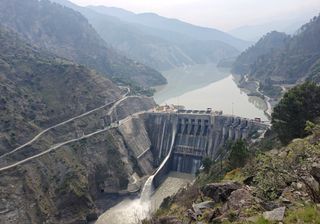
NEW DELHI: Pakistan is facing a looming crisis in its summer (kharif) crop season, with dwindling water reserves at its key dams—Mangla on the Jhelum and Tarbela on the Indus—and a sudden drop in Chenab river inflows attributed to India’s regulation of water flow. The situation has worsened in the wake of the Pahalgam terror attack, after which India suspended provisions of the Indus Waters Treaty (IWT).
The crisis is expected to deepen in June, just as early kharif sowing begins. In a bid to spotlight the issue globally, Pakistani Prime Minister Shehbaz Sharif raised concerns over India’s actions at a glacier preservation conference in Dushanbe, Tajikistan last week.
According to Pakistan’s Indus River System Authority (IRSA), the country is grappling with a 21% shortfall in overall water availability and nearly 50% depletion in live storage at Mangla and Tarbela dams—key sources of irrigation water for Punjab and Sindh and essential for hydropower generation.
In its recent update, IRSA warned that the “sudden decrease in river Chenab inflows at Marala due to short supply by India” would severely impact early kharif season sowing operations. While monsoon rains in the catchment areas could provide relief by July, much will depend on how India manages water flows from its limited reservoir infrastructure, including the Baglihar and Salal dams in Jammu and Kashmir.
So far, India has only released water by flushing these reservoirs and clearing sediment buildup. It has also halted the sharing of real-time water flow data with Pakistan—an obligation under the now-suspended 1960 Indus Waters Treaty.
Current figures show Mangla dam holding just 2.7 million acre-feet (MAF) of water—less than half of its 5.9 MAF capacity. Tarbela is slightly better, with about 6 MAF in live storage out of a total capacity of 11.6 MAF.
Officials in India argue that, with the treaty in abeyance, New Delhi is no longer obliged to share water data with Islamabad, which could pose challenges for Pakistan in managing potential floods during peak monsoon flow—especially since much of the Indus river system’s catchment lies within Indian territory.
Agricultural activities in Pakistan’s Punjab and Sindh provinces are almost entirely dependent on the Indus river system, which draws water from the western rivers—Indus, Jhelum, and Chenab. Under the Indus Waters Treaty, India retains full rights over the eastern rivers—Ravi, Beas, and Sutlej—but has limited infrastructure to use that water, inadvertently benefiting Pakistan.
Although India is permitted to build water storage facilities of up to 3.6 MAF on the western rivers, it has yet to fully utilize this allowance, leaving Pakistan as an unintended beneficiary—until now.