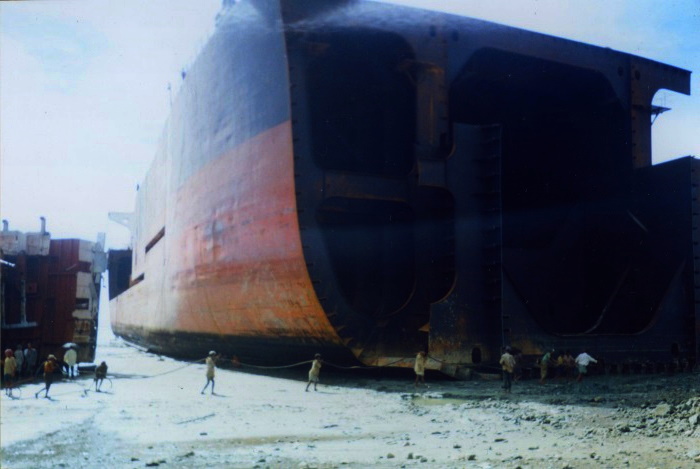
The Basel Action Network (BAN) and the NGO Shipbreaking Platform today condemned Matson Shipping Lines for proceeding with the export of its former U.S.-flagged vessel MOKIHANA for scrapping at the notorious shipbreaking beaches of Alang, India. This last voyage is a blatant reversal of Matson’s policy established together with BAN and the NGO Shipbreaking Platform in 2015 (1) to avoid beach-based ship dismantling, and represents a serious affront to the company’s stated ESG commitments.
The vessel has now been reflagged to St. Kitts and Nevis, a flag of convenience commonly used for end-of-life ships headed for scrapping, and renamed MOKHIA. According to publicly available vessel tracking data, the ship is listed as en route to Bhavnagar, India, the port serving the Alang shipbreaking yards.
As of 2 February 2026 at 14:42 UTC, the vessel was reported to be operating under its own power in the Pacific Ocean, at approximately 23.98° N latitude and 149.61° E longitude, with an estimated arrival in Bhavnagar on 25 February 2026.
“This sequence of actions – reflagging, renaming, and dispatching the vessel to the Alang region – is a regrettable retreat from corporate responsibility and appropriate end-of-life ship management policy,” said Jim Puckett, Founder and Chief of Strategic Direction at BAN. “It directly contradicts Matson’s prior public commitments to avoid beach-based shipbreaking and is a violation of the Basel Convention, calling into question the credibility of Matson’s ESG commitments.”
In 2015, Matson publicly committed to ending the use of South Asian tidal beaches for shipbreaking, following international criticism of the environmental and human-health impacts of the practice. The decision to send MOKHIA to Bhavnagar marks a clear policy reversal, returning to the very practices Matson once pledged to abandon.
In a letter to BAN and the NGO Platform, Ms. Rachel Lee, the company’s Vice President of Sustainability and Governance, cited exporting to a beaching facility that supposedly adheres to the Hong Kong Convention as a rationalization for the export. However, in India no shipbreaking yards have so far been authorized under the Hong Kong Convention. Moreover, the Hong Kong Convention does not regulate transboundary waste movements, a gap long criticized by environmental and labor organizations, while the Basel Convention explicitly governs such exports and forbids trade between Parties like India and non-Parties like the United States. Under the Basel Convention, end-of-life vessels containing any forms of hazardous materials are considered hazardous waste, and their export is strictly controlled and in this case, prohibited.
“Beaching remains the most dangerous and polluting form of ship disposal in the world,” said Ingvild Jenssen, Founder and Executive Director of the NGO Shipbreaking Platform from Brussels. “But companies continue to make use of the beaching yards because this practice offers significantly lower costs than safe, contained recycling alternatives, often through the exploitation of desperate and vulnerable labor forces (2). Changing the name of the ship and its flag does not change the environmental reality on the ground, or the lack of corporate responsibility for sending it there.”
BAN and the NGO Shipbreaking Platform emphasize that the dismantling of end-of-life ships on tidal mudflats externalizes toxic risks onto workers and coastal communities, exposing them to hazardous substances such as asbestos, heavy metals and oil residues, and undermines global efforts to promote safe, contained, and truly sustainable ship recycling.
“This is not responsible recycling,” Puckett added. “It is a retreat from leadership, and a direct contradiction of Matson’s own ESG narrative.”
The organizations are calling on regulators, investors, and customers to scrutinize Matson’s actions closely and to demand that the company immediately recommit to abiding by the Basel Convention, as well as to only utilize off-the-beach, fully contained ship recycling methods, and protecting the human rights of the world’s most vulnerable laborers.
Source: NGO Shipbreaking Platform