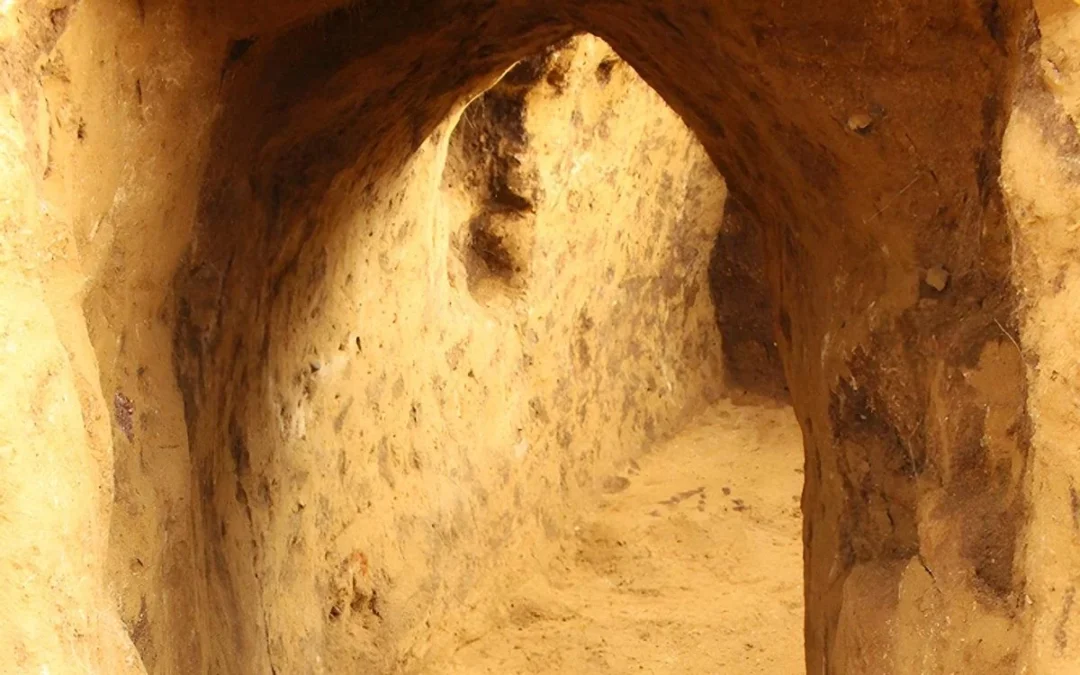
Archaeologists working in Saxony-Anhalt have uncovered a rare underground tunnel inside a prehistoric burial site near the village of Reinstedt in Harz district. The discovery was made during routine excavations carried out ahead of a planned wind energy project.
The site, long known for its Neolithic and Bronze Age remains, initially appeared to contain only a simple pit. However, as excavation progressed, researchers realised the feature belonged to a much later period, most likely the late Middle Ages. Its presence within a burial landscape dating back nearly 6,000 years has drawn attention to how later communities reused ancient spaces.
A Landscape Shaped Over Millennia
The area is dominated by a large trapezoid-shaped ditch linked to the Baalberg culture from the fourth millennium BC. Nearby, archaeologists had previously identified poorly preserved burials from the third millennium BC and traces of a possible Bronze Age burial mound dating to around the second millennium BC. Over thousands of years, the site was repeatedly used, altered and reshaped.
A Pit That Was Not a Grave
During work on the southern section of the Neolithic ditch, researchers noticed a long, oval-shaped pit cutting across it at a near right angle. At first, it resembled a grave. But unlike a typical burial, it continued deeper into the loess soil without ending. Its fill contained late medieval pottery, loose stones and small hollow spaces, suggesting a different function.
An Erdstall Tunnel from the Middle Ages
Further excavation revealed the structure to be an Erdstall—a narrow, hand-dug underground tunnel system known from parts of central Europe and usually dated to the late Middle Ages. The exact purpose of such tunnels remains unclear. Some scholars believe they were used as hiding places, while others suggest ritual or symbolic functions.
Artefacts and Animal Remains
At Reinstedt, the tunnel curves gently toward the northwest. Inside, archaeologists found a horseshoe, the skeleton of a fox and numerous small animal bones. At its lowest point lay a thin layer of charcoal. The soil showed no signs of prolonged burning, indicating a brief fire rather than sustained activity.
Evidence of Deliberate Sealing
The passage is extremely cramped, measuring less than a metre in height in some places and no more than 70 centimetres wide. A pile of stones near the entrance suggests it was deliberately sealed. A carved step and a small wall niche point to careful planning rather than hurried construction.
An Unanswered Question
Why a medieval tunnel was built within a prehistoric burial ground remains uncertain. Researchers suggest that the ancient ditch may still have been visible in the medieval landscape, making the location easy to find. Alternatively, the site may have been avoided by locals, offering privacy for a hidden structure.
For now, the tunnel offers few clear answers, standing as a silent reminder of how people across centuries continued to reshape landscapes created long before their time in Germany.