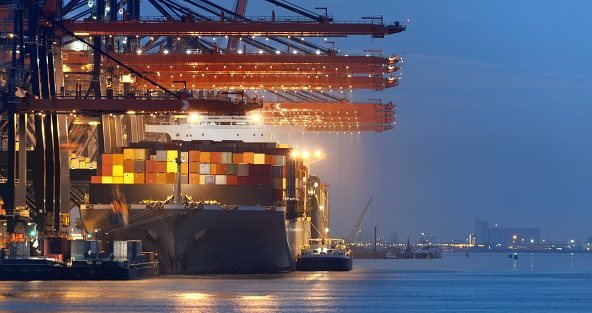
Korea is backing a $150 billion push to revive the U.S. shipbuilding industry, with companies like Hanwha Group already dispatching skilled workers to train local recruits at Philly Shipyard, which it acquired late last year.
The initiative, dubbed MASGA — short for “Make America Shipbuilding Great Again” — reflects Seoul’s broader strategy to embed its industrial expertise in the United States while reinforcing a decades-old alliance under pressure from global supply chain shifts and China’s growing naval power. By restoring capacity at aging U.S. shipyards, Korea’s shipbuilders hope to secure overseas growth and extend their role in the defense and commercial maritime sectors.
If successful, MASGA could tighten the Korea-U.S. alliance across security and economic domains while giving Korean shipbuilders a new foothold in a critical overseas market. But if the initiative falters, critics warn it could instead mire Korean firms in a bureaucratic and operational “quagmire.”
Korea’s three largest shipbuilders — HD Korea Shipbuilding & Offshore Engineering (HD KSOE), Hanwha Ocean and Samsung Heavy Industries — have formed a dedicated task force under the Korea Offshore & Shipbuilding Association, according to industry insiders on Sunday. The task force’s mission is to identify and develop joint opportunities in the U.S. market.
Industry insiders stress that access to skilled labor in the United States is an urgent priority if the project is to succeed. Shipbuilding remains labor-intensive, and the United States has struggled to produce a steady pipeline of shipyard professionals since its post-World War II industrial decline.
Hanwha Group has already dispatched about 50 skilled Korean workers to the United States to train local recruits in essential techniques like welding. Hanwha plans to increase the work force from 1,800 to 3,000 by 2030.
HD KSOE is also preparing an educational program in collaboration with Seoul National University and the University of Michigan to train workers at Korean shipyards before dispatching them to the United States.
“When I visited a U.S. shipyard, I saw welding machines that Korea used back in the 1970s and 1980s,” said one industry executive. “Modernizing equipment is one challenge, but recruiting and training the work force is another massive undertaking.”
Rhee Shin-hyung, a professor at Seoul National University’s Department of Naval Architecture and Ocean Engineering, added that “it may be worth asking the U.S. government to create new policies that allow the use of low-cost foreign labor.”
Even with training programs in place, experts expect it will take time before U.S. yards are ready to build high-value ships. As a result, there are calls for hybrid production strategies, such as manufacturing ship blocks in Korea for final assembly in the United States.
For this to work, however, Korean firms must navigate significant regulatory obstacles.
Chief among them is the Jones Act, a U.S. federal law that restricts domestic maritime trade to U.S.-built, -owned and -crewed vessels. Critics say the law has shielded U.S. yards from global competition and stunted innovation.
Another legal hurdle is the Byrnes-Tollefson Amendment, which mandates that U.S. Navy ships be built exclusively in the United States.
However, growing concerns over China’s naval expansion have prompted U.S. lawmakers to reconsider this stance. In February, Congress introduced the Naval Readiness Act, which would allow allied shipyards to build naval vessels. If passed, Korean shipbuilders could begin production for the U.S. Navy in either country.
Meanwhile, Democratic Party Rep. Lee Un-ju introduced a bill in the National Assembly on Thursday to promote Korea-U.S. shipbuilding cooperation. The proposal includes designating special zones for defense shipbuilding in Korea, including the construction of U.S. naval vessels.
Despite the daunting challenges, Korean stakeholders remain optimistic that overcoming them will pay dividends. Beyond naval contracts, they expect MASGA to strengthen the supply chain for marine components, such as ship engines and parts.
“If small- and mid-sized Korean firms can enter the U.S. market alongside major shipbuilders, the growth potential for Korea’s shipbuilding sector could be significant,” said Lee Jang-hyun, a professor of naval architecture and ocean engineering at Inha University.
Source: Korea JoongAng Daily