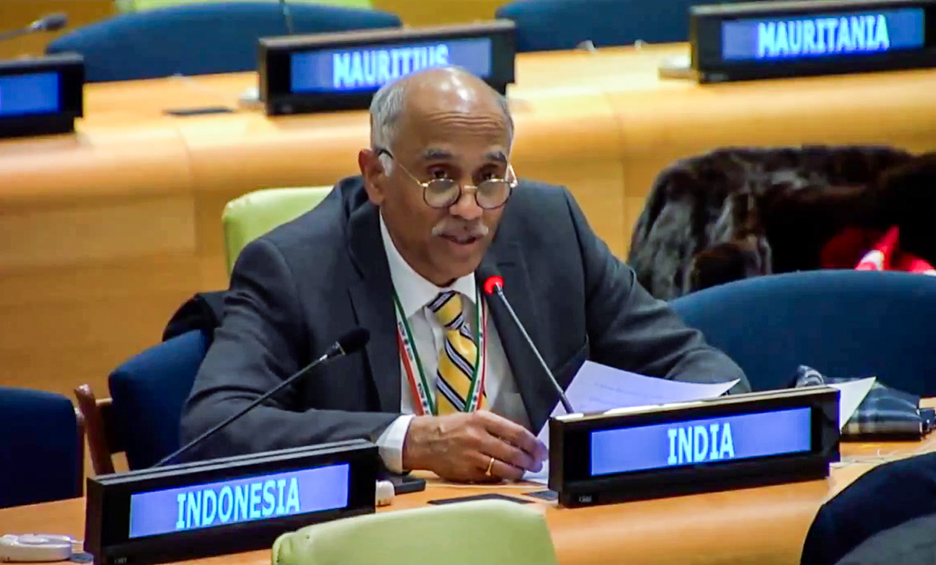
New Delhi: India on Tuesday issued a scathing response to Pakistan at the United Nations, dismissing Islamabad’s claims on Kashmir and the Indus Waters Treaty, and branding it a “serial borrower from the IMF.”
Speaking during the UN’s 80th anniversary commemorations, India’s Permanent Representative to the UN, Parvathaneni Harish, took strong exception to Pakistan’s repeated attempts to internationalize the Kashmir issue and accused it of perpetuating cross-border terrorism.
“There must be a serious cost to nations that violate the principles of good neighbourliness and international conduct by sponsoring cross-border terrorism,” Harish asserted. Referring to the April 22, 2025, terrorist attack in Pahalgam, Jammu and Kashmir, in which 26 tourists were killed, he said the UN Security Council had called for accountability for the perpetrators, organizers, financiers, and sponsors of the attack in its April 25 statement.
“In response, India launched Operation Sindoor, a calibrated and non-escalatory strike targeting terror camps in Pakistan and Pakistan-occupied Jammu and Kashmir. It achieved its strategic goals and ended after Pakistan requested a cessation of military actions,” Harish said.
In a sharp rebuke, he added, “I am compelled to reply to the remarks made by Pakistan’s representative. The contrast on the subcontinent is stark—India is a thriving democracy with a dynamic economy and a pluralistic society. Pakistan, on the other hand, remains mired in fanaticism, terrorism, and economic mismanagement—it has become a serial borrower from the IMF.”
Harish further emphasized the importance of zero tolerance for terrorism in global peace and security dialogues. “It is unacceptable for a member of the Council to deliver lectures on peace while engaging in practices that defy global norms,” he noted.
His remarks followed statements made by Pakistan’s Deputy Prime Minister Mohammad Ishaq Dar, who raised the Kashmir dispute and criticized India’s decision to suspend the Indus Waters Treaty following the Pahalgam attack.
Dar referred to Jammu and Kashmir as “an internationally recognized disputed territory,” and reiterated Pakistan’s demand for a resolution based on UN Security Council resolutions and the “will of the Kashmiri people.”
He also called the Indus Waters Treaty “a historic example of diplomatic cooperation,” and accused India of “illegally and unilaterally” putting the treaty into abeyance, claiming that the move endangered the water security of 240 million Pakistanis.
India, however, maintains that its suspension of the treaty followed grave provocations and reflects its broader counterterrorism policy.