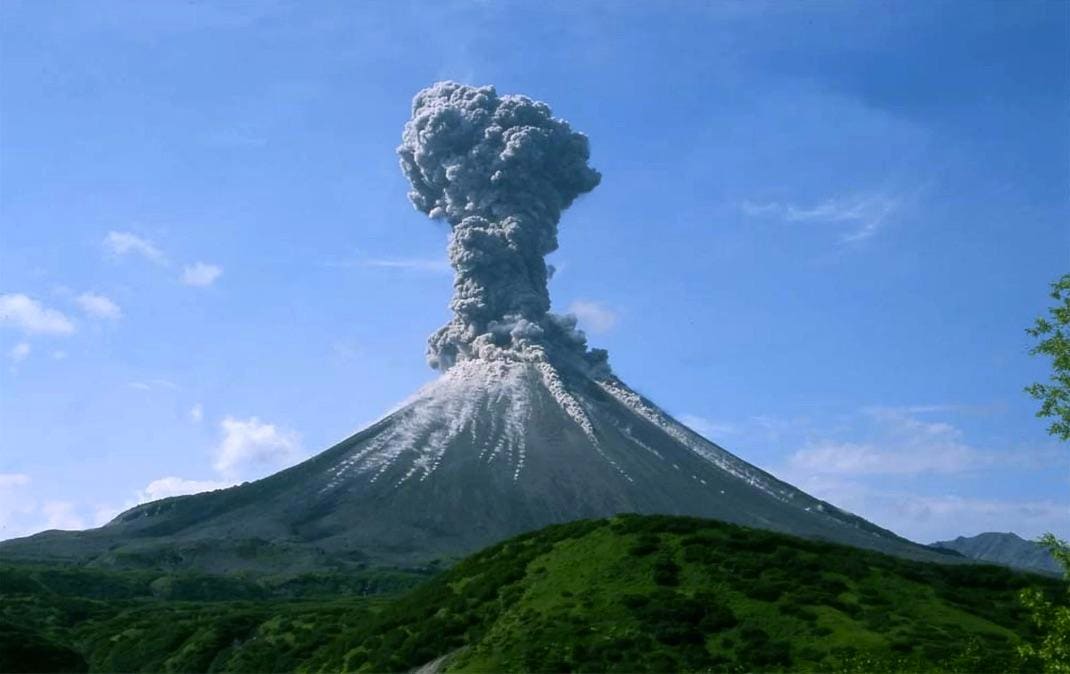
NEW DELHI: An ash cloud from Ethiopia’s Hayli Gubbi volcano reached parts of India on Monday evening, according to IndiaMetSky Weather. The plume first entered Gujarat from the west before quickly advancing toward Rajasthan, northwest Maharashtra, Delhi, Haryana and Punjab by around 10 pm. It is now drifting toward the Himalayas and other northern regions.
Authorities began tracking the plume’s movement toward Delhi and Jaipur after early signs appeared near Jamnagar around 5:30 pm, causing disruptions as conditions evolved.
The ash cloud is travelling at altitudes between 15,000 and 25,000 feet, reaching up to 45,000 feet in some layers. It contains volcanic ash, sulphur dioxide, and small particles of glass and rock. IndiaMetSky warned that skies may appear “darker and hazier than usual” and cautioned that air traffic could see delays.
How did it form and travel?
The Toulouse Volcanic Ash Advisory Centre (VAAC) reported that the explosive eruption began around 8:30 am GMT on Sunday—Hayli Gubbi’s first activity in nearly 10,000 years.
Thick ash columns rose roughly 14 km high from Ethiopia’s Afar region, about 800 km northeast of Addis Ababa near the Eritrean border. Though the eruption has since stopped, VAAC confirmed that “a large ash plume is moving toward northern India.”
Situated in the tectonically active Rift Valley, the volcano expelled ash that travelled across the Red Sea toward Yemen and Oman before drifting east into India and northern Pakistan, according to VAAC and regional reports.
Which cities were impacted?
The ash cloud crossed large parts of northwest India on Monday night, affecting Rajasthan, Gujarat, Maharashtra, Delhi-NCR and Punjab. Visibility dropped locally as the plume shifted eastward.
IndiaMetSky reported a large plume stretching from the Hayli Gubbi region to Gujarat, moving at 100–120 km/h. The agency said the cloud would likely darken skies and influence flight routes. By late night, the sulphur dioxide–rich plume was already drifting over Delhi, NCR, Haryana and parts of Uttar Pradesh.
While some ash pockets were detected over Rajasthan, the likelihood of ashfall on the plains remained low.
Will it affect air quality?
Meteorologists said the ash cloud’s high altitude means India’s surface-level AQI is unlikely to worsen. IndiaMetSky reiterated that the event is “mostly safe” because the ash is travelling 25,000–45,000 feet above ground.
However, SO₂ levels may rise over Nepal’s hills, the Himalayas and the adjoining Terai belt of Uttar Pradesh, where the plume may interact with higher terrain before drifting toward China.
Residents in north India may notice darker, hazier skies similar to a dust storm, but without dangerous particulate concentrations at the surface. Officials advised wearing masks as a precaution, adding that most activity is in the mid-atmosphere. Only a small amount of ash, if any, is expected to reach the ground.
Airlines issue warnings
Airlines issued advisories for flights passing through Middle Eastern airspace. In India, the Directorate General of Civil Aviation (DGCA) released guidelines directing carriers to avoid affected routes and adjust flight plans, routing and fuel loads accordingly. Airports were instructed to inspect runways, taxiways and aprons for possible ash contamination and halt operations if needed.
Several carriers—including Akasa Air, IndiGo and KLM—cancelled flights on Monday. Mumbai’s Chhatrapati Shivaji Maharaj International Airport also warned travellers that volcanic activity in Ethiopia was impacting West Asian airspace and could disrupt some international routes.