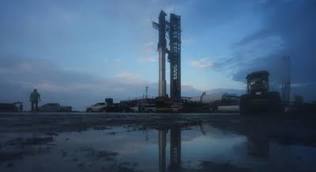
The upper stage of the rocket, designed to transport crew and cargo, has experienced explosions during all three of its test flights in 2025.
SpaceX announced the cancellation of a scheduled test flight for its Starship megarocket on Sunday, citing the need for additional time to address issues, marking yet another setback for Elon Musk’s massive project following a series of explosive incidents.
These issues have raised doubts among some observers regarding the capability of the world’s largest and most powerful launch vehicle to safely transport humans back to the Moon or to fulfill Musk’s aspirations of establishing a colony on Mars.
The rocket was set to launch from the company’s Starbase in southern Texas at 6:30 PM local time (2330 GMT) for its tenth flight. However, approximately 15 minutes prior to the scheduled lift-off, SpaceX declared that the launch had been postponed.
“We are standing down from tenth flight of Starship to allow time to troubleshoot an issue with ground systems,” the company stated on X, without providing further details.
Earlier, SpaceX had indicated that the rocket’s upper stage was in the process of being fueled, implying that the launch was imminent.
Musk had previously posted on X an hour before that “Starship 10 launching tonight.”
According to road closure notices near Starbase, the tenth Starship flight may still take place on, although SpaceX did not provide a specific timeline.
The planned hour-long, uncrewed mission was intended to test the upper stage through a series of maneuvers as it traveled halfway around the globe before the lower stage booster descended into the Indian Ocean.
Series of explosions
Starship is pivotal to billionaire SpaceX founder Musk’s goal of colonizing Mars, while NASA relies on a modified version to facilitate the return of Americans to the Moon.
Nevertheless, the rocket’s upper stage — which is the spacecraft designated for carrying crew and cargo — has exploded during all three of its test flights in 2025.
Two of the unsuccessful tests resulted in debris falling over Caribbean islands, while the third reached space before disintegrating. Additionally, in June, another upper stage exploded on the ground during a “static fire” test.
The 403-foot (123-meter) rocket is intended to be completely reusable in the future; however, the company has yet to achieve the upper stage’s capability to deliver a payload to space or return to the launch site.
Following an investigation into the previous unsuccessful flight in May, SpaceX announced that it would “intentionally stress the structural limits” of the upper stage, aiming for a successful return.
SpaceX has successfully captured the lower stage booster with large “chopstick” arms from the launch tower on three occasions, but the tenth flight is not scheduled to attempt this maneuver.
The company’s philosophy of “fail fast, learn fast” has been widely recognized for its impressive track record, providing the US company with a significant global advantage in launches, thanks to its Falcon rocket family.
However, the challenges faced by Starship have raised concerns about the company’s ability to replicate that success with the largest rocket in history.
Dallas Kasaboski, a space analyst at the consulting firm Analysys Mason, informed AFP prior to the canceled launch that the recent failures were beginning to tarnish SpaceX’s previously stellar reputation.
“I believe there is considerable pressure on this mission,” he stated. “We have conducted numerous tests, and it has not demonstrated reliability — the successes have not outnumbered the failures.”
Will Lockett, a former engineer who has transitioned to commentary, went further, asserting in his Substack newsletter that the rocket’s inability to deliver a payload to orbit thus far indicates that “the concept of Starship is fundamentally flawed.”
The world’s wealthiest individual has bet the company’s future on Starship, intending to eventually phase out its current generation of rockets and spacecraft in favor of this new system.
Even if the tenth test ultimately succeeds, significant technical challenges persist — from achieving full and rapid reusability at a low cost to demonstrating the ability to refuel super-cooled propellant in orbit, which is essential for deep-space missions.
Nevertheless, SpaceX continues to move forward, ramping up the number of launches in spite of objections from environmental organizations regarding ecological consequences.
The Federal Aviation Administration (FAA) announced that it has concluded its inquiry into the recent Starship explosion, stating that there were no injuries.
Elon Musk, recognized for establishing highly ambitious schedules, has asserted that Starship is set to conduct its initial uncrewed missions to Mars in the upcoming year.