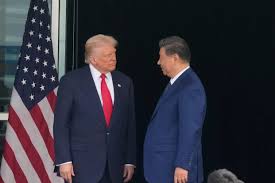
US President Donald Trump has initiated new tests of the American nuclear weapons system, raising concerns about whether the United States is gearing up to resume nuclear detonations after a hiatus of over thirty years. This announcement was shared on social media last week and was accompanied by statements made prior to his meeting with Chinese President Xi Jinping in South Korea. Nevertheless, US Energy Secretary Chris Wright clarified that the testing would not entail nuclear detonations but would concentrate on ‘the other components of a nuclear weapon’ to verify their proper functionality. Wright’s remarks came four days after Trump stated that he was instructing the US military to recommence nuclear testing ‘on an equal footing’ with other nations, evoking fears of a return to the most troubling periods of the Cold War. ‘I believe the tests we are discussing at this moment are systems tests,’ Wright mentioned during an interview on the Fox News program The Sunday Briefing. ‘These do not involve nuclear detonations. These are what we refer to as noncritical explosions.’ Wright also indicated that residents in areas like Nevada, which hosts a nuclear test site larger than the state of Rhode Island, should not anticipate witnessing a mushroom cloud. On Wednesday — just moments before his meeting with President Xi Jinping of China in South Korea — Trump stated in a social media update that he was directing the Pentagon to enhance testing of nuclear weapons.
“We ceased our testing many years ago,” Trump later informed reporters, referencing the last US nuclear weapon explosive test conducted in 1992. “However, given that others are conducting tests, I believe it is fitting for us to do the same.” Wright emphasized that testing was currently in progress on the new nuclear systems. “Once again, these will be nonnuclear explosions,” he stated, further adding, “These are merely aimed at developing advanced systems to ensure that our replacement nuclear weapons surpass the previous ones in quality.” The uncertainty regarding Trump’s intentions arose just moments prior to his significant meeting with Chinese President Xi Jinping in South Korea. In a post on his Truth Social platform, Trump seemed to indicate that he was on the verge of lifting the long-standing US moratorium on nuclear weapons testing. Later that day, upon his return to Washington, the President remained noncommittal regarding whether he was authorizing the resumption of full-scale nuclear detonations — a practice that has only been observed in North Korea this century — or if he was instead alluding to standard tests of the systems utilized for delivering such weapons.
Detonation tests have become increasingly rare. The sole nation that has consistently conducted nuclear tests over the past twenty-five years is North Korea, with its most recent test occurring in September 2017. China has swiftly augmented its nuclear arsenal and has deployed missiles in newly constructed silos; however, it has not executed a nuclear weapon test since 1996. Russia has not performed a verified test since 1990, although it recently announced that it had tested two new delivery systems for nuclear arms — a nuclear-powered cruise missile and an underwater torpedo known as Poseidon, which is capable of traversing the Pacific Ocean to reach the US West Coast. The United States itself regularly conducts tests of unarmed missiles. In 1993, the Clinton administration revealed plans for a treaty that would compel nations to abstain from nuclear detonations. Although the 1996 test-ban treaty never officially came into effect, it set a global standard against the testing of destructive bombs.
Washington is presently engaged in a significant initiative to substitute its warheads with modernized versions. The total expenditure for this extensive program over a span of thirty years is projected to be $1.7 trillion.