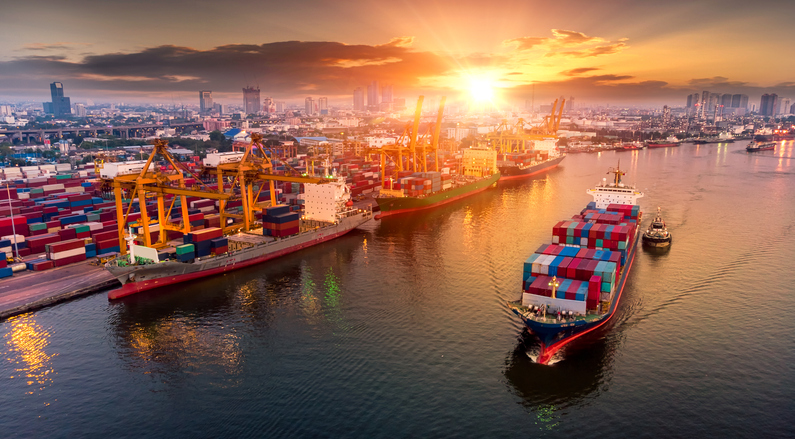
Global container capacity could surge by year’s end as speculation about a return of commercial shipping to the Suez Canal increases, but the change could lead to congested ports and trade lane disruptions that could pressure prices higher.
Most commercial shipping stopped using the Suez Canal just more than two years ago because of missile and drone attacks from Yemen-backed Houthi rebels, who were attacking vessels affiliated with Israel.
Longer sailing distances around the Cape of Good Hope are currently absorbing around 2 million TEU (20-foot equivalent units) of global container shipping capacity and increasing the transport demands on the fleet.
Amid a ceasefire between Israel and Hamas, the Houthis said in an undated letter to Hamas’s al-Qassam Brigades published online by the group in November 2025 that they were pausing their attacks but threatened to resume them if Israel broke the ceasefire.
A large-scale return to the Red Sea would reduce the transport work required of the fleet and potentially cause freight rates to plummet – unless carriers take drastic measures, such as idling, demolition, slow-steaming and widespread blank sailings, Sand said.
FULL SCALE RETURN NOT EXPECTED IN NEAR TERM
Market intelligence group Linerlytica does not expect a full-scale return to the canal in the near term.
“No full-scale return to the Suez is expected in the next two months despite the statement from the Suez Canal Authority on 25 November that Maersk will send their ships back to the Suez Canal in early December,” Linerlytica said. “Neither Maersk nor its Gemini Cooperation partner Hapag-Lloyd are scheduled to return any of their ships to the Suez next month.”
Linerlytica said CMA CGM remains the only main carrier to test the early return to the Suez, with three of its Asia-Europe and Mediterranean services set to resume eastbound voyages from the end of December.
Peter Sand, chief analyst at ocean and freight rate analytics firm Xeneta, said carriers are keen on returning to the Suz Canal, but must remain cautious.
“There is ongoing speculation of a largescale return of container ships to the Red Sea, but the situation remains fragile,” Sand said. “Carriers will continue to test the water – particularly on backhaul services with less cargo and therefore lower liability – but insurance remains a major stumbling block when ships are still sailing through an area designated as high risk.”
Lars Jensen, president of consultant Vespucci Maritime, said there is plenty of speculation pertaining to a return to Suez routing for the global container carriers.
“And indeed, it does look more hopeful than at any point over the past two years, but this is not yet a ‘done deal’,” Jensen said.
Jensen said that his experience over the past five years leads him to expect some upward pressure on container rates should carriers return to using the canal.
“For those hoping that a return will lead to a swift reduction, or collapse, in freight rates please note that all experience from the past five years shows that congestion and disruption lead to increased freight rates, not the reverse,” Jensen said.
“A return to a Suez routing will indeed temporarily lead to substantial congestion and disruption in especially Europe, but also with some direct impact on USEC and then spill-over on the Atlantic as well as Europe to South America and Africa,” he added.
CONFUSING MESSAGE FROM SUEZ CANAL AUTHORITY
Talk about an imminent return of commercial vessels to the Suez Canal emerged after the Suez Canal Authority said it had reached an agreement with global container shipping major Maersk for a return to the waterway from 1 December.
The return of Maersk-affiliated vessels through the canal would be a precursor to full capacity, according to a press release from the authority on 25 November.
“The return of Maersk-affiliated vessels represents a revert in the right direction towards the optimal route for the sustainability of global supply chains as the shortest, fastest and most secure waterway linking the East and the West,” Adm Ossama Rabiee, chairman and managing director of the Suez Canal, said.
Rabiee underlined that the Peace Summit held in Sharm El-Sheikh has succeeded in promoting peace in the Red Sea and Bab El-Mandab region.
But Maersk quickly issued a statement saying a return was not imminent.
“At the launch of the Gemini Cooperation in February 2025, AP Moller-Maersk and Hapag-Lloyd introduced a Cape of Good Hope network due to the ongoing disruptions in the Red Sea,” Maersk said.
“Gemini’s ambition has always been to return to a Suez-based east-west network once security conditions in the region permit. However, as the safety of crew, vessels and cargo remains our top priority, we currently have no specific timing to change the Gemini East-West network to sailing through the Red Sea.”
Maersk said it will continue to monitor the situation and progress of the ceasefire in Gaza.
“When security conditions warrant it, and in keeping with the Gemini trademark of industry-leading schedule reliability, Hapag-Lloyd and AP Moller-Maersk will carefully coordinate with our respective customers and important stakeholders to ensure an orderly transfer to a Suez-based network with minimal disruption to our customers’ supply chains,” Maersk said.
CONGESTED PORTS, TRADE LANE DISRUPTIONS
Judah Levine, head of research at online freight shipping marketplace and platform provider Freightos, said shippers should prepare for market turbulence rather than smooth sailing once carriers return to the canal.
“This return to the Suez could create a push then pull for container rates,” Levine said. “We will likely see a short-term rate spike as congestion grows, followed by significant downward pressure as operations normalize and carriers face an even greater challenge managing capacity in an oversupplied market.”
The initial congestion spike would come from vessels suddenly arriving seven to 10 days early, which will create significant bunching at already-congested European ports, temporarily absorbing capacity and potentially driving rates higher.
Levine also pointed to the timing of the Lunar New Year holiday.
“The December-January transition coincides with pre-Lunar New Year demand surge, amplifying disruption during what analysts estimate could be a two-month schedule normalization period,” Levine said.
But once schedules stabilize, Levine said that more than 2 million TEU (20-foot equivalent units) of capacity (about 9% of global container capacity) will be released back into an already oversupplied market.
CURRENT RATES NEAR TWO-YEAR LOWS
Rates for shipping containers from east Asia and China to the US fell significantly week on week and are around two-year lows as available capacity continues to outstrip demand.
The following chart from Xeneta shows rates from North China to the US West Coast have fallen from more than $8,000/FEU in June 2024 to around $2,000/FEU at present.
Container ships and costs for shipping containers are relevant to the chemical industry because while most chemicals are liquids and are shipped in tankers, container ships transport polymers, such as polyethylene (PE) and polypropylene (PP), are shipped in pellets. Titanium dioxide (TiO2) is also shipped in containers.
They also transport liquid chemicals in isotanks.
Source: ICIS by Adam Yanelli.