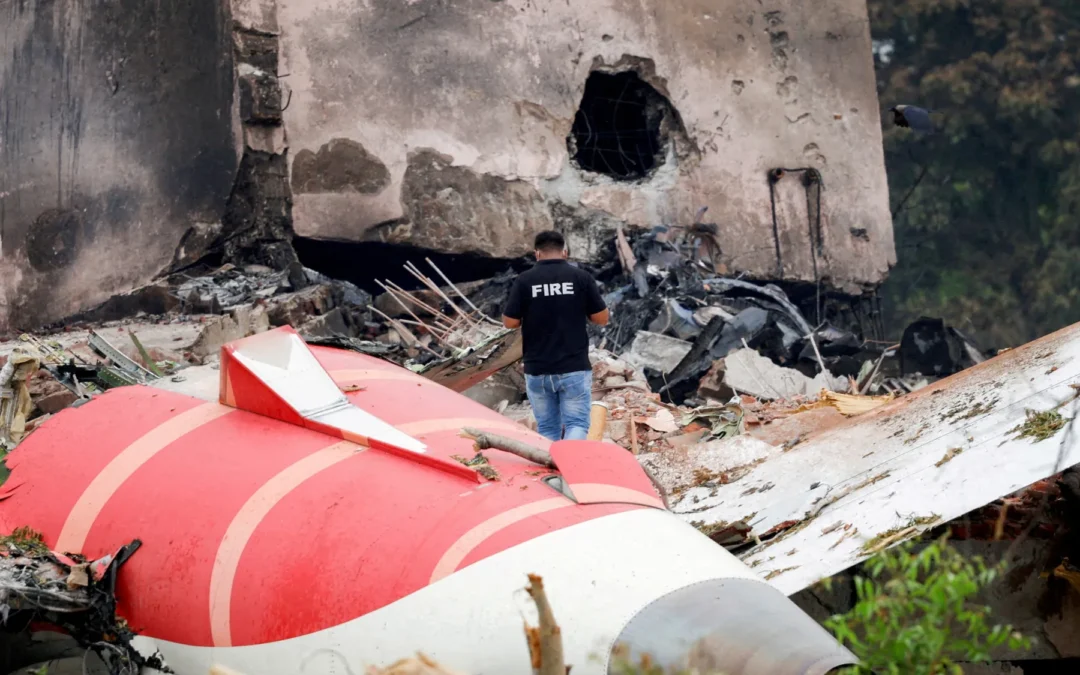
NEW DELHI: The Supreme Court on Friday heard a plea seeking a court-monitored, independent investigation into the June 12 Air India crash in Ahmedabad that killed 274 people, including passengers, crew members, and civilians on the ground.
A bench comprising Justices Surya Kant and Joymalya Bagchi tagged the petition with a previously filed case raising similar concerns. The court directed petitioner Akhilesh Kumar Mishra, a Delhi University research scholar and practising advocate, to serve a copy of the petition to the parties concerned.
Filed through advocate Shubham Upadhya, the plea called for judicial oversight to ensure a fair, transparent, and unbiased probe. Mishra’s counsel, senior advocate Rajiv Shakdher, argued that the current investigation by the Aircraft Accident Investigation Bureau (AAIB) lacks independence and risks shielding corporate interests—particularly Boeing—from accountability.
Questions Over AAIB Report
The plea raised doubts about the AAIB’s preliminary report, which suggested the crash occurred due to the sudden shutdown of both engines—caused by the fuel control switches moving from “RUN” to “CUTOFF” within a second. However, the petition flagged several “inconsistencies and contradictions,” including a cockpit voice recording in which one pilot reportedly asks, “Why did you cut off?”, to which the other replies, “I didn’t.”
The aircraft had been airborne for just 40 seconds before crashing into a hostel block of BJ Medical College, killing 241 on board and 33 on the ground, including former Gujarat Chief Minister Vijay Rupani and several students and staff.
“Pilot Blame Protects Boeing”
Mishra’s plea emphasized that both pilots were highly experienced, logging a combined 19,000 flight hours, over 9,000 of which were on Boeing 787s. Aviation experts have noted that fuel cutoff switches are designed to require deliberate manual action, making accidental activation unlikely and casting doubt on claims of pilot error.
“The investigation appears to unjustifiably shift blame onto the deceased pilots, who cannot defend themselves, while allowing Boeing to evade liability—a pattern not unfamiliar in its corporate history,” the petition stated.
Media Leak, Confidentiality Breach
The petition also highlighted a breach of protocol and confidentiality, pointing out that preliminary findings were reported by the Wall Street Journal nearly 20 hours before the official release. It argued that such leaks risk creating a skewed public narrative and undermine trust in the investigation process.
Similar Plea Already Pending
The court had earlier, on September 22, agreed to hear a similar plea by the Safety Matters Foundation, an aviation safety NGO. At the time, the bench had described the selective leak of the preliminary report as “unfortunate and irresponsible,” warning that it could distort public perception and fuel misinformation.
The Supreme Court has already issued notices to the Centre and the Directorate General of Civil Aviation (DGCA) on the demand for an independent and time-bound probe. It also stressed that such investigations must uphold the dignity and privacy of victims’ families, while proceeding swiftly to prevent speculation or selective media leaks.
June 12 Crash: What Happened
- Flight: Air India AI-171 (Boeing 787-8 Dreamliner)
- Route: Ahmedabad to London
- Crash Site: Hostel block of BJ Medical College, near the airport
- Fatalities: 274 (241 on board, 33 on ground)
- Survivor: Only one passenger, Viswashkumar Ramesh, survived
- AAIB Finding: Fuel control switches for both engines moved to “CUTOFF” within seconds of takeoff
The crash is now the deadliest single-aircraft disaster in Indian aviation history.