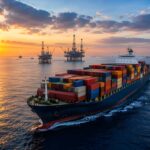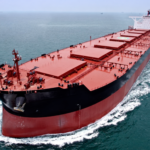
Chinese shipbuilders secured approximately 40% of all newly ordered large liquefied natural gas (LNG) carriers worldwide during the first to third quarters of this year, January to September. While China leads in the general merchant ship market, such as container ships and bulk carriers, by leveraging price competitiveness, large high-value-added LNG carriers with a capacity of 174,000 cubic meters or more were considered a market dominated by South Korean shipbuilders, who possess differentiated technology. Chinese shipyards have aggressively penetrated this sector this year.
According to Clarksons Research, a British shipbuilding and shipping analysis institution, as of the third quarter of this year, South Korea has accumulated 173 orders, while China has 71, maintaining a significant gap. However, this year, a clear trend has emerged where China has rapidly strengthened its LNG carrier production capabilities over recent years and is closing the gap at a rapid pace. While the shipbuilding industry notes, “LNG carriers, which remain more profitable, are still ordered from South Korean shipyards,” there is growing tension that complacency could lead to being overtaken.
◇China Overcoming the Gap Through Production Capacity
LNG carriers transport gas liquefied at minus 163 degrees Celsius, making cargo containment technology crucial. Key aspects include ensuring airtightness to prevent gas leakage and reliquefaction. While French company GTT virtually monopolizes cargo containment technology, South Korean shipyards with long experience are highly regarded for their welding, construction, and operational technologies that enhance fuel efficiency. Particularly, LNG carriers are difficult to order based solely on price competitiveness, as any issues with the vessel can lead to significant losses.
However, Chinese shipyards have recently entered the LNG carrier market one after another, beginning to accumulate experience and engaging in a “long-term battle.” Until 2021, only Hudong-Zhonghua Shipbuilding in China could construct large LNG carriers. As the first Chinese company to build and deliver a large LNG carrier in 2008, it grew by securing 36 orders out of 128 LNG carriers ordered by Qatar during its mass LNG production drive from 2020 to 2024, excluding those secured by South Korean shipyards. By 2025, Hudong-Zhonghua Shipbuilding increased its annual construction capacity from three to 11 vessels by establishing a dedicated LNG carrier dock.
Over the past four years, four additional Chinese shipyards—Jiangnan Shipyard, Dalian Shipbuilding Industry, Yangzijiang Shipyard, and China Merchants—have entered the LNG carrier market. Jiangnan Shipyard delivered its first 175,000 cubic meter-class LNG carrier to a shipowner in November 2024, while Dalian Shipyard did so in September of last year, already accumulating shipbuilding experience. In September, Chinese shipyard Hengli Petrochemical announced an aggressive market entry plan, constructing two large LNG carriers before securing shipowners and selling them through a “build-first, sell-later” approach.
Another factor is that South Korea’s “Big Three” shipbuilders—HD Hyundai Heavy Industries, Hanwha Ocean, and Samsung Heavy Industries—have virtually saturated their docks capable of constructing large LNG carriers. Chinese shipyards are capitalizing on this by securing orders from shipowners urgently needing LNG carriers amid the global energy transition.
◇The Battle of Technological Prowess Begins Now
South Korea’s shipbuilding industry sees the next three to four years as a critical period. LNG carriers typically undergo special inspections every five years to check their cargo tanks and major equipment. Except for Hudong-Zhonghua Shipbuilding, China’s newer shipbuilders have only recently begun delivering large LNG carriers, leaving their quality and reliability unproven through these inspections. Their vessels are expected to undergo the checks around 2029-2030, when their operational reliability will be assessed. Many in the industry fear that fierce competition will begin in earnest if Chinese shipbuilders win shipowners’ trust at that point. “Now is our golden window while we still have the lead,” a shipbuilding industry official said. “We urgently need to advance our technology further to widen the gap.”