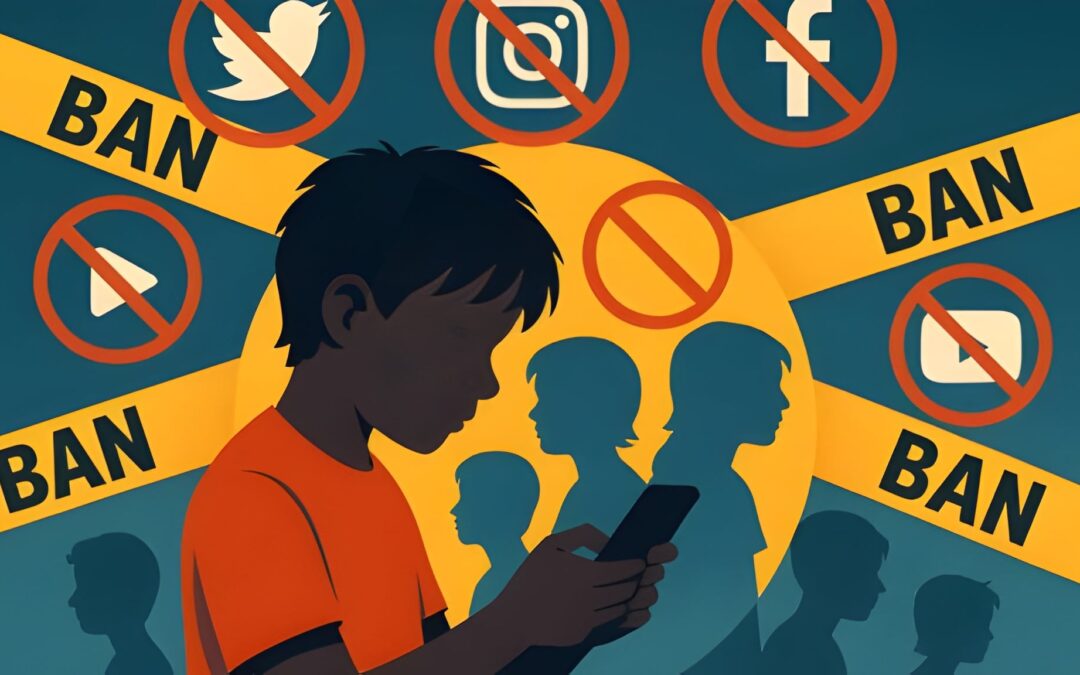
The Supreme Court on Friday agreed to examine a petition seeking age-based restrictions on children’s use of social media platforms and sought responses from the Centre and concerned ministries. The matter has been scheduled for further hearing on December 7.
A bench comprising Chief Justice of India Surya Kant and Justice Joymalya Bagchi issued notice on a public interest litigation (PIL) filed by Indore-based Emerald Heights International School and its director, Siddharth Singh.
The petition seeks a comprehensive regulatory framework to protect children from online risks, including cyberbullying, sexual exploitation, exposure to harmful content, compulsive social media use and mental health problems.
Petition Seeks Enforceable Safeguards
The petitioners have argued that protecting children from digital harms is a constitutional responsibility of the State and cannot be left solely to parents or voluntary safety measures adopted by technology companies.
The respondents named in the plea include the Union government, the ministries of electronics and information technology, women and child development, and law and justice, along with the National Commission for Protection of Child Rights.
The petition, filed through advocate Vaibhav Choudhary, with the petitioners represented by advocate Khushbu Jain, invokes Articles 14, 15(3), 21 and 21A of the Constitution. It argues that the absence of effective safeguards against foreseeable online harms threatens children’s fundamental rights.
The plea also refers to Articles 39(e) and 39(f), which call for protecting children against abuse and exploitation and ensuring opportunities for their development in conditions of freedom and dignity.
Concerns Over Children’s Online Safety
The petition highlights several risks associated with children’s social media use, including depression, anxiety, low self-esteem, sleep disruption and body-image concerns. It also raises concerns about online grooming, cyberbullying, sexual exploitation, coercion involving intimate images and exposure to violent, sexually explicit, self-harm and suicide-related content.
According to the petitioners, behavioural profiling and platform designs that encourage compulsive use can further increase these risks.
The plea maintains that parental controls and voluntary measures introduced by social media companies are insufficient to address the scale of the problem.
“The Constitution does not envisage a childhood defined by exploitation, distress or abandonment,” advocate Khushbu Jain said, arguing that children deserve a safe digital environment that supports their well-being and development.
The petitioners have urged the court to direct the Centre to introduce a dedicated regulatory framework for children’s safety on social media platforms.
Alternatively, they have sought a prohibition on social media use below a prescribed age and enforceable age-based restrictions governing the creation, maintenance and use of accounts by older children.
India Weighs Age-Based Restrictions
The petition comes amid growing international efforts to regulate children’s access to social media. Australia implemented a minimum age of 16 for accounts on designated social media platforms in December 2025, requiring companies to take reasonable steps to prevent younger children from accessing them. France’s 2023 legislation introduced parental authorisation requirements for social media accounts belonging to children under 15.
In India, the Economic Survey 2025-26 recommended age-based safeguards, including age verification and age-appropriate default settings on digital platforms. The government has also been considering possible restrictions through amendments to the Information Technology Rules.
India’s Digital Personal Data Protection law provides for verifiable parental consent before the personal data of children under 18 is processed. However, the country does not have a general statutory minimum age for accessing social media.
Earlier Plea Also Raised Child Safety Concerns
The Supreme Court had taken up a related issue on September 10, when a bench headed by Chief Justice Surya Kant sought the Centre’s response to a petition filed by a child rights non-profit seeking guidelines for social media accounts maintained by minors.
“There is need for some safeguards in India. Some firewall is necessary for protecting our children,” the bench observed while issuing notice in that matter.
The latest petition also invokes the United Nations Convention on the Rights of the Child, particularly its provisions on children’s best interests and protection from violence, sexual abuse, exploitation and harmful material.
The Supreme Court’s decision to seek responses from the Centre marks a further step in the judicial examination of whether stronger legal safeguards are needed to protect children from risks associated with social media use.