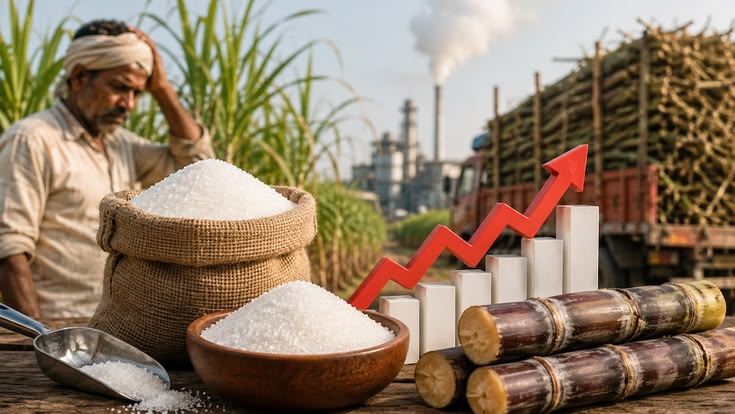
Sugar prices have surged across major producing states in India amid tightening supplies and rising demand ahead of Diwali. Ex-mill prices in Maharashtra jumped 17% in six days, while rates in Uttar Pradesh increased by 13%, raising concerns over further price hikes during the festive season.
According to local traders, ex-mill sugar prices in Uttar Pradesh rose to ₹5,200 per quintal on October 12 from ₹4,600 on October 6. In Maharashtra, prices climbed to ₹5,100 per quintal from ₹4,350 over the same period.
Agriculture expert and independent director GK Sood said domestic supplies remained insufficient despite the government’s decision to divert an additional 300,000 tonnes of sugar, initially intended for export, to the domestic market. He noted that the additional quantity had already been absorbed in September.
Restrictions on stockholding and trade have also contributed to pressure on the supply chain, Sood said, adding that the measures taken so far had failed to provide lasting relief.
The Centre has introduced several measures to improve availability and prevent hoarding, including permitting duty-free imports of one million tonnes of raw sugar, imposing stock limits on dealers and restricting bulk consumers’ purchases from the domestic open market.
However, the government is concerned that prices could rise further as Diwali approaches. Plans to advance the 2026–27 sugarcane crushing season have encountered difficulties due to a shortage of harvest-ready sugarcane in Maharashtra and Karnataka.
Industry associations had proposed an earlier start to crushing to ensure fresh supplies reached the market before the festive demand peak. Based on industry assurances, the government had expected some mills to begin operations from October 15.
A government official said large-scale crushing was unlikely before November. In parts of Maharashtra and Karnataka, standing sugarcane has dried out, while farmers are reluctant to harvest the remaining crop early without compensation for potential losses in yield and sugar recovery.
Sugar recovery refers to the proportion of sugar extracted from sugarcane during processing. Harvesting before the crop matures can reduce recovery rates, lowering the quantity of sugar produced from each tonne of cane.
A meeting with Karnataka farmers on October 12 failed to resolve disagreements over early crushing. Farmers have sought higher support prices, citing rising production costs and an increase in the minimum selling price of sugar from ₹31 to ₹50 per kg.
Although a few mills may begin crushing ahead of schedule, limited availability of suitable sugarcane could restrict additional production. This may leave the market dependent on existing inventories and imported supplies until the new crushing season gathers momentum.
The Centre intensified its intervention in August after sugar prices rose sharply ahead of the festive season. The government attributed the increase to lower-than-expected domestic production, weather-related crop damage, seasonal demand and possible hoarding and speculation.
Stockholding restrictions were tightened further in September and October. Bulk consumers were also restricted to holding sugar equivalent to 15 days of consumption when purchasing from the domestic open market. They may hold up to 30 days of stocks if the additional quantity is sourced exclusively from imported sugar under specified schemes.
The government has additionally ordered weekly stock disclosures from bulk consumers and physical verification of inventories at sugar mills.
Authorities had expected an early start to crushing to raise October sugar production from the usual 300,000–400,000 tonnes to more than one million tonnes. With the start of large-scale operations likely to be delayed, the government may need to reassess its supply strategy as festive demand intensifies.