Srishti Gupta has now been in custody for more than five months. According to those close to her, her only real offense was showing compassion for the poor.
At a community art exhibition held on September 6 in Shahbad Dairy, a working-class North Delhi neighborhood, resident Pinky Kumari pointed proudly to a photo of a young woman addressing a group of attentive women — calling her a close friend. The photo captured 28-year-old artist Srishti Gupta, who once ran basic literacy sessions for local women.
Nearby, children had pinned notes to a sheet of blue chart paper, many addressed affectionately to “Srishti didi” using the Hindi term for “elder sister.” Several children recalled that beyond art lessons, she also helped them with schoolwork.
Gupta hasn’t been seen in the neighborhood since April 11, when Uttar Pradesh Police detained her over alleged incitement during a workers’ protest in the industrial city of Noida. Friends who call her an unjustly imprisoned artist organized the Shahbad Dairy exhibit to draw attention to her case.
Background to her arrest
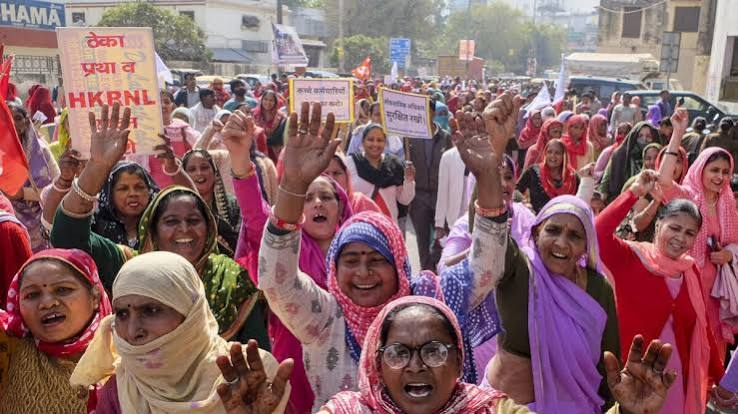
In April, thousands of factory workers in Noida took to the streets demanding wage increases that, for many, hadn’t come since 2014. Gupta joined the protest alongside other members of the Left-leaning Progressive Artists’ League and was among the earliest demonstrators arrested — she has now been jailed for over five months.
On September 1, the Allahabad High Court criticized authorities investigating the protest-related cases, specifically rebuking the Gautam Buddha Nagar district magistrate and state police for what the court characterized as fabricated allegations against Akriti Chaudhary, another young artist detained alongside Gupta.
Despite that rebuke, Gupta remains in custody: police have filed 11 separate cases against her connected to the protest, and she has not yet obtained bail in two of them.
From Amethi to art school
Gupta grew up in Amethi, a small town in Uttar Pradesh, and moved to Delhi in 2016 to study printmaking at Delhi University’s College of Art. Her college friend and fellow League member Vinod Karki described printmaking as physically demanding, often leaving students little time even for meals — he recalled Gupta consistently making sure everyone ate together, even bringing food to classmates who couldn’t join.
Karki said Gupta wasn’t especially political during their college years. That changed after she enrolled for a master’s degree at Visva-Bharati University’s Kala Bhavana art department in Santiniketan, West Bengal, in 2020, where she spent roughly four years. Karki recalled their conversations during that period increasingly touching on Palestine, capitalism, and politics, reflecting her shifting worldview.
Her artistic practice evolved alongside her politics — she took up poetry and traditional handicrafts, including papermaking and ropework she learned from the Santhal Adivasi community near Santiniketan. Several of these handmade items featured in the Shahbad Dairy exhibition.
A bond with the Santhal community
Maksud Ali Mondal, a Visva-Bharati alumnus who met Gupta during her studies, said she built a genuine, respectful relationship with Santhal villagers in Boner Pukur Danga rather than an exploitative one. Speaking from Amsterdam, he said villagers still call him regularly to ask about her wellbeing and possible release.
After finishing her master’s in 2022, Gupta chose to stay in the village for two more years, even learning to plant paddy from local farmers — an experience Mondal saw as her way of integrating with the community rather than just observing it. He wasn’t surprised when she later turned to labor activism in Delhi, viewing it as a natural extension of that same impulse.
Life and work in Delhi
Back in Delhi from 2023, Gupta gravitated toward grassroots Left politics rooted in working-class neighborhoods rather than electoral politics — particularly community libraries serving women and children in areas like Karawal Nagar and Shahbad Dairy, which drew her to volunteer and eventually live in Shahbad Dairy.
She also joined protests around the city, including demonstrations outside businesses activists accused of ties to the war in Gaza. Friends frame her involvement in the Noida workers’ protest as consistent with this broader pattern of activism.
Competing narratives
Police chargesheets describe Gupta differently — as a “key conspirator” responsible for producing protest posters and paintings and inciting workers, per the document. Investigators have tied her to several Leftist groups, including the Revolutionary Workers’ Party of India, Mazdoor Bigul, and Naujawan Bharat Sabha, and labeled her ideology “Maoist,” citing revolutionary literature found in her possession, including a book allegedly linked to the banned CPI (Maoist).
The investigation itself has drawn scrutiny: fellow activists have circulated videos online alleging police planted evidence at her home following her arrest, a claim police deny, saying the search was conducted under a court order.
Delhi-based artist Shuddhabrata Sengupta, who has visited Gupta in jail, argued that her real “crime” was caring deeply about working-class people and their children. Mondal echoed this, saying her politics centered less on party affiliation and more on trying to live as an ethical artist — someone from a modest, non-artistic family who questioned how artists could accept funding from corporations involved in environmental harm while claiming ecological concern.
A life beyond art alone
Before her arrest, even Gupta’s own family reportedly didn’t know the extent of her activism or political thinking — one relative said they’d simply supported her artistic ambitions because they admired her talent. Her Visva-Bharati professors have declined interviews citing university policy, and Sengupta noted that Delhi’s broader artist community has largely stayed silent about her case.
To those who knew her well, though, Gupta’s identity extended far beyond her art. Karki emphasized how embedded she was in the daily lives of the communities she worked with. Naureen Sabba, a 26-year-old student-activist who shared a room with Gupta in Shahbad Dairy for eight months, said Gupta reshaped her entire understanding of what art could be — showing her artists who lived among marginalized people and used their work to amplify unheard voices.
In the neighborhood, Gupta’s contributions went well beyond teaching: she helped organize health camps, assisted with garbage cleanup, and — as Kumari recalled — once accompanied her to the hospital after her son suffered a burn injury and even helped arrange a blood donor for the family. Kumari says she misses her deeply.